print - search results

Axélero acquires Atex Group for Euro 6.7 million
Axélero SpA signed a binding agreement for the acquisition of the venerable publishing systems software provider Atex Group for a sum of Euro 6.7 million on 22

PackPlus begins on a high note, picks up pace on second day
The first day of the PackPlus 2017 exhibition began on a good note with healthy footfalls. The event witnessed around 2500 visitors on the opening day itself. While the event has around 350+ exhibitors.

INMA to host 11th Annual South Asia Conference
The International News Media Association (INMA), the world's leading provider of global best practices and marketing ideas, will host its 11th Annual South Asia News Media Conference on 10-11 August at Holiday Inn, Aerocity, New Delhi.

Getting book industry and GST experts together
The publishing and printing industry is in a state of dilemma with the new tax structure affecting businesses. The German Book Office (GBO) in New Delhi wants an end to

manroland web systems helping in improving productivity, reducing costs
manroland web systems has increasingly become a provider of overall solutions for all classical web offset users and the newly developed market segments of digital and

Five women leaders in publishing to share their experiences at Frankfurt Book Fair
Five successful female leaders in publishing will share their experiences at THE MARKETS conference on 10 October 2017. THE MARKET is now one of the most

QI commemorates TPH for web-offset automation
The Printers House (TPH) and Q.I. Press Controls - Engineering Automation Electronics (QIPC-EAE) have an association that dates back 15 years.

Pune’s APK Publishers woos first-time writers
APK Publishers, the only ‘truly English’ publishing house based in Pune, in their eight-year-long journey has always encouraged young and fresh talent to write and have their books published.

GST – a half-baked cake!
Both big note currency demonetization at the end of 2016, and the current goods and services tax (GST) one-tax one-country regime have been optimistically cheered on by much of the publishing and printing industry.

Bringing government and the publishing sector closer
FICCI’s Publishing Committee is organizing a program ‘Scrapbook – Children’s Publishing Conclave’ on 19 August at FICCI, New Delhi to support the mandate in K-12 publishing space.

Magazine publishers gear up to revoke 12% GST on LWC paper
After firing a letter to the Union Revenue Secretary asking for the removal of 12% goods and services tax (GST) on lightweight coated paper (LWC), magazine publishers are gearing up for a long-drawn struggle with the government.

Publishing industry restructuring with digital options
According to a report recently published in The Times of India, British sales of eBooks are waning, suggesting that readers may be suffering from screen fatigue.

The attraction of the Multicolor option in Heidelberg’s Prinect
While 7, 8 and even 10-color gravure and flexo presses have been used in India for flexible packaging and labels, more than 6-color plus coater presses have only just

Naph Graphics’ engineering-based ship is steady
Delhi NCR-based Naph Graphics is known for building quality web offset presses designed for printing medium-sized editions of newspapers and periodicals.

From page making to content automation
On 12 July 2017, Quark Software based in Denver in the United States announced its acquisition by Parallax Capital Partners, LLC (Parallax), a Southern California based

Color expansion and automation gain traction in the newspaper industry
Although India is one of the few markets where overall newspaper readership is growing, in the last couple of years the industry has been hit hard by factors beyond its control.

VDMA forecasts Indian GDP growth in FY 17-18 at 7.2%
According to the VDMA, which is active in India with support to more than a 100 major German company investments in the country, India’s economy may grow

TOI adds 4 x 1 towers in Chennai and Pune plants
According to its managing director Sudeep Bhattacharjee, manroland web systems completed three installations of Regioman 4 x 1 tower extensions last month at The Times of India’s Chennai and Pune plants.

Countdown begins for 25th WAN-IFRA Conference India 2017 in Chennai
This year’s WAN-IFRA Conference, to be held from 12 to 14 September 2017, is special as it is the 25th (Silver Jubilee) year of the event in India.

manroland web systems one-stop service solutions
manroland web systems will start the pilot stage for the new MARKET-X trading platform from August 2017 in order to connect more and more qualified suppliers to the future marketplace of the printing industry.

Sandesh adds Manugraph Hiline 2 x 1 press
Indian Printer and Publisher met Bharat Desai, assistant general manager of Sandesh at its Ahmedabad head office. While the daily’s six production plants are located in Ahmedabad, Surat, Baroda, Rajkot, Bhavnagar and Bhuj (Kutch district), its Mumbai edition is printed by a third-party printer there.

Mouvent – Bobst and Radex launch their joint-venture company
On 6 July 2017 at the new Wetzikon plant, which is a 30 minute ride from Zurich airport, Bobst and Radex announced the formation a new joint-venture digital press manufacturing company called Mouvent.
CHILI publisher to host webinar on best practices for online document editing
On 31 July 2017, from 2 until 3 p.m., CHILI publish will be hosting a dedicated webinar for the Indian marketplace, revealing the best practices for online document editing. During this one hour online session. . .

Provin Technos to represent Miyakoshi in South Asia
“Provin Technos announced its association with Japan-based web press manufacturer Miyakoshi at their 5th year anniversary events in Surat and Delhi. Provin Technos will be representing Miyakoshi pan India, Bangladesh, Sri Lanka and Nepal.

Germany’s August Faller orders Primefire 106
Waldkirch, Germany based August Faller GmbH & Co. KG has placed an advance order for the Primefire 106 digital printing system from Heidelberg, becoming one of the first customers in the world.
manroland’s automated maintenance – Maintellisense
manroland web systems has redefined its service and takes the complete support and service range into consideration, adding more value.

New digital textile ink production facility added
Netherland-based SPGPrints has strengthened its commitment to the textile printing industry by doubling the size of its digital ink production facility at its Boxmeer headquarters for the second time in two years.

Perfect Digital gets western India’s first HP Latex 315

Comart creates vehicle wrap for Hector’s Paper Boat

Fuji’s Samba heads dominate emerging digital press market
Tushar Xerox installs Canon, HP and KIP digital solutions

Delhi signage and display firm installs first multifunction cutting table in India

VDMA interview with Sandeep Saini of Boettcher India

DPA organizes seminar on GST

Frankfurt Book Fair — 11-15 October 2017
Frankfurter Buchmesse, which will be held from 11-15 October 2017, will see 134 authors and artists from France, the French-speaking region of Switzerland, Belgium, Luxembourg, Canada, Africa, Asia and the Maghreb present their work.

Parragon Publishing India allies with Shree Book Centre

Indian SMEs gear up for GST

HP Indigo WS6000 digital press in Mumbai

HP promotes green technology at Hemtextil
At Hemtextil, HP and its channel partner, Insight Print Communications, had a joint stand displaying the HP Latex 560 printer. “The HP Latex 560 is primarily used for signage and display, but now we are exploring the home furnishing and de décor segments

KM India bags best ‘Subsidiary Company of the Year 2016’
Konica Minolta India recently added a new benchmark to its portfolio of achievements on receiving ‘Best Subsidiary Company of the Year 2016’ award in a conference held recently in Manila, Philippines.

Canvera Digital Technologies launches #Yougraphy
Bengaluru-based Canvera Digital Technologies, an eCommerce portal specializing in online printing services, has deployed HP’s state-of-the-art Indigo Digital Press technology to revolutionize the Indian photo book industry.

Provin Technos completes five years on a high
Provin Technos recently celebrated five years of growth and success with strategic partner RMGT (RYOBI MHI Graphic technology) during an event held at the India Habitat Centre in New Delhi on 2 July 2017. During the celebrations, Provin announced yet another strategic partnership with Japanese OEM, Miyokashi Printing Machine, well known for its range of rotary and semi-rotary presses.

ColorJet creates home environment at Heimtextil
At Hemtextil, ColorJet displayed a 4-color eco-friendly digital textile printer with speeds up to 24 square meter per hour and a sublimation machine for all polyester materials.

DuPont showcases digital textile inks at Heimtextil India 2017
At the recently concluded Heimtextil India 2017 event in Delhi, DuPont Advanced Printing showcased its pigment and dye sublimation digital textile inks for home textile applications. Designed primarily for cotton textile roll-to-roll printing, the dye sublimation inks are the most recent addition to the DuPont Artistri digital printing inks portfolio.

Dignity in Rags
By all accounts the textile printing business is set to explode, thanks to digital printing technologies.

Shah and Nahar goes conventional in the digital era
The Indian Printer & Publisher team caught up with some renowned printers at Shah and Nahar Industrial Estate, dubbed as the Mecca of print industry in Mumbai,
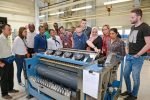
KBA-Sheetfed training for specialists from 15 countries
A special practical training session for print industry lecturers and teachers was held at KBA-Sheetfed in Radebeul on 15 June 2017. It was attended by 15 specialist teachers from 15 countries on four different continents, who had been invited to join the 4-week seminar at the AZP training centre for the graphic arts in Chemnitz by the PrintPromotion organisation. The key focus was placed on solutions for unbroken printshop workflows, and one day of this seminar agenda was devoted to KBA-Sheetfed. Further visits to industry manufacturers and suppliers rounded off the programme.
After a brief introduction to the KBA Group and its wide-ranging product portfolio, KBA trainer Stefan Splett presented some of the components and automation features of the modern Rapida sheetfed offset presses. Particular mention was made of the DriveTronic dedicated drive components such as SIS (sidelay-free infeed), SPC (simultaneous plate changing) and SFC (simultaneous coating forme changing), as well as further automation solutions for fast, parallel makeready such as the job changeover program or CleanTronic washing systems.
A second training block addressed inline and online variants to measure and control print quality. The participants gained interesting insights into KBA’s modern sheetfed offset production facility and had ample opportunity to obtain competent answers to all their questions about KBA and about sheetfed offset technologies in general.
The whole day was characterised by intensive knowledge transfer and everyone agreed that they would be taking home valuable information on the latest trends and developments in sheetfed offset. Armed with this knowledge, they are now ideally prepared to act multipliers for print professionals back in their own countries.
Edited by the IPP-PSA desk

Arya Sons installs Komori Enthrone 429 in Bawana
Bawana-based Arya Sons recently installed a 4-color Komori Enthrone 29 press, making it the company’s first capital investment in a brand new press. The Enthrone 29 is a 20 x 29 inch press with speeds up to 13,000 sheets per hour. In addition to the above, the company has two used 5-color Heidelberg presses —SM 72 and SM102—which were installed in 2013 and 2015, respectively, and two double-color Heidelberg presses. “I wanted to engage my 5-color presses more on metallized printing. So this is one of the reasons why I invested in the 4-color brand new Komori,” says Jitender Kumar of Arya Sons.
Kumar is a veteran in the print industry who joined his father to set up a small plant in 1987 with a used varnish machine to cater to clients in the segments of spare parts, liquor, playing cards, etc. “The varnish machine was the first equipment we had ever bought,” reminisces Kumar nostalgically. Interestingly, although he started his career by catering to liquor companies, today he refrains from catering to any product that are considered a health hazard.

Jitender Kumar with the newly installed Komori Enthrone 429 press. Photo IPP
Kumar started the Bawana plant in 2011 with a business partner. However, in 2013, his partner parted ways and Kumar bought his first printing press—a 5-color Heidelberg SM72—followed by another two years later. “The demand increased over time and the company started adding more clients owing to its capability of producing better quality and making timely delivery. Eventually, we have become a well-known printer in this area. With the new Komori running, our productivity has doubled,” shares Kumar. According to Kumar, Arya Sons prints about 40,000 sheets every day. Today, the company prints all kinds of commercial jobs such as banners, posters, books, magazines, wedding cards, etc. as well as prints for packaging and pharma companies.
In addition to the Enthrone 29, the company has also invested in a plate punching machine from Noida-based Rado Packaging Machines. “By September 2017, we plan to install a Scodix Ultra digital press for embellishment and value-added printing,” says Kumar. The company has a host of semi-automatic and fully automatic screen printing machines and varnish machines to cater to its discerning clientele.
In 2016, Arya Sons set up its own prepress unit powered by a Kodak Trendsetter CtP and an Epson SureColor P7000 proofer. The company consumes around 80 Kodak plates daily.
“We have been witnessing healthy growth over the years. The biggest challenge in the printing industry today is not job orders; it’s is in fact the scarcity of skilled labor and supervisors. If you look at our industry, the supervisors are basically skilled labor who have spent a longer time with the owner. He is neither highly qualified nor has any leadership skills. The owners have no choice but to rely on them because hardly ever a educated employee wants to join a printing press,” concludes Kumar.

In-line cold foiling – the fascination of metallic effects
We know that shiny, glittering, metallic and reflective objects and print are hugely attractive. We are often mesmerized by mirrors and shimmering diamonds, gold and silver jewellery—by light itself.

Why are South Indian language papers investing in 4 x 1 presses?
The divergent paths of Indian language newspapers
According to the Group M report published by Mint on 16 February 2017, ad spending in India including radio, cinema and OOH is expected to grow by 10% in 2017 to Rs. 61,204 crore (approximately US$ 9.7 billion). The same report states that digital advertising will record the fastest growth at 30% to reach Rs. 9,490 crore in 2017, albeit at a slower pace than the 47% growth in 2016. Television is the largest ad medium and is expected to reach Rs. 27,638 crore at a growth rate of 8%.
In 2017, print advertising is forecast to achieve a stable growth rate of 4.5% to Rs. 18,258 crore, which is a slight increase over the 4% ad revenue growth in the previous year according to the same report. The increased spends is expected from sectors like auto, banking, financial services and insurance and eWallets that are said to prefer print advertising.
The report further quotes Girish Agarwal, director of DB Corp., which publishes the Hindi daily Dainik Bhaskar and Gujarati and Marathi dailies both named Divya Bhaskar, “In the past few years, English dailies have grown around 1-2% while Indian language print publications have grown at around 8-9%.” Other research indicates that a part of the digital ad revenue is also coming to newspapers. At the same time, the Indian dailies are reducing their dependence on ad revenues by increasing their subscription revenues by as much as 4-5% annually.
Indian language dailies are growing much faster than the big English language dailies and they are also benefitting from subscription price rises and growing digital ad revenues. However, there seems to be an imbalance or difference in the quality of investment in productive assets between the North and South Indian language dailies.
Long-term trends
More than a decade ago, it became apparent that the major trends amongst Indian dailies were increased circulation, increase in the number of color pages, an increase in geographic reach and in some cases new launches in other Indian languages. Another established trend was that many of the Indian language dailies were highly localized with at least one broadsheet page being changed for each district that the newspaper covered. Even before the idea of big data, Indian language dailies were able to fine-tune print runs on a daily basis with quality feedback from their distribution system.
As runs became longer, with many Indian language dailies having multiple editions and production plants, combined circulations reached and exceeded a million copies. Since they were driven by color ad revenues, to produce significant quantities with high quality color pages and plate changes for localized coverage, the new technology 4x1 presses were a reasonably logical choice—at least for their main or major centers.
Simultaneously, 4x1 press design improved with better shaftless motors, spray dampening systems and slenderness ratios that allowed thinner diameter narrow gap plate cylinders to reliably perform at higher speeds. New CCD technology brought better registration and closed loop color control systems while improved electronics and software improved computerized integration and control systems.
4x2 and 4x1 presses for high volumes
To reiterate, a 4x1 web offset press has a four broadsheet newspaper page wide and single page circumference plate cylinder. Before the advent of the 4x1 web offset presses, in order to print 70,000 copies an hour and above, it was necessary to have a 4x2 press whereby the press essentially rotated at 35,000 RPM but there was a second set of plates that could double the output. Big English language groups such as Bennett-Coleman, HT Media as well ABP for its high circulation Bengali daily have been running 4x2 presses for many years.
Of course this also meant that for changing one page for as little as 5,000 or 10,000 copies, two plates need to be changed. In addition, 4x2 presses with four color towers (4-Hi stacks) occupied large press rooms with a separate floor for the reel-stand and auto-splicers.
The four operation levels included a basement, a ground floor for press towers and control console; a first level gallery for plating and inking the 3rd and 4th color plates; and, a second level gallery for the superstructure (web movement, splitting, turning and combining webs). This necessitated large pressrooms and infrastructure costs for 4x2 presses. (There was also the additional cost of a mailroom equipment to automate the evacuation of high volume output which remains a consideration even with 4x1 presses).
In contrast with the huge infrastructure capital costs for installing a 4x2 press, the 4x1 (single circumference plate cylinders) reduced the height and weight of press towers while also encouraging reel-stands to be mounted on the same floor as the more compact towers. The operational costs associated with running a 4x2 press were also high in terms of manpower and electricity—webbing up and restarting after web breaks took a lot of time and considerable newsprint waste.
Made for India 4x1 presses
The initial 4x1 presses imported were the manroland Web Systems Regiomans by Bennett-Coleman and HT Media. Kasturi and Sons who were convinced of the 4x1 design and configuration, and were running a Mitsubishi 4x2 press at their Chennai plant, approached Mitsubishi to design and build a 4x1 for them. Called the DiamondSpirit SA (for South Asia), this 4x1 was first installed in one of Kasturi and Sons’ out of state plants in South India and later in many of their plants including its new plant in Maraimalai Nagar near Chennai. Japanese newspapers came to India to see the new 4x1 press and purchased these for their own modernization.
Partly at the urging of some of the language dailies in South India, the web press manufacturers such as manroland, Mitsubishi and Manugraph came up with more economical ‘made for India’ 4x1 presses. While Dainik Bhaskar was the only Hindi daily to purchase 4x1 presses which consisted of several KBA Prisma lines in a joint purchase with the newly launched English daily DNA, in collaboration with the Zee Television group, most of the 4 x1 presses have come to South India.
The exceptions are TKS 4x1 presses purchased by HT Media for their Greater Noida plant and the manroland Cromoman 4x1 presses purchased by Bennett-Coleman for their Pune editions in both English and Marathi and another Cromoman 4x1 purchased for their new Bengali daily out of Kolkata. The Cromoman was the first ‘made for India’ 4x1 press—designed to fit into a 2x pressroom—and could handle electricity outages with a soft stop instead of web breaks and webwraps.

South Indian dailies dominate the 4x1 market
The largest base of 4x1 presses and the one with the greatest growth momentum is clearly amongst the South Indian language dailies. Malayalam daily Malayala Manorama has in several stages purchased more than a dozen 4x1 presses from both Manugraph and Mitsubishi. Its fierce competitor Mathrubhumi has purchased five TKS 4x1 presses over the past five years. Tamil daily Dinamalar installed a Manugraph Smartline 4x1 in its new Madurai plant and then purchased a pair of the Goss Uniliner S 4x1 presses that were initially installed by the Deccan Chronicle group. Tamil daily Dina Thanthi installed both a new Seikan 4x1 press and a second-hand Seikan 4x1. The Printers Mysore, publishers of Deccan Herald in English and Prajavani in Kannada, purchased and re-installed the KBA Prisma 4x1 that English daily DNA had installed in Bengaluru. The most recent installation is of a manroland Cromoman 4x1 press is by Telugu daily Namaste Telengana for its new plant in Hyderabad.
Economics?
Apart from the question of why it is the South Indian language dailies that are by and large interested in and investing in 4x1 presses, there is also the question of why some of the Hindi, Marathi and Gujarati dailies are reluctant to do so? In many cases, language dailies are buying 6- and 7-tower 2x1 presses at speeds of 35,000, 40,000 or 50,000 copies an hour to cope with increased color pagination and circulation. In many of the language dailies, there are now multiple centers with circulations above 250,000 and in some cases around the 400,000 level and even above this. To produce this number of copies of a 24-page broadsheet daily with even acceptable quality color pages and advertising would require a minimum of two 2x1 presses, each with 6 full-color towers.
While the cost of two locally manufactured 2x1 presses is less than that of an imported 3-tower 4x1 press (for 24 pages full-color broadsheet pages), there are significant operational economies in a 4x1 press in terms of space, manpower, newsprint wastage, electricity and even ink. Both webbing up and ink pumping are automated functions in a 4x1 press. This difference in cost is greater in the case of the imported 4x1 presses than would be the case of Manugraph’s Smartline 4x1, which is locally manufactured. It is true that the cost of an automated mailroom is significant but attempting to automate the evacuation of several high-speed 2x1 presses may be more challenging than a mailroom system for a single 4x1 press, let alone the facility of producing uniquely counted and wrapped bundles with on-line labelling for distribution.
Flexibility
Apart from the cost considerations, some newspaper publishers feel that they have more flexibility and ease of operation with a battery of 2x1 presses, as they can run a variety of products. In fact, this often means that when running the edition with the same pages and advertisements on several presses, color quality is compromised while wastage and other costs are much higher.
The operation of 4x1 presses with automatic register, remote ink pumping and other controls has become easier. Improved handling with slitting of the web on top of the tower for combining the two webs into a single-width folder makes it easier for operators trained on 2x1 presses.
As far as running more than one product, this flexibility is now available on 4x1 presses with several types of split runs, especially as these presses are truly shaftless and electronically controlled. Any number of press towers on either side of a double folder configuration can be configured as two presses with great flexibility in the pagination of each product.
The author is a G7 Expert and an offset printer with hands-on experience in running sheetfed and web offset presses. You can reach him at editor@ippgroup.in.