wan-ifra - search results

Conference highlights rapid growth of digital sphere
Hosting over 425 delegates from across 22 countries, the Wan-Ifra conference began on a high note at Chennai’s ITC Chola Hotel on 13 September 2017. The conference kicked off with a welcome

MWM presents Media 365 and Print 365 for media houses and printers
Sweden’s MWM Group, a software and consulting company, plans to showcase its smart software solutions for media houses and printing companies at the WAN-Ifra Expo 2017 from 10 to 12 October in Berlin.

Newspapers should go for value addition to reclaim lost advertisement share
Although India is one of the few countries where newspaper circulation continues to show signs of growth, especially in the regional language segment, the

ColorJet to launch 3.2-meter UV LED Roll to Roll Printer VULCAN
ColorJet India, manufacturers of wide-format inkjet printers, will be launching VULCAN, a high-speed 3.2 meter UV LED Roll to Roll Printer,

Lower Parel – A thriving printing hub of Mumbai
Two leading print service providers in the Lower Parel region of Mumbai have invested in digital presses recently. Preview Print Zone in Adhyaru Industrial Estate has installed a

Bhawna Trading installs Ricoh Pro C9100 press
Establish a decade and a half ago by Ashok Kalra, Bhawna Trading focuses primarily on commercial printing output such as brochures, catalogs, fliers, posters as well as customized printing for corporate gifting.

Konica Minolta’s new EFI Fiery DFEs
Electronics For Imaging and Konica Minolta Business Solutions Europe have announced two new EFI Fiery digital front ends (DFEs) designed to drive the AccurioPress line of digital presses from Konica Minolta.

Siemens and HP partner to advance 3D printing
Building on a longstanding partnership, HP and Siemens are accelerating 3D printing for industrial production through the creation of a new HP-certified Additive Manufacturing (AM) software module from Siemens.

Xerox Trivor 2400 High Fusion Inkjet Press launched in India
Xerox India has launched the Xerox Trivor 2400 High Fusion Inkjet Press that produces high-quality results direct to offset coated paper on the Trivor 2400, eliminating the need for intermediate

The Hindu on the web – with character!
On speaking with the design team at ICD and from comments from the business team of the news daily, one gathers that the year-long and not-so-easy exercise of redesigning the The Hindu’s website is also an attempt to redefine the paper’s ethos in terms of the new media

DB Corp upgrades its web offset presses with QIPC-EAE
In the past year, the Dainik Bhaskar group, which publishes newspapers in English, Hindi, Urdu, Marathi and Gujarati, has upgraded its web offset presses around the country with color registration systems

Hunkeler Systeme’s secure disposal systems for banknotes
Stocks, shares, bonds and other financial instruments and documents are increasingly being dematerialized by financial institutions. Just as the Reserve Bank of

The new unified tax system bodes well for newspaper advertising revenues
The Indian economy faced two historic disruptions in less than a year. It came in the shape of demonetization in November, when high denomination currency notes were

Paid digital content is in the cards at The Hindu
In the Indian newspaper market, which is dominated by an advertising-led approach, The Hindu is transforming its 138-year old organization by means of a reader-centric,

HT Media and ToI order UV curing systems
In the beginning of August, German UV curing system manufacturer IST METZ GmbH announced the sale of three UV curing systems to HT Media Ltd. for installation at their Greater Noida plant and six UV curing systems to The Times of India, for Installation at three of their plants.

Ambitious plans for Greater Noida show from 1 to 6 February 2019
At a meeting of its general body on 25 August 2017 at the Greater Noida India Exposition Centre, IPAMA elected its new president Dayakar Reddy, who later that

Digital finishing systems installed at Manikya Press in Agartala
Monotech Systems has installed six machines of digital finishing systems—Dumor 331SCC Gemini Cut, Dumor Booklet Maker EB215, GMP Excelam Plus 355R Laminator

Good journalism wins the heart and the purse of the readers
It’s a no-brainer that quality journalism and content are key elements to hold your readers. Readers expect that the stories are covered in detail with great journalistic presentation.

Technology is an important lever for creating unique solutions
At the recent INMA South Asia conference in New Delhi, Ashish Pherwani, who leads the media consulting practice of Ernst & Young in India, attempted to decode the puzzle of the new media

India’s newspaper industry is still growing but can it adapt?
At the end of this week, on 10 and 11 August there is the INMA Conference in Airport City in the Delhi NCR. Next week, on 16 and 17 August the WAN-IFRA Conference

Fly higher by proving your great color printing
For the first time since its launch in 1994, the WAN-IFRA’s International Color Quality Club now open to all newspapers and magazines. The worldwide quality printing

Scholarly journals and magazines from ICPR

Naph Graphics innovates its web offset presses

Manugraph enters the Japanese 2 x 1 newspaper market

Sakata India to consolidate gains in 2017
The Indian government needs to get serious about forests and paper
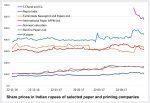
It’s true that print prices and margins are under pressure globally and also that Indian print businesses through the All India Federation of Master Printers led by the two Mumbai associations, have started a campaign to inform print buyers of the prevailing increase in prices of inputs including paper. The campaign has had initial success in Mumbai, with commercial printers persuading regular customers to raise prices in some cases by 5, 7.5 and 10%. However, the same report says that so far the offset packaging printers have not been able to similarly influence their generally larger volume customers.
There is no question that hyper-competition or selling at unremunerative prices has resulted in a crisis in the industry which has not been able to protect itself at a time when the domestic paper industry is in fact healthy and becoming more efficient. The subcontinent needs a healthy paper industry but this is a difficult proposition considering that the country is totally inefficient in its production of wood fiber or raw material.
Not only are the forests dismally mismanaged by the states and the national government but so are the water and ground water resources in the country. India uses more ground water than either China or the United States, and this too mostly in its hugely inefficient agriculture. While we take great pride in exporting Basmati rice, most of us are neither aware of the extraordinary amount of water needed to produce it, nor that that Indian scientists have developed genetically modified varieties that use less water but which cannot be tried out because our discussion of genetically modified crops is both unscientific and sentimental.
Healthy forestry which can yield fiber requires organized harvesting of old trees since it is the faster growing young trees that have the maximum capacity to bind carbon and act as carbon sinks that generate oxygen and clean the atmosphere. Thus, healthy forests can actually supply better fiber and pulp than Indian paper manufacturers currently have access to. Although one of my friends has recently written about fast growing bamboo as an alternative raw material for pulp, I believe she may be somewhat misguided. Bamboo is first of all inefficient for paper pulp because it is hollow and its one-way logistics from the forests to the mills is expensive. Secondly, bamboo is far more useful as a raw material for directly manufacturing other products. Eucalyptus, a fast growing tree, is also of limited value for pulp since it tends to rapidly bring up ground water and the water table.
Although our current government and the state are perceived to be more responsive, we are still far away from having rational and politically acceptable thinking on matters such as sustainable forestry or the role of forestry in protecting watersheds that in turn feed the rivers. Similarly, in spite of the good work done by various organizations including the Centre of Science and Environment and its recognition by the government, a rational and systematic approach to solid waste, garbage and recycling is still in the hands of a few ethical city commissioners and non-governmental organizations. As I have written several times, very little of our used paper actually reaches paper mills for recycling—a figure that is still below 20% and still relies on the ‘informal sector’ for collection.
Although there is no question that both the demand for paper and print in India are above our 7% GDP growth, the paths to health for the paper and print industry are not simple or short term. But isn’t this why we elect governments? To go beyond slogans and to meaningfully invest in and exploit our two most abundant natural resources in a virtuous cycle—human ingenuity and natural sunlight—which can be combined to generate better forests, rivers, pulp, paper and print.
– Naresh Khanna, editor@ippgroup.in

Down to Earth celebrates 25 years with Hindi launch

Increase in paper price hits book printers

Navbharat upgrades color quality and editorial management servers

Motilal Banarasidass’ century-old journey

Manroland’s digital finishing solutions for publishers

Publishing Next Industry Awards 2017

World News Media Congress and World Editors Forum 7 to 9 June

Publish Asia 2017 in Kuala Lumpur from 18 to 20 April

The Hindu on the web – with character!

Trelleborg focuses on the Indian market

Trelleborg increases focus on Indian newspaper market

“Print is increasing globally” – Manfred Werfel

O Globo Olympic for sport fans in Rio

Indian Digital Media Awards 2016

TOI and ABP show the path ahead at Publish Asia

Mostly upbeat about smartphones – some reality at the end

Publish Asia in Manila 29 to 31 March 2016

5th Digital Media India Conference New Delhi 22 and 23 February 2016

Newspaper printer as a service provider is the most favoured model – Werfel

5th Digital Media India Conference – New Delhi 22 and 23 February 2016

‘Now we have to wake up, reinvent our business’

‘Go green’ was the theme at Pamex

World Publishing Expo 2016, 10 to 12 October