EFI used a press conference at the recent Fespa trade fair to announce a number of new printers, including a new hybrid for display graphics, further textile printers and two additional single-pass Nozomi printers, expanding its overall portfolio yet further.
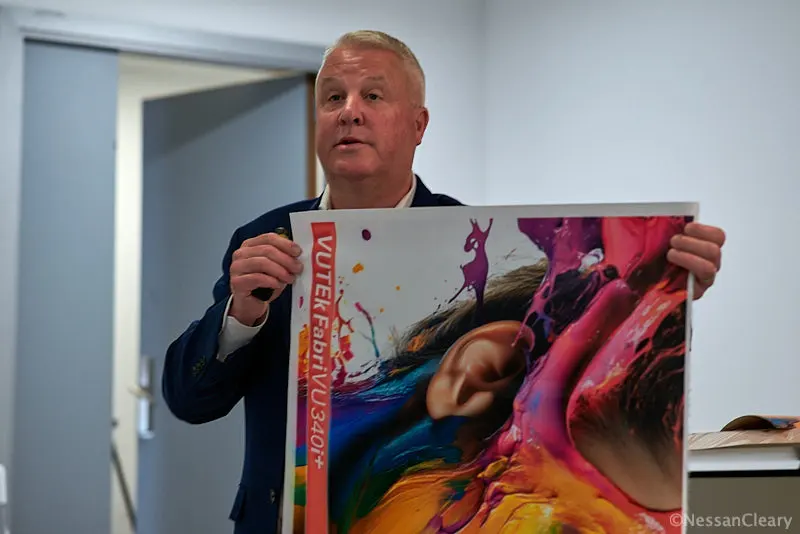
Ken Hanulec, EFI’s vice-president for worldwide marketing and business development, identified several trends, including the growing use of Artificial Intelligence to inform decision-making, ever-increasing automation and the convergence between different markets within printing as customers look to diversify. He added, “Automation is a big part of what we are doing. It’s a big part of our portfolio.”

To this end, EFI is continuing to expand its cloud-based Insight platform, which is an analytics tool that records running actions on each machine to measure production data, performance metrics and system efficiency and to predict failures and optimize utilization. It was first introduced for the single-pass Nozomi platform, but Hanulec says that it is now being added to the multi-pass hybrid printers “and we are bringing it to industrial textile and sign and display.”
Another tool, InSpec, also uses the cloud to record the images being printed and analyze these using AI for quality control and verification. The idea is to continuously scan the printed output during production to identify defects, support real-time correction, and reduce waste and reprints. The scans can be stored to be used for later traceability and post-production analysis. As Hanulec noted, “Like everything with AI, the more data you put up there, the more intelligent it will be.”
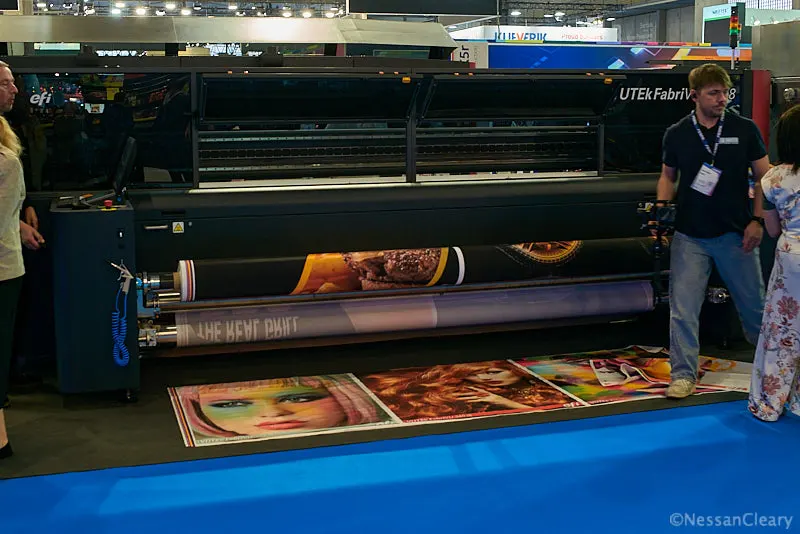
Of the new printers, the main draw at Fespa was the Vutek M3H X, pictured above, which is a 3.2-m-wide hybrid that replaces the last of the older GS series. Hanulec says that this delivers much better detail thanks to a native 7 picolitre drop size, adding, “It’s a combination of quality, speed improvements and cost.”
The standard configuration is for CMYK plus white, though it can be ordered with just CMYK and there are options to add clear or orange ink. It can produce up to 105 boards per hour.
EFI also showed off its existing 3.34-m-wide Vutek Q3h XP but with a new seven-color configuration. This includes CMYK plus light cyan, light magenta, and light black. EFI claims that this leads to an expanded color gamut with good neutral grey balance and smooth pastels. There is an option to add white and clear ink and a further option to enable multilayer printing. Hanulec noted that EFI exploits its white and clear ink to enable customers to offer more embellishments, noting, “About 90% of our printers are sold with white and clear ink. It opens up the ability to do high-value applications.”
The Q3h XP is mainly aimed at producing retail displays, backlit graphics, and event and exhibition graphics. There’s a choice of three-quarters or fully automated loading/ unloading as well as several roll-to-roll options. It can produce up to 905 square meters per hour or 243 boards per hour.
In addition, EFI brought along the existing Vutek X5R, which is a 5.2-m-wide roll-to-roll LED printer, but which now gains the Insight and InSpec AI features.
EFI also showed off a new textile printer, the Vutek FabriVU 340 I8. This is a 3.4-m-wide dye-sublimation printer with inline fixation. It’s mainly designed to print direct to polyester-based textiles, but the fixation unit can be turned off and an optional vacuum plate added to print to transfer paper. Either way, it’s mainly aimed at soft signage applications such as backlit displays and wall graphics, and it also features an integrated flag printing kit.
The new I8 version gains a new 8-color inkset that includes CMYK plus orange and blue as well as light cyan and light magenta, one of which can be replaced by light black. Micol Gamba, senior director of product management for EFI Reggiani, says that the additional colors will help improve the reproduction of brand colors.
As with previous EFI textile printers, it uses Kyocera printheads, in this case eight of the KJ4B heads. These deliver a native drop size of 4pl with four further greyscale levels of 0pl, 7pl, 12pl and 18 pL that together achieve up to 2400 dpi resolution. It can produce up to 375 square meters per hour, but a more realistic production speed is 210 square meters an hour for 600 x 600 dpi resolution with two passes.
She also discussed the new Reggiani EcoNext Plus textile printer, which is an existing Next Plus printer but running EcoTerra pigment inks to print directly to fabric. As such, this is a straightforward 3.4m wide roll-fed textile printer. It’s an entry-level solution so it lacks the sticky belt that is common to many roll-fed textile printers to handle stretchable materials. That keeps the price down and helps make for a more compact footprint but also limits it to non-elastic woven fabrics such as cotton, polyester and synthetics. It can be configured with up to seven colors, including CMYK plus red, green and violet. Gamba added, “Violet is a key differentiator because it helps with the blue tone part of the color gamut.”
The EcoTerra ink is designed to facilitate on-demand printing by including the binder with the ink to eliminate the need for many of the traditional pre- and post-treatment steps associated with textile inks. Gamba noted, “We are going in the direction of short sustainable processes.”
The EcoTerrra ink is also helping Reggiani pursue the reshoring market, with Gamba saying that the main target market is Europe and North America for home decor. In general, the home decor market is moving towards pigment ink, instead of the more common reactive ink, because removing the post-treatment steps helps improve overall productivity. She says that the main challenge is the need to cut and sew, but notes: “We are seeing some demand for personalization.”
She admits the productivity is not so high at around 100 meters per hour but adds, “For customers who today are outsourcing, it’s simplifying their overall production workflow. And there are more small companies doing this kind of work, especially the cut and sew, in Europe.” EFI has already sold one to a customer in North Carolina in the US.
EFI is also offering two new 1.7-m-wide variants on its Nozomi single-pass printers. These are the Nozomi 17000 SD platform for signage and display applications at 60mpm, and the Nozomi 17000 LED platform for corrugated packaging and display production at 75 linear mpm. In both cases, these complement existing 1.4-m-wide versions.
Hanulec describes printing to packaging boxes as a “pure revenue play,” explaining, “You can eliminate the shipping labels and the inserts by printing direct to the outside of the box. And you can add more advertising on the outside.”
However, there is still no word on the Nozomi AQ with water-based inks that was originally promised for the end of 2024. EFI is still struggling to master drying the inks at speed. There is one running at a beta site in Spain and my understanding is that this is in daily production but that EFI is still tweaking it and not able to comment as to when it might be commercially available.
Otherwise, EFI appeared to have a very busy Fespa, with Hanulec telling journalists, “I think the industry is in a really good place. We had a fantastic Q1.” You can find further information from efi.com.