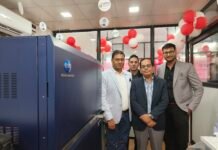
HP has expanded its large-format printing portfolio with the launch of a new scalable Latex platform and the HP Latex FS70 W printer at Media Expo Mumbai 2026, positioning the offering as a future-ready solution for print service providers (PSPs) seeking flexibility, productivity and sustainability.
The launch builds on HP’s fourth-generation Latex ecosystem, which now spans 10-foot industrial roll-to-roll devices, 5-foot systems and hybrid platforms such as the R530. The newly introduced FS70 W forms part of HP’s flexible scalable (FS) platform, designed to evolve alongside customer requirements.

Vitesh Sharma, country head – India, Bangladesh, Sri Lanka for large format printing business, HP, said that the platform is built to allow users to upgrade capabilities over time rather than replace equipment. Customers can enhance speed, ink capacity and application range through add-ons and accessories, while a dedicated productivity kit enables further performance upgrades as business volumes grow.
The FS70 W is HP’s most productive Latex printer to date, delivering speeds of up to 162 sq m per hour, while maintaining consistent print quality across applications. A 6-litre white ink cartridge expands the printer’s capability into higher-margin segments such as window graphics, signage and décor, while features such as dual-roll support, high-capacity ink systems and optional overcoat printheads enable long, unattended production runs.
A key focus area for HP is workflow integration and business efficiency. The upgraded PrintOS Production Hub, showcased alongside the printer, enables PSPs to digitise operations, manage orders centrally and track production in real time. The system integrates with multiple devices, allowing users to streamline workflows beyond printing and gain visibility across their operations.
Sharma noted that many smaller PSPs still rely on manual processes, and tools such as Production Hub are designed to help them transition to automated, data-driven systems. The platform also integrates design, eCommerce and production workflows, offering a unified dashboard and analytics to improve decision-making and operational control.
The product launches come at a time when India’s large-format printing industry continues to show resilience and growth. According to Sharma, demand is being driven by three key trends: expansion of organised retail into non-metro markets, infrastructure development and rising demand for interior décor applications.
Growth in tier-2 and tier-3 cities is reshaping the print landscape, with brands increasingly targeting non-metro consumers who now exhibit similar purchasing behavior to urban markets. This shift is encouraging PSPs to expand geographically and invest in versatile printing solutions that can serve multiple applications.
Infrastructure investments are also creating new opportunities. The development of airports, metro rail networks, highways and public transport systems is generating demand for signage, safety graphics and vehicle wraps. The transition to electric buses and the growth of EV infrastructure are further contributing to new application segments.
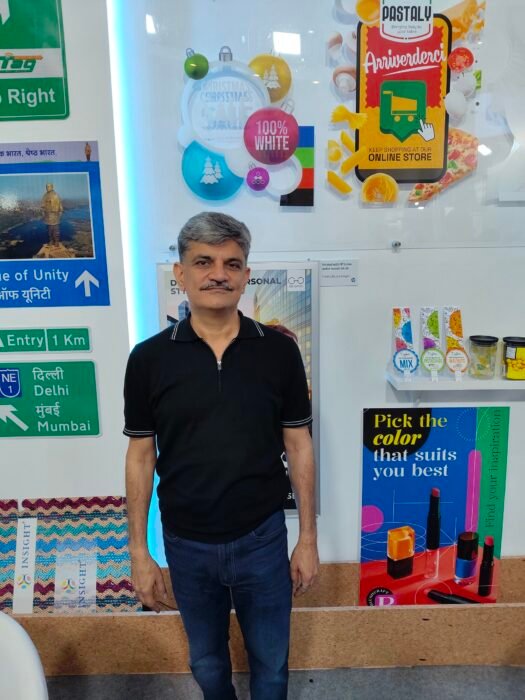
At the same time, rising disposable incomes are fuelling demand for customized décor products such as wallpapers, canvases and window graphics. HP showcased a wide range of such applications at its stand, including PVC-free banners, backlit and frontlit displays, clear vinyl graphics, multi-layer prints and digitally produced safety signage.
All applications on display at the company stand were produced using HP’s Latex technology, which ensures consistent colour output across substrates and devices. The water-based inks used in the system are designed to deliver durability while supporting safer printing environments.
Sustainability remains a central theme in HP’s strategy, supported by initiatives such as the Sustainability Amplifier programme and Planet Partners recycling system, which enable customers to reduce environmental impact across consumables and hardware.
Despite ongoing geopolitical uncertainties and supply chain disruptions, Sharma indicated that the Indian market has so far remained stable, supported by diversified sourcing strategies and steady domestic demand. Sharma stressed that long-term growth will depend on how PSPs adapt to change, adopt new technologies and differentiate their offerings in an increasingly competitive market.