The Beyond the Layers of Polymers 3D Printing webinar series, in its seventh session, dived into materials innovation for industrial-scale additive manufacturing. The session focused on three advanced polymer solutions within HP’s Multi Jet Fusion (MJF) ecosystem, PA-12 Flame Retardant (FR), PA-12 Electrostatic Dissipative (ESD), and the newly launched PA-11 Gen-2 highlighting how these materials are enabling new applications across regulated and performance-driven industries.
Emily Levin, application engineer at HP, started the discussion with PA-12 FR, HP’s flame-retardant polymer developed in collaboration with Evonik. Levin highlighted the widespread and often underappreciated role of flame-retardant materials, noting that they are found “in outlet covers, surge protectors, furniture, mattresses, carpets, curtains, insulation—really all throughout your house.” The fundamental purpose, she explained, is safety, flame-retardant materials are designed to “self-extinguish” and, more importantly, “delay ignition to give people time to escape.”

In industrial contexts such as aerospace, railways, automotive interiors, and electronics, flame-retardant requirements are governed by strict regulatory standards. HP’s PA-12 FR is a non-halogenated material, addressing the regulatory and environmental concerns associated with halogen-based additives, and achieves a UL94 V-0 rating at a thickness of 2.5 mm. Levin emphasised that the larger the cross-section you have, the easier it will be to stop the burn, which is why thickness plays a critical role in flame-retardant classification.
A key differentiator of PA-12 FR lies in the encapsulation of flame-retardant additives within the polymer particles. This ensures consistent performance across the entire build area, an essential requirement for large-format powder bed fusion systems.
According to Levin, from a sustainability and cost perspective, PA-12 FR supports a 60:40 powder refresh rate, significantly reducing virgin powder usage. Levin described this as “really disruptive in terms of cost per part and reduced environmental impact,” particularly when compared with other flame-retardant powder bed materials that require much higher refresh ratios.
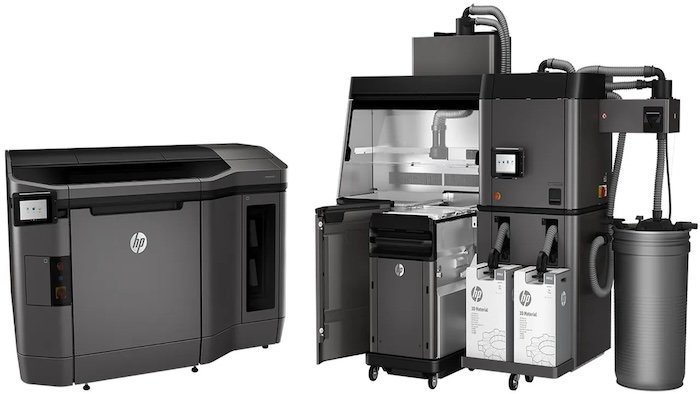
The session then moved to PA-12 ESD, an electrostatic dissipative solution enabled through a dedicated print mode on HP’s Jet Fusion 5600 series. Rather than introducing a new material, HP has developed a specialized printing recipe that adjusts agent deposition and thermal control to achieve the required surface resistivity. Levin explained, “ESD-safe materials must be conductive enough that it’s going to dissipate that charge, while avoiding excessive conductivity that could create other risks.”
This print mode based approach allows manufacturers to produce both standard PA-12 and ESD-safe parts using the same material, consumables, and processing station. “No new material is needed, no new consumables, and no new hardware,” Levin noted, adding that this eliminates the need for additional factory footprint.
The webinar highlighted an HP case study, which illustrated the benefits, where ESD pallets used in printhead assembly lines were previously CNC(computer numerical control) machined. “By switching to MJF, HP achieved 70% lead time savings and 50 percent cost savings, while enabling on-demand production with no minimum order quantities,” Levin noted.
The final segment introduced PA-11 Gen-2, HP’s latest bio-based polymer designed exclusively for the 5600 series. Derived from castor bean oil, PA-11 is known for its ductility and impact resistance. PA-11 Gen-2 represents a significant advancement, increasing powder reusability to an 80:20 refresh rate and reducing part cost by up to 40% compared to the previous generation. Equally important, Levin highlighted that the new formulation reduces variability, offering “better repeatability in terms of part-to-part variation,” which is critical for serial production.
The session highlighted certain real-world applications that included custom orthotic insoles and automotive components. Discussing material selection, Levin explained that PA-11 is preferred for orthotics because it offers really high ductility, enabling flexibility and durability under repeated load.