The recent Japan Inkjet Technology Fair (JITF) in Tokyo saw this annual show move to a larger venue as it continues to grow in popularity. It’s a unique event that combines both Western and Japanese exhibitors and serious discussions around cutting-edge inkjet technology, but with a laid-back atmosphere.
This event mostly features component suppliers, ranging from printheads to software, as well as lab equipment and some smaller inkjet printers. Apart from Japanese exhibitors, it attracts several Western suppliers, many of whom time their visits to see customers in the region around the dates for this event. This year, the timing allowed for companies to fly directly from the All In Print China trade fair in Shanghai to Tokyo for the JITF.
Visitors represent a cross-section of the Japanese print industry, from OEMs to print service providers. One of the things that has always struck me is how similar the issues facing Japanese companies are to those that their European counterparts have to deal with and how quickly these discussions transcend the language barrier.
This year marked the fifth outing for JITF, which has grown steadily since the first event in 2022. As a result, the show has outgrown its original venue in Ichigaya and moved to a new home on the 22nd floor of the Kyobashi Edogrand building, just a five-minute walk from Tokyo’s central station. This allowed for a significant increase in the number of exhibitors, up to 65 this year, but with more space around the booths so that it felt quite buzzy rather than crowded.
The event is run by Akiyoshi Ohno, the former head of Konica Minolta’s inkjet division who oversaw the development of the KM1 and now runs his own Ohno InkJet Consultancy. He has modelled JITF largely on European events that combine small table-top presentations with several conference tracks, but in this case those tabletop stands take up the main room.
As Clive Ayling, managing director of Meteor Inkjet, noted, that gives it a very democratic feel as every company has exactly the same sized stand – a table and two chairs – regardless of how big or small they are.
As before, there was a lively conference program, but the new venue allowed for much bigger conference rooms, which were all well attended every time I looked in. There were two separate conference tracks, with a third smaller space in the main room that allowed companies to introduce themselves. Naturally, the majority of the presentations were in Japanese, but there were enough in English to keep international visitors occupied.
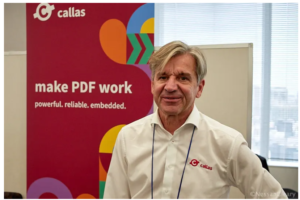
Callas Software used one of the spots on the conference program to introduce its software. Dietrich von Seggern, CEO of Callas, explained, “We develop a PDF engine that is mostly used embedded in other technology, but we do have end user products.” He explained that Callas has 76 OEM customers, starting with Xerox as the first in 2004 and also including Adobe since 2006 for its preflight technology.
He says that the Callas offering can be split across three layers, with the first being normalization. He explains, “Everybody understands what a PDF is but not that it’s a very complex thing. It’s very powerful, and it does many things. It’s the most complex graphic arts file format that we have on Earth. It was designed to take in any data you want, with fonts and images. There are thousands of specifications covering fonts, images, colour and so on that these files all have to conform to. Many PDF files are created by non-professional software that has not always understood PDF, such as ChatGPT.”
The second layer is optimization, which takes care of long RIP times and differences in color across output devices. This means removing things that are outside of printing and would confuse a RIP, as well as cachng variable data elements that are going to be used across a print run.
The final layer is preparation, which von Seggern describes as “the most interesting because it’s the most visual.” He says this layer can change the layout of a file, adding: “We have a tracing engine that can check and identify the outline and create shapes, and we can use that shape to create a cut line. Or you can use it to make a white or a varnish. And you can use the cut line to create bleed, scaling, pixel repetition and so on.” He went on to say this could also create imposition, step and repeat, ganging and nesting.
According to von Seggern, the main challenges are the number of non-professional programs now creating PDF files for print and the fact that many people in the industry who understand the history of how things work are now aging and retiring. But he also points out that print needs to find its role in a world that is changing, both in terms of the media landscape and in social communications.
Adobe used its presence at JITF to highlight the recently announced Adobe Print Services, which is a group of three Software Development Kits for optimizing PDFs for print, adding embellishments, and sorting out finishing steps such as cut lines and bleed. I’ve covered all this in more detail in a separate story, but it heavily uses AI technology and significantly enhances what Adobe was already offering with its PDF Print Engine.
Several of Adobe’s OEM customers also had a presence at JITF, including Fiery, which uses the Adobe PDF Print Engine within many of its RIPs, including the Impress DFE that it highlighted at the event.
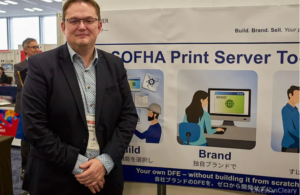
Another OEM, Sofha, which had the tabletop next to Adobe, is also looking at Adobe’s APS, with Paul Jones, director of technology innovations for Sofha, telling me, “We are evaluating APS to see whether it gives us anything helpful and are still deciding on it.” He says that it’s an additional cost “so we have to evaluate if it’s something our customers want to have inside or not.”
Sofha is developing a Digital Front End that is based on Adobe’s PDF Print Engine. It is sold as an SDK to OEMs such as Konica Minolta, who can use it to create their own DFEs, complete with their own branding for a minimal amount of time and effort.
For this year, Jones says, “We have done more of the actual implementation. We took the original RIP board that we had and built a layer on top to get to the IPP Internet Printing Protocol standard.” The use of the IPP standard allows for driverless printing without having to install drivers for each available printer. Jones says that the OEM customers can configure the layout themselves without having to do much extra work, adding: “You can customize it completely, all the layouts, the order in which things are presented, it can all be done by the OEMs. They don’t have to ask us to do it. And an OEM can define their own constraints, such as requiring some types of prints to be duplex.”
He says Sofha has implemented all the screening, color management and imposition, noting, “It’s all Adobe PDF Print Engine but heavily optimized by Sofha over the years.”
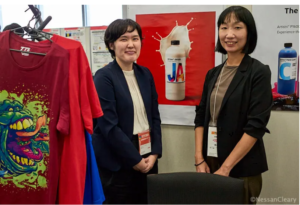
Several vendors showed samples printed with powderless DtF inks, which all use a jettable adhesive alongside the colors to replace the powder stage. Thus, DuPont showed off its Artistri P1600 powderless DtF solution, which will print to polyester, cotton and blends of the two materials. This lays down first the CMYK colors, followed by the white and then the JA11 jettable adhesive. This ink is aimed at printers fitted with the Epson i300 heads, as these are the most commonly used within DtF printers. As with other powderless DtF inks, the hand feel of garments printed with these inks is notably better than standard DtF with a much thinner ink film that makes the graphics feel less plasticky.
Kaori Okumoto, technical sales representative for Dupont Speciality Products, says, “We are now collaborating with Brown Manufacturing in the US and they are developing an automated printer system.” This would presumably include automated cleaning because there is an increased risk with all powderless inks of clogging to the printhead nozzles, especially for the jettable adhesive. Okumoto says that the time needed for cleaning has to be factored into the cost, adding, “We are doing some beta testing so it should become clearer how much the cost will compare with powder-based inks.”
The Chinese vendor Lanyu also showed off a powderless DtF solution at JITF, which has been tested by Keypoint Intelligence for washability. The tests involved putting it through a 30°C wash cycle for 20 times, with Toru Yamauchi, director and head of Asia Pacific for Keypoint Intelligence saying that the results had been very good.
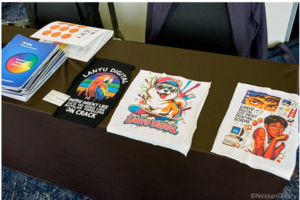
The Lanyu system is similar to DuPont’s, laying down the CMYK colours first, then the white, followed by the glue. Yamauchi says that keeping the glue separate allows for better adhesion. The print web still needs to be routed through a heater unit to cure the inks, which in most cases is going to mean people using their existing powder shaker units just as a heater. But as powderless DtF takes hold, we should see a new generation of simpler heater units that can be matched to the DtF printers.
This ink has also been designed to work with Epson’s i3200 printhead, though Yamauchi says they are working on other heads. The ideal configuration would be three of these heads, one each for the colors, the white and the glue. The Lanyu powderless inks are available now.
Among the machine builders and component suppliers, I came across Sakawa Printing at JITF, a print service provider based on Shikoku, which also took a stand. I’ve previously written about how this company is meeting the challenges of an ever-shifting print landscape, so it was a pleasure to catch up with CEO Masazumi Sakawa again. Sakawa’s premise is that the company can print to any substrate and has brought a number of items along to demonstrate this. This includes 3D printing courtesy of a new Mimaki 3DUF 2207, as well as textiles such as garments.
Sakawa has also branched into furniture items using carton boards. This includes tables, chairs and catalog stands, all for B2B use, and all of which can be printed on to further a customer’s branding. Sakawa explains, “Large companies are interested in their environment and the carton board is very sustainable.” Sakawa has established a joint venture with the local Ehime university to make the furniture.
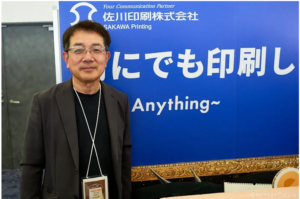
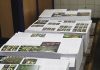
Sakawa still produces his exceptional 2.5D textured prints, which are made on an Agfa Mira and feature raised effects of up to 1.5mm to enhance prints beyond flat images. Sakawa’s presence also offered a useful reminder that such print service providers are the end customers for all the various solutions being shown.
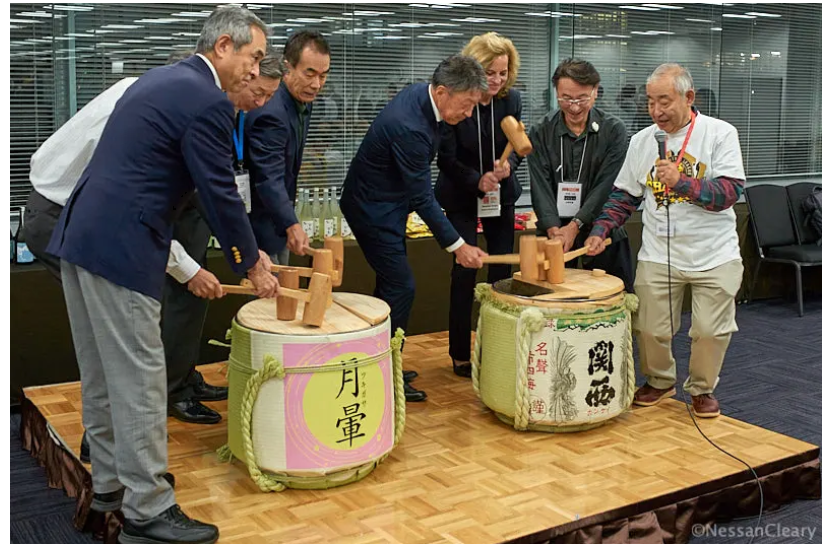
As in previous years, the first day of JITF ended with a networking party, which is still a big part of the success of this event, and which was also much bigger than in previous years. Ohno has long stated his belief that if you bring enough people together in a convivial atmosphere with good food and plenty of sake, then something interesting is bound to emerge. But that belies his attention to detail in ensuring a good mix of people, including the senior management of many Japanese vendors, as well as overseeing the catering and even providing traditional Japanese music accompaniment. It is the highlight of the event, and I saw many deep conversations between people from different companies who might not normally get together.
And it is this spirit of collaboration that is absolutely the key to this event. While many trade fairs on the print calendar focus on opportunities for selling equipment, JITF is about bringing different suppliers together and fostering a sense of partnership between them.
In the second half of this story, I’ll cover the printheads and related technology and trends. In the meantime, you can find further information on JITF at ohno-inkjet.com.
(First published in the Print and Manufacturing Journal. Republished with permission)