Print resilience and resurgence, the future of newspapers and print media, new technologies, printing innovation, distribution challenges, cost optimization, newsprint issues, sustainability, world press trends, getting the next generation to read newspapers, the hybrid model, alternative business models, and even book publishing – these were some of the myriad topics that came up for debate and discussion during the 33rd edition of Wan-Ifra’s Indian Printers Summit (IPS), held at Eros, Nehru Place, in Delhi.
This year’s edition had two parallel tracks. The Printing Summit focused on the latest trends, technologies, and innovations in the printing industry, offering insights to improve efficiency and quality in print production. In the Distribution Summit, professionals in newspaper circulation and distribution gave case studies and explored strategies and solutions to enhance delivery, logistics, and subscriber management.

This time, there was a sense of hope and optimism, though cautious – a transition from the general mood in such media events. A shift from ‘print is dying’ to ‘print has a lot of steam left.’ In our conversations as well as in the sessions, some quoted the latest financial results of leading media houses while others cited the latest figures of the Audit Bureau of Circulation (ABC) to buttress this point.
The average qualifying sales of daily newspapers stood at 29,744,148 copies, as compared to 28,941,876 copies in the previous period (July-December 2024) – an increase of 2.77% or 802,272 copies, the bureau stated.
In one of the opening sessions, the CEOs of leading media houses agreed on how local and hyperlocal news is, and will continue to be, the USP of newspapers. In the discussion moderated by Ritu Kapur, co-founder and CEO, The Quint, media heads such as Amar Ujala’s Tanmay Maheshwari, DB Corp’s Pawan Agarwal, ABP CEO Dhruba Mukherjee, and Malayala Manorama’s Jayant Mammen Mathew were unanimous about hyperlocal not only in news but also in ads.
“Being hyperlocal gives us the opportunity to buy local ads. The impact is high, wastage is low and exposure is greater. This is one area where TV and digital have not been able to penetrate,” Mukherjee said.
The discussion veered around understanding the consumer’s needs better, offering personalized news, the careful curation and gatekeeping of news in print, and its trustworthiness versus an overdose of news on non-traditional digital platforms, and the challenge in monetizing online news.
The participants shared a common dilemma – in spite of the rise in the consumption of online news, the rates of advertisements on digital media are far below print ads. One of the reasons, as one expert pointed out, is that print offers an uninterrupted eyeball experience, leading to higher retention.
Coming to print recovery, they spoke about ABC’s circulation figures and fresh hiring in media houses, but at the same time, stressed the need for the medium to innovate to stay relevant and attract new readers.
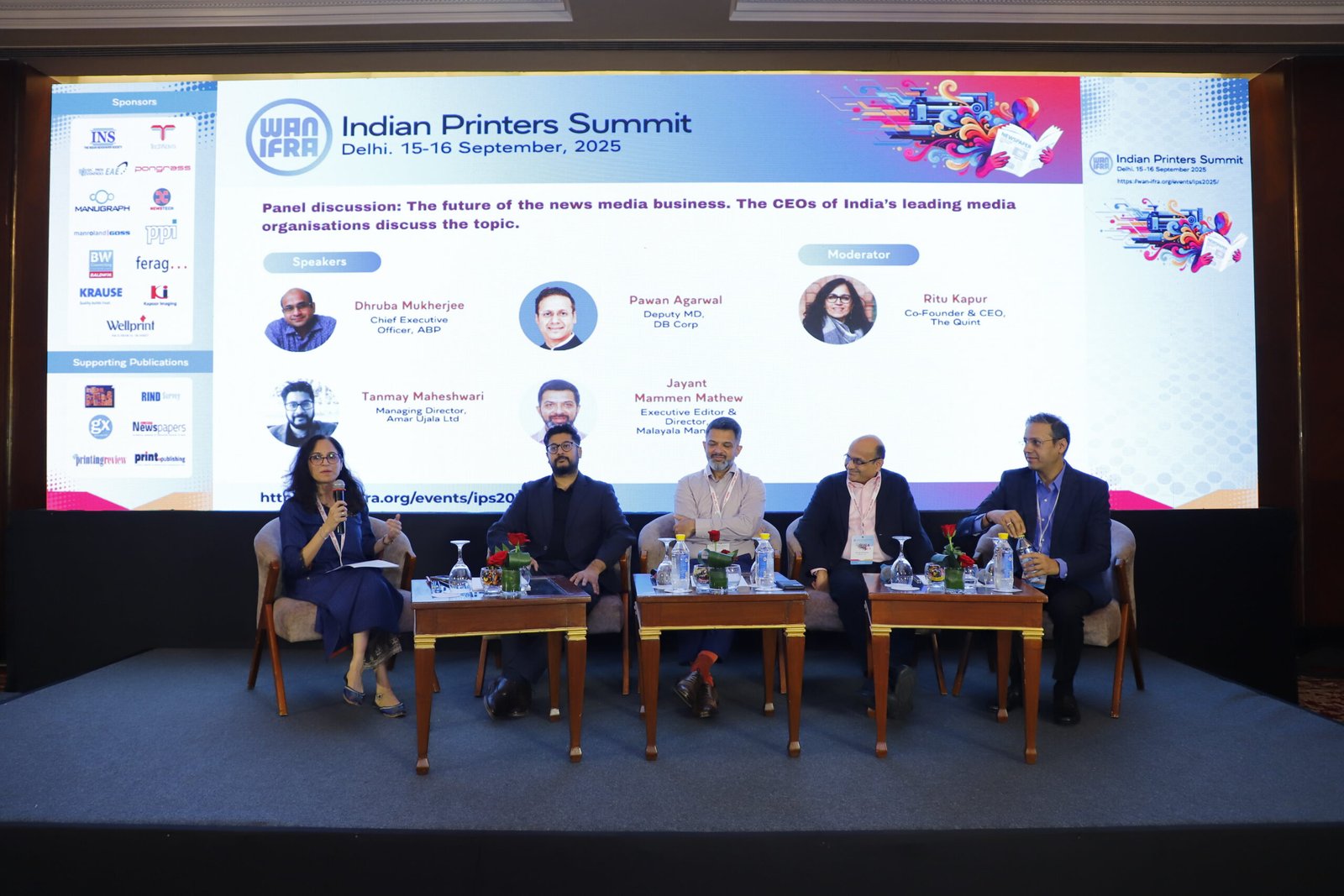
“Readers now want knowledge, not information, from newspapers,” Pawan Agarwal said, implying that in an era of news breaking first on digital, newspapers have to offer something extra the next morning. “Digital is snacking content whereas print is a healthy meal,” Mukherjee seconded.
“The good news is the industry is stable. We have to continue to focus on print. Digital cannot substitute what print is doing ever. Each medium has to make its own niche,” Agarwal said.
Offering his take on the rise in circulation, Mukherjee said soaring newsprint prices had put a lot of stress on cost, and hence, newspapers were controlling circulation. Now circulation has gone up with the newsprint cost stabilizing. Mukherjee also mentioned the turbulence in digital, with traffic going down because of Google’s overview and similar AI tools.
To a question on the rise of vernacular dailies compared to English, Mathew explained how Kerala readers are willing to pay a cover price of almost Rs 10 for something extra with any ‘offers or schemes.’ Keeping in tune with the readers’ changing habits, Malalaya Manorama evolved over time with exclusive stories, more analyses, and youth-centric articles.
Resonating with what Mathew said, Anand G, senior general manager – Circulation, Mathrubhumi, in a separate session, explained how initiatives to understand readers and study their reading habits strengthened the reach and relevance of regional language newspapers. He gave examples of how Mathrubhumi took up hyperlocal issues, reported them, and followed them up till their logical end.
Ritu Kapur raised the prospects of a hybrid model to which Maheshwari said it’s a constantly changing game where publishers have to experiment, fail, and learn from the failures. Agarwal said the focus should also be on converting young readers, either from print to print or digital to print, and counter the perception that print is dying, especially in the wake of the improved results and the ABC figures. The leaders said all INS (Indian Newspaper Society) members were working on a common campaign to prop up the power of print.
In her opening remarks on Day 1, Mariam Mammen Mathew, vice president of Wan-Ifra and CEO of Manorama Online, said it’s time to discuss how print can co-exist with digital platforms. “Print and digital go better together,” she said.
Artificial intelligence, like every time, figured in the discussions. In his opening keynote, Benjamin Peetre, senior business developer, print, at Bonnier News Local, Sweden’s Sweden’s largest local newspaper group, explained how a chunk of its newspapers are produced entirely using AI-assisted workflow. “While print revenue is going down, digital revenue is growing. Our focus is on making print production as efficient as possible to keep it profitable.”
Other sessions revolved around revenue collaborations beyond print and newspapers, the need to diversify, last-mile and distribution challenges with aging delivery partners and a reluctance of the next generation to take up newspaper delivery, tapping young minds with school editions, how to optimize print technologies, automation, waste reduction, workflow management, innovations that bind print and digital, newsprint challenges, etc., which we will write about in subsequent articles.
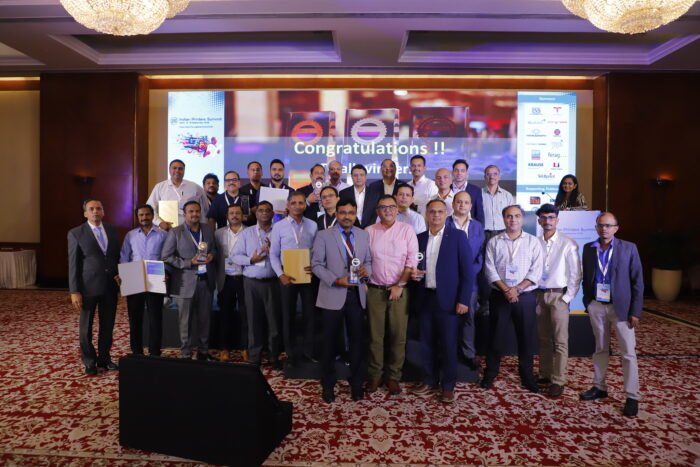
Winners of the Best in Print Awards 2025 were recognized on the evening of the Summit’s first day. The Awards recognize excellence in print reproduction and encourage healthy competition across the newspaper printing industry.
Magdoom Mohamed, managing director of Wan-Ifra South Asia, also presented the early findings of World Press Trends 2025-2026.