The Reuters Digital News Report 2026 points to a general trend that has become routine in recent years – young audiences shying away from news, unwillingness to pay, third-party platforms pushing news publishers to the digital sidelines, declining trust in news, and the rise of news creators.
Pointing to shrinking confidence in the legacy news media, the report states that trust in news has fallen to 37% globally (39% in India), its lowest point in a decade, ever since the institute started measuring the metric in 2015.

The report by the Reuters Institute for the Study of Journalism reveals disruption in the news ecosystem as audiences turn to creators and video-led platforms for information. News, on the other hand, is becoming less central to daily life, and harder to monetize.
Authored by Jim Egan, Craig T. Robertson, Amy Ross Arguedas, Nic Newman, Rasmus Nielsen, Mitali Mukherjee and Richard Fletcher, this year’s report is based on an online survey of almost 100,000 people fielded in January and February in 48 markets, including India.
Impartial news is much in demand, and so is dissatisfaction with news coverage. There has been a fast growth in the proportion of people getting news through AI chatbots.
Key points
Shift to third-party platforms: A growing number of people now access news through third-party platforms rather than traditional news websites or TV channels. Marking a global shift, social media and video networks have overtaken news organizations’ own platforms as the most widely used sources, largely due to the decline of traditional media. This trend is visible in nearly two-thirds of the markets studied, though direct access remains stronger in Western and Central Europe and more affluent Asian regions.
Shift across all age groups: The transition is not limited to younger audiences but is evident across all age groups. While younger users show the strongest shift, people of nearly all ages now prefer social media over television and owned news platforms compared to five years ago, except those aged 55 and above, where habits remain steady. Data also shows 56% of 18–24-year-olds have never regularly read a newspaper, suggesting a lasting generational change, with older audiences increasingly adopting similar habits.
Rise of video: News consumption via video platforms is rising significantly, extending beyond short clips. Around 77% of people globally watch online news videos each week, mostly on platforms like YouTube, Instagram, TikTok, and Facebook rather than publishers’ own sites. Video consumption on news websites and apps has dropped by five percentage points since 2025 and ten percentage points since 2021. Notably, a quarter of YouTube news viewers watch videos longer than 20 minutes, and one in five tune in for live broadcasts.
Trust factor in news: Trust in news has fallen to its lowest level in a decade, with only 37% of people globally expressing confidence. Trust declined in 29 out of 48 markets, with significant drops in countries such as the Philippines, Ireland, Thailand, Peru, and Poland. In the United States, trust stands at just 25%, dropping further to 15% among right-leaning audiences. Major networks like CBS News and Fox News saw declines of 10 points, while CNN dropped by six.
Audiences are increasingly dissatisfied with how news media cover major global stories, especially on issues like inflation, climate change, conflicts in Ukraine and the Middle East, and US politics, with immigration standing out as a particularly poorly handled topic.
News takes a backseat: Since 2021, the share of people ‘extremely’ or ‘very’ interested in news has dropped by an average of 13 percentage points across surveyed markets. Meanwhile, casual or passive users—those who check news about once a week and show little interest—now make up 25%, up from 16% in 2021. Still, while the pool of dedicated news followers is shrinking in most countries, this group remains highly engaged and willing to pay, making it a smaller but reliable audience.
Paying for news: Paid news remains steady at 17% across 20 countries, but growth may slow as fewer users enter the subscription funnel to news websites and apps. While most people pay for direct content benefits (81%), nearly half are also driven by values like supporting journalism, highlighting opportunities for both traditional and non-traditional outlets.
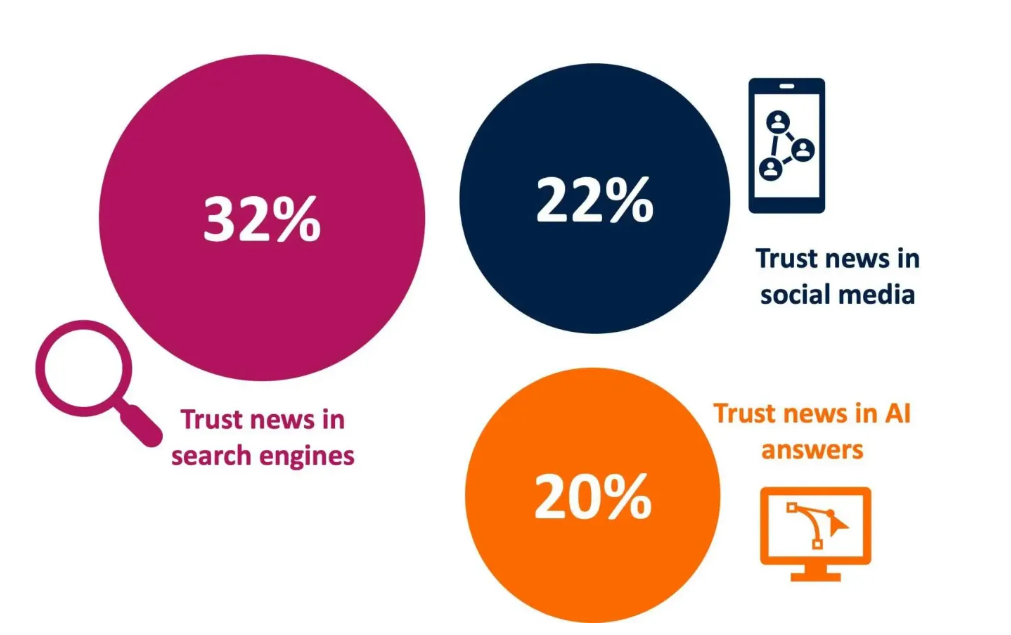
News via AI chatbots: The use of AI chatbots as a source of news is steadily increasing, particularly among younger audiences. Weekly usage has grown from 7% to 10% globally and reaches 16% among those under 35. These users are typically highly engaged with news rather than disengaged. However, trust in chatbot-generated news remains low at 20%, significantly below overall trust levels in news.
Creators rise but face trust issues: Creators are driving video growth, with 27% of people getting news from news-focused influencers and 46% from creators overall. While they’re seen as more engaging, easier to understand and relatable than traditional outlets, they’re viewed as less trustworthy and less impartial. Most users still pair creator content with traditional media—only 13% rely on them for most news and just 3% exclusively.
Support for impartiality: Despite declining confidence in how news is delivered, most people still value impartiality—preferring neutral coverage by more than two to one. Almost half (45%) of respondents still prefer news that does not take sides, and a similar share (46%) also believes consuming news that does not take sides is best for others in society. However, dissatisfaction persists, especially around issues like immigration, and views on the social impact of public service news vary widely, often shaped by trust levels and political divides.
The India factor – Surge in online news
In the India section, Anjana Krishnan writes about how India’s news cycle centered on state elections, bilateral ties, and a contentious constitutional amendment, alongside a surge in regional language and hyperlocal reporting from both mainstream outlets and independent journalists.
As video-first social platforms expand, television has adapted by offering multiple access points, blurring the line between broadcast and digital.
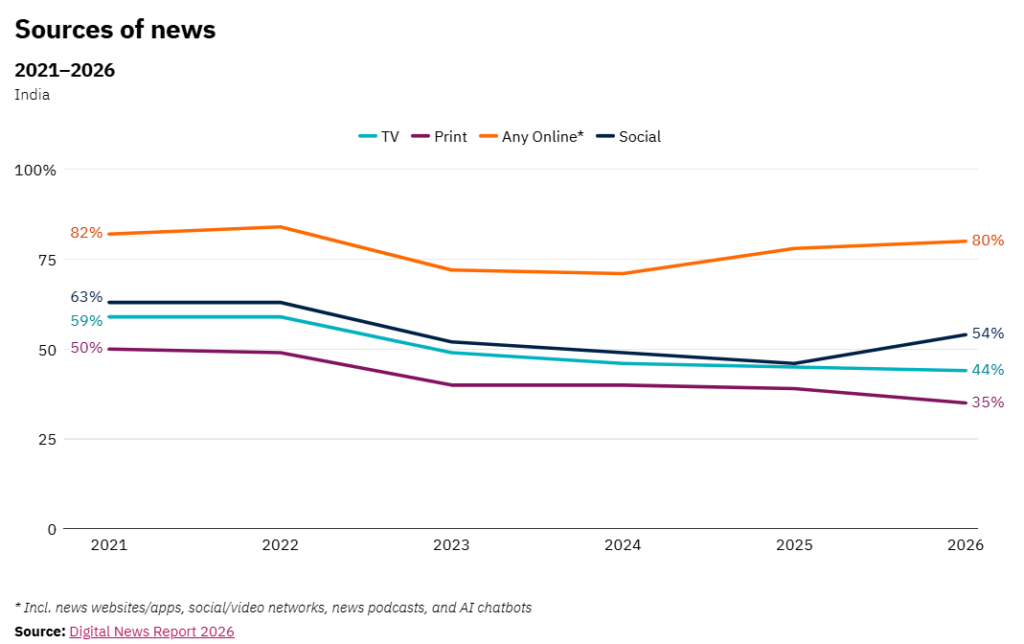
Most respondents (80%) consume news online, with over half (54%) relying on social media, while TV still holds strong at 44% by diversifying through subscription and connected formats. Print was down at a 35% share, compared to 50% in 2021.
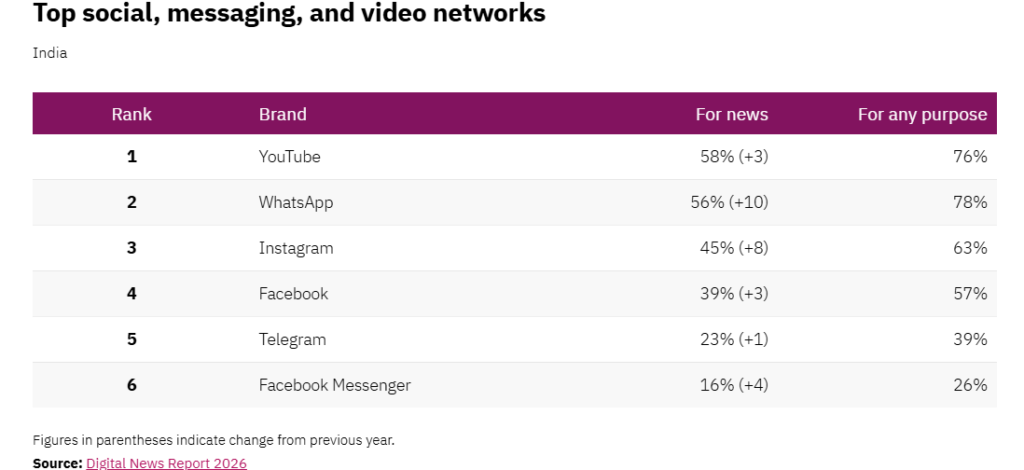
Video, messaging and social platforms now host a mix of news organizations, independent journalists, and creators, with about 58% of Indians turning to YouTube for news. WhatsApp had a 56% share, Instagram 45%, Facebook 39%, and Telegram 23%.
Efforts to formalize creator partnerships are growing. The Collective Newsroom is piloting frameworks in Hindi and Marathi, while The Indian Express Group brought in Saurabh Dwivedi to strengthen Hindi digital reach. Independent creators continue to draw large audiences, and the government is collaborating with creators via DD News and AIR, alongside plans to train 15,000 professionals in AI.
Newsrooms are experimenting with AI, from regional channels using AI anchors to outlets like Scroll.in converting text into short videos, and The Hindu testing AI characters during elections. Adoption remains uneven due to resource gaps and concerns about editorial integrity and trust.
Regulatory changes to the IT Intermediary Guidelines now focus on labeling synthetic content and accelerating takedowns, including oversight of non-publisher creators. Critics argue these rules risk weakening safeguards, expanding executive control, and threatening free speech, especially as platforms face penalties for non-compliance.
Press freedom concerns persist. The sealing of United News of India’s office in Delhi drew sharp criticism from journalist bodies, highlighting heavy-handed enforcement.
India witnessed a 4pp decrease in trust levels. Overall trust in news for India is 39% (down from 43% in 2025), placing it 18th among 48 markets in the survey. At the brand level, trust in legacy print publishers and public broadcasters remains high. All India Radio led with a 65% score, followed by BBC News at 64%.