The challenges in scaling digital news businesses in India, decline in referral traffic, zero click, the rise of third-party platforms and creators, winning young audiences, the transition from text storytelling to film and documentaries, navigating news in the AI era as well as adapting and adopting AI formed the core of discussions and deliberations at the Wan-Ifra Digital Media India 2026 (DMI) conference, on 24 – 25 June 2026, at Sheraton New Delhi, Saket.
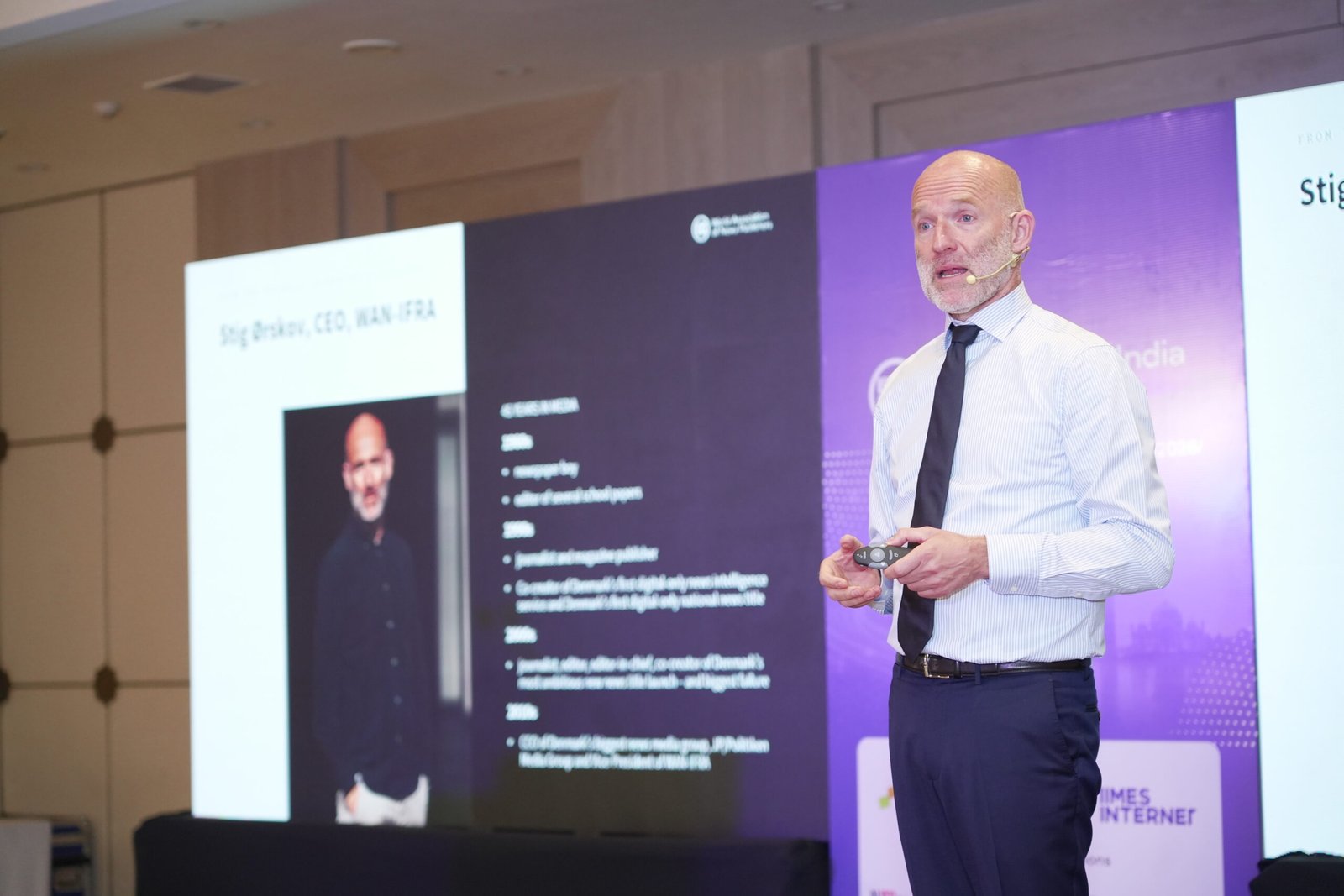
In the opening keynote, Stig Orskov, CEO, Wan-Ifra, spoke about five burning issues framing the future of media, including diversified business models, staying ahead of the curve in terms of emerging maturity in the use of AI, monetary paths for publishing deals on AI platforms such as licensing deals, finding a sweet spot in the economy, and focusing on audio and video.

Barring India, where the news model is still print-heavy, there has been a shift to digital, which has also consolidated, as well as other revenue sources such as events, B2B platforms, grant funding, membership, business content licensing, etc.
On the use of artificial intelligence in news media, Orskov said 22% of the usage is still in the nascent stages, 58% emerging, and 20% advanced. Organic search traffic is under pressure while AI referrals are growing, with ChatGPT leading and Perplexity growing slowly. “There is a shift from AI in media to media in AI,” he said.
Elaborating on the monetary path for publishers in AI platforms, he focused on licensing deals, user-based revenue, pay per crawl, collective licensing, etc.
Collective action is the way forward, he said, referring to the SPUR (Standards for Publisher Usage Rights) Coalition, a non-profit of 36 news publishers and affiliate organizations established to shape the technical and commercial environment within which IP owners can control and monitor the use of their content by generative AI applications.
The key takeaways from his presentation are balanced and diversified revenue models, control of AI in usage and adaptation, a now-or-never audience-first approach, integrating news creators in the traditional newsroom, and more focus on the audio-video format, which third-party digital platforms are cashing in on.
The two-day conference had CEOs, editors, and technical experts speak on a wide range of topics covering digital news, which we shall write about in subsequent days.