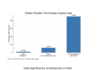
The Indian signage industry has witnessed increasing cross-segment migration, especially after the pandemic but the recovery has been slow in comparison to other forms of printing. Many of the industry providers claim that regulatory challenges and lack of proper representation are some of the reasons the growth is slow along with the coming transitions in technology. For instance, it seems that many states in South India have already banned eco-solvent inkjet signage in order to bring in solvent-free and UV-inkjet technologies.
The Indian digital signage industry is expected to witness exponential growth in the coming years as brands recognize the benefits new technologies offer vis à vis both traditional solvent-based inkjet and inkjet to LED signage. Although the LED signage is catching on in cities like Mumbai it is still a novelty in most parts of the country. Even in Mumbai the LED screen-equipped bus stops are still advertising their availability and looking for paying customers.

As Sanket Rambhia, managing director of Xtreme Media, told Indian Printer and Publisher at the In-Store Asia expo held in Mumbai from 1-3 June, there is a huge demand potential for digital LED signage, especially in metro cities. However, he highlighted the challenges the industry faces in the regulatory grey area.
Signage rules vary across different cities, and clarity in rules is necessary for the industry to flourish. He said the advantages of LED digital signage over traditional wide format inkjet hoardings include its low running cost compared to traditional hoardings since it is a one-time investment, where the content can be easily changed by a centralized console. In comparison, with traditional inkjet hoardings, the entire signage needs to be changed every few weeks.

With the coming of LED digital signage, conventional inkjet billboards and posters are shrinking in retail, said Santosh Nair, director of Skytek Technologies at Media Expo 2023, Mumbai. “The signage printer providers are investing heavily in machines. Where will they go in such a scenario? We are trying to show them the unique opportunities we are coming up with using UV inkjet technologies,” he said.
The global signage market is said to be almost a US$ 600 billion (approximately Rs. 50 lakh crores) segment. The Indian signage industry is variously estimated at around Rs 30,000 crore and figures that are considerably lower. The signage industry in India seems to be stagnating and growing at 2 to 3% when it should grow by at least 15% CAGR in the next three or four years, according to Nair.
“What I am slightly worried about is that digital LED is coming, and the wide format signage industry needs to wake up and look at various ways of sustaining the business and analyze where they see themselves in the next four years. Artificial intelligence and 3D modeling are also coming into play. So many new elements are coming, which is now going to take a lot of value from a marketer’s perspective from the brand side. Conventional signage as I see is both growing and shrinking. To keep up the pace or to balance it with digital, I think the signage industry will have to act fast, innovate, and see what it is that they can provide that will deliver a better value proposition to a brand.”
Nevertheless, Nair thinks that signage is never going to die and will remain a significant communication medium because, with new technologies like digital arriving, the recall value will remain high with outdoor and indoor signage. However, the signage industry needs to have an association or an organization to better represent its needs to the government.
Transition from eco-solvent to UV inkjet signage printing
According to Shailesh Mehta, director of Mehta Cad Cam, the Indian signage industry is undergoing a transition period as the technology is changing. The Ahmedabad-based company has developed laser technology products, CO2 laser technology equipment, fiber laser technology equipment, a range of CNC routers, and various types of digital printers since its start in 1989.
“There is a certain stagnancy. The market should go from solvent-based inkjet to UV printers. However, this shift has not taken place. As a result, solvent printers have stopped opting for the latest UV printers, and are just waiting and watching, creating a kind of vacuum.” It seems that the implication may be that printers who have made large investments in UV-inkjet technology, may not have not grown at a rate that met their expectations and investment.
Kenichiro Seki, managing director of Mimaki India, who joined the company’s Indian operations a year ago, spoke on a similar note at Media Expo 2023, Delhi-NCR. “We want to promote our UV technology as the market will eventually shift towards UV from eco-solvent. In terms of media compatibility, UV has a wider range of applications than eco-solvent and Mimaki is a leading provider in this segment. The Southern markets are more aware of the market and technology as they have already banned eco-solvent technology and are pushing for UV printing technology,” he said.