Though the aggregate profits of our Indian newspaper industry are high because of a handful of dominant groups, they hide the poor median industry profits. Newspaper owners, publishers, and managers need to examine both before they judge the strength of the recovery.
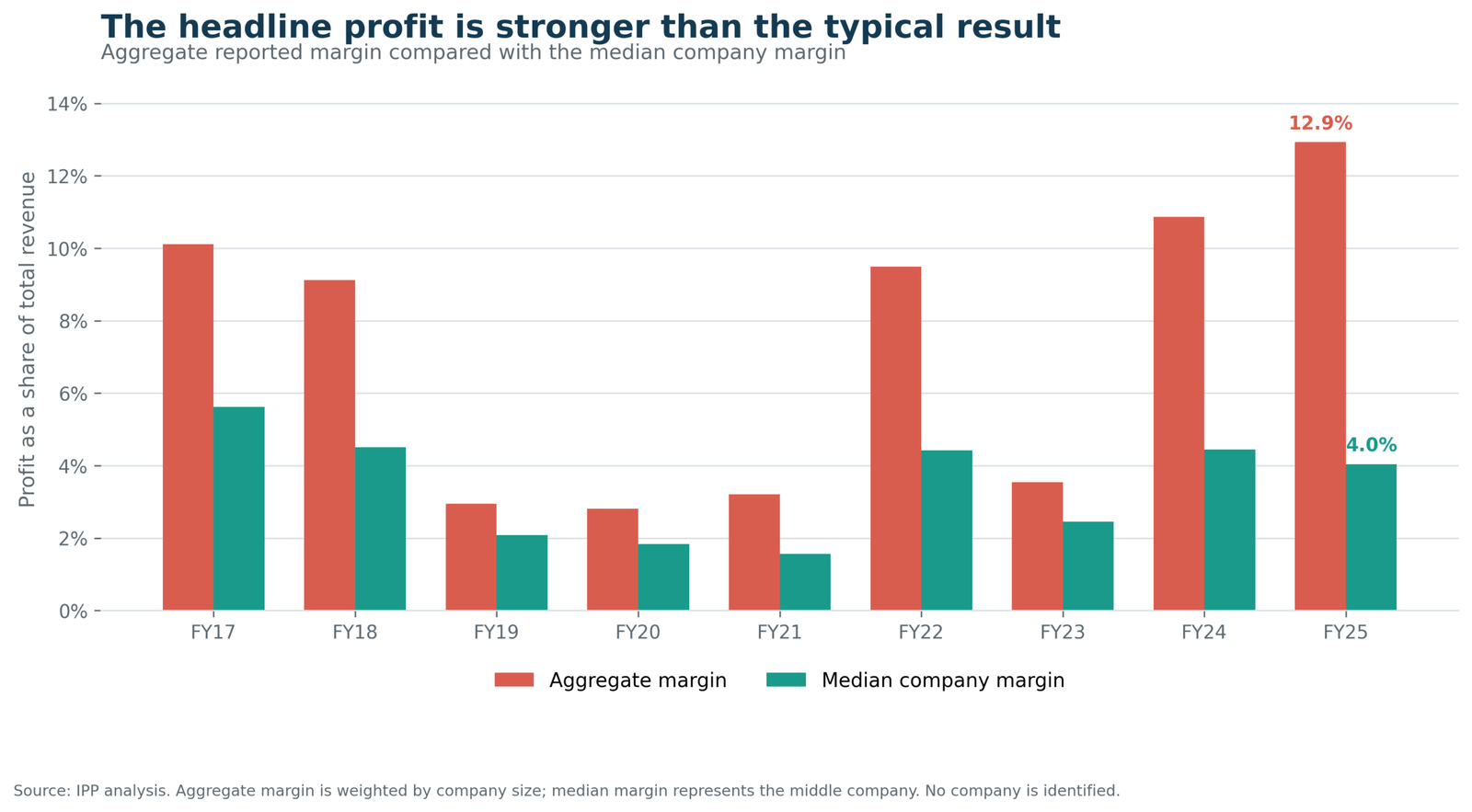
Aggregate profit for the 47 newspaper groups covered in this analysis did increase by almost 16% in FY25, and their reported profit reached 12.9% of total revenue. This was the highest aggregate margin in the complete nine-year period covered.

But the result changes when we look at how widely that profit was shared. The median company margin was only 4.0%. The number of profitable groups fell from 41 in FY24 to 35 in FY25. In addition, nearly 79% of the 47 newspaper groups’ combined profit came from the three largest and most profitable groups.
Why the two margins are different
The aggregate margin adds the profit and revenue of every group and then calculates one ratio. Large businesses therefore have a greater influence on the result. The median margin lines up all company margins and takes the middle one. It gives a better picture of the typical company in the 47 newspaper groups.
Neither measure is wrong. Each answers different questions. The aggregate tells us how many rupees the full 47 newspaper groups earned. The median tells us whether the improvement reached the middle of the market. When the aggregate rises, but the median remains low, the recovery is being driven mainly by a smaller group of larger and stronger profit contributors. The larger newspaper groups are cannibalizing the ad revenues of the smaller ones.
Reported profit is not the same as newspaper profit
Another distinction is important. Profit for the period can include interest income, investment gains, exceptional items and earnings from businesses outside newspaper publishing. The gap between total revenue and operating revenue also widened in the latest period. It would be unsafe to assume that all of this improvement came from circulation, advertising or printing efficiency.
Before approving capital expenditure, a newspaper board should therefore separate recurring operating profit from other income and one-off gains. It should ask whether the newspaper is generating cash after the costs of news gathering, processing, paper, labor, power, maintenance and distribution; whether working capital is improving; and whether the expected return is high enough for the risk involved.
A simple management dashboard
A useful monthly dashboard does not need dozens of ratios. It should show operating revenue, contribution by edition, paper yield, employee cost per thousand good copies, energy per thousand copies, maintenance cost, returns and unsold copies, cash conversion, and recurring operating margin. Digital, events, radio and other activities should have their own direct costs and contribution measures.
This separation does not weaken a multi-platform strategy. It makes the strategy more credible. Management can see which channels bring customers into the wider group, which channels generate cash, and which assets need improvement or consolidation.
The newspaper industry is more profitable in aggregate than the revenue trend alone would suggest. That is welcome. But the benefit is not evenly spread. The strongest publishers will use the current margin relief to build credibility and repeatable operating advantages. Others may discover that a favourable cost cycle can improve the headline without repairing the underlying business.
(This is the third and final part of IppStar’s 9-year review of 47 Indian newspaper groups)
Read part 1 here
Read part 2 here
References
Crisil Ratings, 19 August 2026: non-print revenue and the print slowdown
Crisil Ratings, 25 July 2024: regional print growth and newsprint costs
EY India, 24 March 2026: FICCI-EY media and entertainment report
PwC India: India Entertainment and Media Outlook 2024-28
Press Registrar General of India: Press in India reports
IppStar’s own research from 2008 onwards