A newspaper can grow profit in two basic ways: earn more revenue or spend less to produce that revenue. The data show that cost relief has done more of the work.
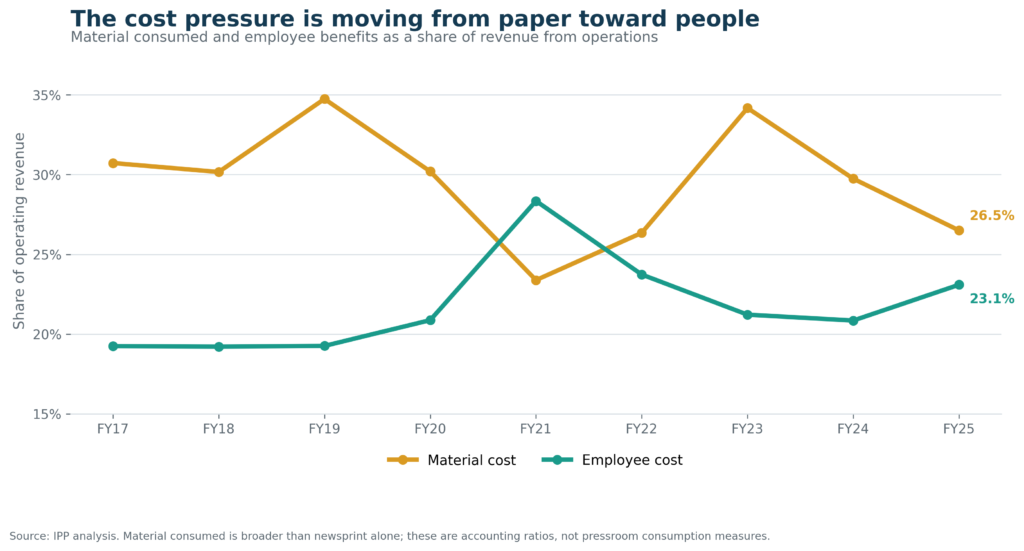
Raw material (newsprint, plates, blankets, inks and chemicals) consumed represented almost 35% of operating revenue in FY19. The ratio returned to more than 34% in FY23, when imported newsprint prices, freight and supply conditions put pressure on most publishers, while some optimistically inflated unpaid for circulations to maintain their higher ad rates. It then fell to 29.7% in FY24 and 26.5% in FY25.

In the latest year, total material cost fell by about 14%, even though operating revenue declined by less than 4%. That gap helped protect profit. Public analysis by Crisil has also identified newsprint as one of the largest operating costs for newspaper publishers and reported a substantial fall in prices during FY24.
The employee-cost line moved in the opposite direction. Employee benefits represented 19.3% of operating revenue in FY19 and 23.1% in FY25. In the latest year, employee cost rose by almost 7% while operating revenue declined. This does not automatically mean that staffing is excessive. It means that there may be limits to editorial downsizing, and productivity may become a more visible management issue as the material burden falls.
Move from cost cutting to accountable quality & process improvement
Publishers cannot control the international price and freight and insurance costs of newsprint, especially at times of war and supply chain disruptions. Apart from better reporting and editorial accountability, they can control how efficiently newsprint is converted into saleable copies. Useful operating measures include start-up waste, web breaks, plate remakes, ink consumption, good copies per press hour, energy per thousand copies and returns from the distribution chain.
These measures should be available by press, edition, and shift. A single monthly paper-consumption number is not enough. Managers need to see where waste starts, whether it is caused by material, maintenance, settings, scheduling or training, and what action reduced it.
The same principle applies to people across the news organization. Productivity is not simply a word count or headcount exercise. In production, better planning, automatic presets, closed-loop color control, condition-based maintenance, production-data capture, and more accurate dispatch information can improve output without weakening quality or reliability.
Lower paper prices can create a temporary margin advantage. If the savings are treated as permanent, publishers may add fixed costs that become difficult to carry when material prices rise again. A safer approach is to use part of the relief to restore the credibility of the brand and strengthen the balance sheet, and part to fund projects with measurable payback.
Good projects are not always the largest projects. A retrofit that reduces make-ready, a maintenance system that prevents stoppages, or software that improves the editorial quality and edition planning may produce a better return than capacity that is not fully used. Every investment proposal should state the expected saving per copy, per ton or per productive hour.
The survival lesson
The cost story has changed. Newsprint and other materials remain critical, but they are no longer the only visible pressure. Apart from credibility with a new demographic, the next margin gains will increasingly depend on productivity, process control, energy efficiency, maintenance and the ability to match production capacity to realistic demand.
The next improvement must come from better ideas and thinking, research, production workflows, lower waste and higher output from existing people and equipment. And possibly, as Gen Z has recently expressed, a higher commitment to honest and accountable news, rather than relying on editorial sycophancy and political and government-led advertising support.
(This is the second part of a 3-part series of IppStar’s 9-year review of 47 Indian newspaper groups. Next: Aggregate profits of 47 newspaper groups grow by 16% in FY25)
Read part 1 here
References
Crisil Ratings, 19 August 2026: non-print revenue and the print slowdown
Crisil Ratings, 25 July 2024: regional print growth and newsprint costs
EY India, 24 March 2026: FICCI-EY media and entertainment report
PwC India: India Entertainment and Media Outlook 2024-28
Press Registrar General of India: Press in India reports
IppStar’s own research from 2008 onwards