The Indian digital production print market is entering FY 2026-27 on a positive note, with equipment manufacturers expecting steady growth in installations and print volumes despite continued uncertainties. While growth expectations vary across companies, there is an agreement that demand for digital printing continues to strengthen as commercial printers expand into new applications, publishers modernize production, and businesses increasingly seek shorter print runs, faster turnaround times and personalised output.
The industry’s outlook also reflects a gradual evolution in customer investment behavior. Digital printing is no longer viewed simply as an alternative to offset for short runs. Instead, manufacturers point to growing adoption across publishing, education, packaging, labels and other application-driven segments, where flexibility, automation and workflow integration have become equally important considerations.

Mixed performances in FY 2025-26
For some manufacturers, FY 2025-26 exceeded expectations, while others reported more modest growth. Minosha, which is a Ricoh distributor, reported a 50% year-on-year increase over the previous financial year, attributing the growth to stronger demand from tier-2 and tier-3 markets, increased digital transformation initiatives, greater demand for automation and a gradual migration from conventional offset printing to digital production systems.
Meanwhile, Monotech, also a Ricoh distributor, recorded 6% topline growth, although the company noted that the performance fell short of its internal expectations. Nevertheless, it expects overall digital print volumes and equipment sales to continue growing during the current financial year.
According to insights from the industry, it can be noted that the growth is continuing, but not uniformly across all technologies, customer segments, and geographical regions.
Installation forecasts remain positive
Minosha expects to install between 200 and 250 production digital presses during FY 2026-27, with installations matching order bookings. Around 60-70% of these are expected to come from new customers rather than repeat buyers, indicating continued market expansion rather than replacement-driven demand alone.
Monotech has projected a similar installation range of 200-250 presses, while noting that approximately half of its business is expected to come from new customers.
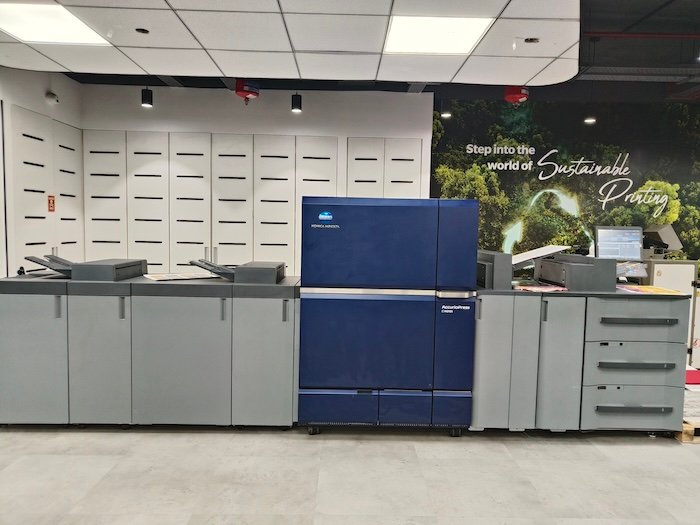
Konica Minolta expects combined installations of all OEMs of approximately 2,800 digital production presses during FY 2026-27, representing an anticipated 5-7% increase over FY 2025-26. The company estimates that it currently accounts for 50-55% of the market and reports that toner consumption continues to grow by more than 10%, indicating healthy utilization of installed systems.
Canon is experiencing approximately 10% growth in its installations over the previous financial year, and indications are that print volumes are increasing across the industry at 10% also. Apparently, digital demand is increasingly concentrated in the light production press segment, particularly as investments accelerate in Tier-2 and Tier-3 cities, while the mid-production segment has begun to mature.
Minosha credits much of its recent growth to increasing demand from tier-2 and tier-3 cities, where commercial printers are investing in digital technologies to meet changing customer requirements.
Canon also identifies these markets as the principal driver behind the growing popularity of light production presses. Monotech similarly observes that while established commercial printers continue investing in higher-productivity equipment, expansion into Tier-2, Tier-3, and Tier-4 markets is creating sustained demand for entry-level production presses.
Taken together, it suggests that future market growth is likely to come not only from capacity expansion among established printers but also from the increasing adoption of digital production technologies by first-time buyers in emerging regional markets.
External risks
Despite the positive outlook, manufacturers remain cautious about several external factors that could influence capital investment during the year.
Most of the companies identify inflation, geopolitical developments, exchange-rate volatility, financing constraints, and supply chain disruptions as potential risks affecting purchasing decisions and installation schedules. It further notes that uncertainty in the global economic environment could affect customers’ willingness to invest, with businesses likely to postpone capital expenditure during periods of heightened uncertainty.
Evolution and more local manufacturing
Manufacturers expect continued growth in installations, increasing print volumes and wider adoption across regional markets, supported by customers looking beyond traditional commercial printing into publishing, education, packaging and personalised print applications.
Technology is also evolving alongside market demand. Inkjet continues to gain momentum across several production segments, while toner-based systems remain heavily utilized. At the same time, printers are increasingly evaluating investments in terms of productivity, workflow integration, automation, and total cost of ownership rather than hardware specifications alone.
If the industry’s expectations are realised, FY 2026-27 is likely to be characterized not by a single defining technology or application, but by a broader shift towards digital production workflows across a wider spectrum of India’s print industry.
Inkjet gathers momentum
The industry expects growing adoption of both continuous-feed and sheetfed inkjet presses, stating that inkjet will continue to influence future demand across commercial and industrial printing, embellishment, marking and coding applications. TP Jain from Monotech explains that “Inkjet is the way forward” for the market.
For Kridwinn, FY 2026-27 has already seen 10 installations of its print-on-demand inkjet presses. The company believes that improving print quality and declining running costs are encouraging more printers to consider digital production technologies.
Kridwinn’s focus on webfed print-on-demand inkjet systems reflects a similar direction, with the company observing that improvements in print quality are narrowing the gap between digital and offset output while operating costs continue to decline.
Webfed inkjet presses for book production are also manufactured by Monotech and together with the several Chinese manufactured and imported presses for the commercial market, these may see about two dozen installations in the financial year. Increasingly, apart from selling or rebadging Chinese equipment, other Indian manufacturers are looking at developing inkjet production presses. At the same time, inkjet head, technology and ink suppliers are looking for growth in this market. Epson is already working with OEMs and others such as Namrata Sharma of Global Print Konnect are attempting to bridge the technology and understanding gaps in inkjet device manufacturing by holding three-day workshops in the country later this year.
Note: HP, Fujifilm and Xerox are also active in the Indian market, but we were not able to elicit any meaningful responses from them for this article.