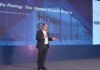
The All India Federation of Master Printers (AIFMP) hosted the World Print and Communication Forum (WPCF) Conference and board meeting alongside the biennial Pamex 2020 exhibition in Mumbai. The conference held at the Westin Garden City Hotel on 8 January 2020, called ‘Redefining printing- a discussion with world leaders’ saw the participation of over 150 delegates from the USA, Belgium, South Africa, Japan, China, and India.
The conference consisted of two sessions, moderated by Rajendrakumar Anayath, who is now the vice-chancellor of Deenbandhu Cho Ram University of Science and Technology. The inaugural session of the conference was conducted by Kamal Chopra, chairman of Pamex, Raveendra Joshi, chairman of the organizing committee of WPCF, Dibyajoyti Kalita, president AIFMP, and Anayath. They set the tone of the conference and explained what the delegates were in store for the day.
The first technical session was conducted by Narendra Paruchuri, managing director of Pragati Offset and the winner of the first Viren Chabbra Print Leadership Award (VCPLA). Tracing the changes over the last 40 years in the print industry, he spoke of its scope in the future. His presentation ‘Printing – Kal, Aaj, Aur Kal’ emphasized the need for printers to collaborate to grow while also urging the audience to go green and use bio-degradable materials for printing and packaging.
He was followed by Sukhdev Singh Saini of Colgate Palmolive, talking about ‘Get Print-ready to deliver Branded Packaging in India.’ Speaking about the tremendous growth in the printed packaging sector, he suggested that there is a need for printers to provide complete branding solutions to their customers.
The next presentation by Kaz Arai, general manager, public relations, The Japan Federation of Printing Industries, discussed the paradigm shift in the printing industry in Japan. He spoke about the importance of moving towards smart factories and how automation is essential to increase the efficiency of presses and the printing businesses.
Abdool Mahjed Mahmood, chief executive officer, Printing SA, then spoke about the challenges the printing industry was facing in South Africa. Chang Xiaoxia, vice president, The Printing Technology Association of China and general manager of Beijing Keyin Media & Culture, gave a presentation on ‘The Present Situation & Transformation Trend of the Printing Industry in China.’ Her presentation gave an in-depth scenario of the Chinese market, the prevailing trends, and the looming opportunities. Kaz Arai then rounded off the first technical session with a talk on ‘Current Trends in the Japanese Printing Industry and the direction it needs to move in the future.’
The second technical session started with a presentation from Beatrice Klose, secretary-general, INTERGRAF, who spoke on the trends visible in the European market and the challenges it faces due to EU legislation. She noted that package printing has overtaken graphic print in Europe and also spoke about the lack of skilled professionals in the printing industry.
Anayath then gave a presentation on behalf of Marcus Heering, managing director of The German Association of Printing and Paper, ‘Status Quo and the upcoming trends for the Printing Industry.’ Heering cites four significant trends in Europe – Artificial Intelligence, Connected Customer, Platform Economy, and Circular Economy – the same as the drupa promotion presentation made in Mumbai and Delhi a few months ago.
Ashutosh Tripathy from the R&D Group of the Natural Centre for Flexible Electronics, IIT Kanpur, gave an interesting presentation on ‘Printed Electronics – Challenges and opportunities for India’ in which he highlighted the opportunities in flexible electronics for the printing industry.
Michael Makin, president and chief executive officer of Printing Industries of America, spoke about the state of the US printing industry and its challenges. His macroeconomic overview of the industry, print markets, and forecasts presented the key opportunities and the outlook of the industry in 2020. The conference culminated in an interactive session with the audience.