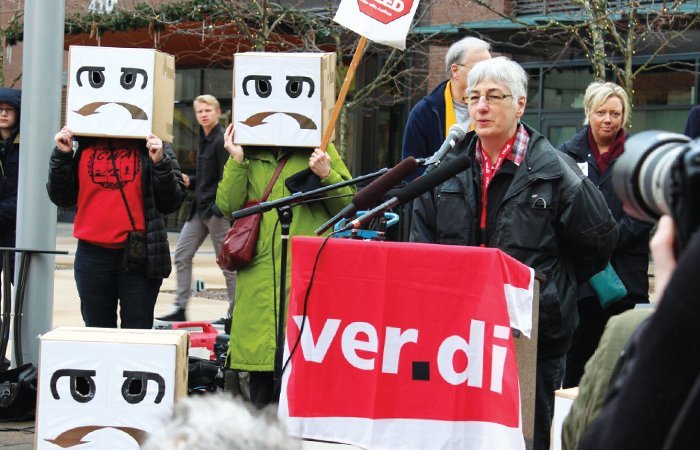
Two weeks before Christmas, when year-end deliveries soar, workers affiliated to German trade union Verdi struck work and held rallies outside Amazo warehouses in Bad Hersfeld, Leipzig and Graben. The online retail giant has eight warehouses called FC’s or fulfilment centres across Germany with a combined storage space of 7 million square feet. It has a workforce of 9,000 warehouse staff and 14,000 temporary workers that arrive on short-term contracts during the winter. The Verdi union says that the strikes are going to be repeated in 2014.

Germans protest robotic conditions
Verdi says Amazon pays much lower wages than other retail warehouses in Germany, uses GPS trackers and wifi to keep employees under surveillance and in a state of perpetual motion and work, and employs too many shortterm contract for migrant workers who dare not complain about working conditions and unfair wages. Germany accounts for around 10% of Amazon’s total warehouse area of 70 million square feet and churns out nearly 15% of its global turnover of US$ 61 billion. It is the largest operation centre outside of North America and possibly the most profitable. Amazon confirmed that 1115 workers did not show up on Monday the 17 December, but it was still able to ship out the 4 million packages scheduled for delivery to Christmas shoppers.

Amazon, the world’s fastest growing retailer, increased sales by 27% to US$ 61.09 billion in 2012. Walmart, the largest, grew only by 2.2% to US$ 466 billion in comparison, with its online sales lower than US$ 9 billion. While Walmart provided support to retail stores, Amazon shipped directly to the consumer and helped replace brick and mortar retail business worth US$ 15 billion last year. Profits for Amazon in 2012 were down to a minimal US$ 676 million, cleverly camouflaged by its massive investment in fulfilment centres. Each year Amazon adds around 10 fulfilment centres globally, that makes its profit appear paper thin. After the 13 fulfilment centres being set up this year, it would have 102 warehouses by 2014.
The protests against Amazon have been rife after British and French papers brought outstories of tough working conditions and low salaries at Amazon FCs. Here pickers and stowers have to work relentlessly sometimes on a 12-hour extended shift at around 10€ per hour, 20% lower wagesthan other retail warehouses. Amazon hasthree aces up itssleeve to counter strikes. With over 20,000 seasonal workers listed on its contract rolls, and only 14,000 currently engaged, it can afford to replace a few thousand striking workers without any disruption. Last year it purchased Kiva Systems, a builder of robotsfor US$ 775 million, that could start replacing its pickers and stowers by 2015.It also plansto start FC’sin the Czech republic and Poland which haslow-cost workers and weaker legislation compared to western Europe and could crush the morale of any organized protest very easily.
French protect retail book stores
Even ifAmazon can beatthe German strike,they are unlikely to beat French legislation.In October this year, French law makersin a rare move of unity came together to ban the free delivery model ofAmazon (See IPP December 2013) that were reportedly closing independent retail book stores.The French have valiantly foughtto protect small booksellers against organized retailsince the early eighties. French law makers and booksellers claim that indie book shops are part of their culture and heritage and employ 18 times more people than online retailer Amazon. France has nearly 2,500 indie bookstores compared to 1,000 book storesin the UKwith both nations having a population above 60 million Amazon founder Jeff Bezos, however, seems to be planning ahead for the days when indie book shops may be a protected species by law.
He has worked painstakingly on the Kindle Reader and said recently, “We’re now seeing the transition we’ve been expecting. After five years, eBook is a multi-billion-dollar category for us and growing fast — up approximately 70% last year. In contrast, our physical book sales experienced the lowest December growth rate in our 17 years as a bookseller, up just 5%. We’re excited and very grateful to our customersfor their response to Kindle and our everexpanding ecosystem and selection