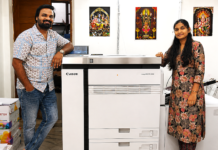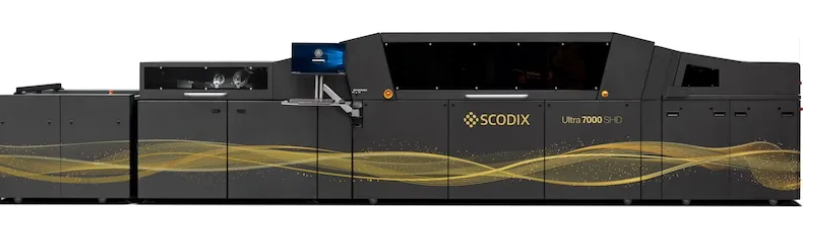
Scodix has announced a new embellishment press, the B1-sized Ultra 7000 SHD, which has been developed to work with heavy-duty substrates from Dibond to corrugated boards to allow Scodix to expand into the sign and display market.
As such, this marks a strategic expansion into the Sign & Display and Corrugated Packaging sectors for Scodix. Amit Shvartz, general manager and chief operating officer for Scodix, says that the company has grown by expanding into new markets every couple of years, having started in commercial print before moving into web-to-print and folding carton, adding, “And now we are offering a solution for signage and display.” He continues: “And this is coming from the request of our customers, some of them current customers, some of them people that always wanted embellishment from Scodix but we did not serve their market yet, so now we do.”

The Scodix presses are designed to take substrates that have already been printed, either using offset or digital presses with water-based or UV inks, and then to add further effects or embellishments to increase the value of those prints.
The Ultra 7000 has been built on to an existing Scodix chassis, which limits it to B1 media. Shvartz accepts this might be a limitation in the sign and display business, but says, “We see B1 as our entrance to this market and we do see a lot of requests for B1.” He points out that it may not be necessary to add embellishments to a whole point of sale display, but just to one part, such as a header to grab a customer’s attention. Shvartz says that Scodix invested a lot of R&D into developing ways to handle the thicker, heavier materials typical of sign and display, while also ensuring that it could still support all the previous range of substrates.
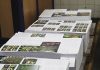
The substrates are loaded onto one of two trays and held in place by a vacuum and then transported through the machine for the different effects. This allows the Scodix presses to handle a wide range of different media, from paper to rigid boards to corrugated sheets. The Scodix presses use inkjet technology to apply embellishments to printed sheets. At the heart of these machines is a page-wide array of Ricoh printheads with resolution up to 2540 x 450 dpi. The individual effects are created by different polymers suspended in a clear fluid and cured via UV lamps, allowing each print to be customised.
The effects themselves can be built up one layer at a time. There are 17 effects in total, which include foil, embossing, glitter, metallics and security effects. It is possible to combine up to seven of the polymer-based effects on one print which Scodix calls Multi-Layer Embellishment. It also benefits from the SHD Smart High Definition, which can create fine details down to 4-point text, and which I’ve previously explained in more detail here.
Now, it’s worth noting that a lot of wide-format printers can already produce some effects without requiring investment in additional machinery. For example, most wide-format printers use UV ink, and many can create tactile effects – including braille – by printing and curing multiple layers of ink on top of each other. Some can also offer gloss effects by varying the degree or direction of curing, and some can jet clear inks to produce varnish effects.
Shvartz expects that the majority of customers will be drawn to the foiling effects, noting: “The possibilities of adding them to both corrugated and to sign and display are almost non-existent. They are very, very difficult to do and limited to very, very high quantities. We are now offering something that is very easy to use and you can add foil to things or to a subject that you couldn’t have done before.” The Ultra 7000 can take up to six rolls of foil, with up to 720mm foil width.
He adds: “I think that from the initial feedback that we got from customers, and definitely from the customers who pushed us to this direction, we believe that there is a big market there for embellishments that are beyond what is possible today with some of the systems out there.”
He continues, “Many of the customers that we are now addressing with the new ultra 7000 SHD are current customers that want to take their business and offer additional things. Or they already offer signage and display, but they do not offer signage and display with embellishment, and from their perspective, being able to offer that as part of their offering to their customers is something that would bring them a lot of value or differentiate them from anybody else in their region.
The new Ultra 7000 SHD can handle the type of rigid substrates that are normally used for display graphics and some packaging applications such as acrylic, Forex and foam board and even leather. Naturally, the new press will also handle all the same substrates that Scodix’s existing range are used with, including coated and uncoated sheets of diverse media weights. It will take media up to 1060 x 760mm, though the maximum image size is 1000 x 700mm. It will take rigid boards up to 4mm thick and corrugated sheets up to 4.5mm in height and up to 3.4kg in weight per board. It takes paper from 135 to 675gsm. It can produce per hour up to 1300 B1 corrugated sheets, or up to 780 B1 rigid boards, or 1310 B1 paper sheets. These timings will depend on the type and number of embellishments being applied to any given sheet.
Eli Grinberg, Scodix CEO and co-founder, commented: “We are creating a new category by bringing our SHD embellishment technology to rigid substrates, and we are empowering printers to enter high-margin markets that were previously unreachable, proving once again that Scodix leads where others follow.”
Scodix is also introducing a new visualisation software for creating realistic previews of customer print jobs with the various embellishment effects. This should be available both as a plug-in to existing Web-to-Print systems as well as a standalone offering.
The Ultra 7000 SHD will be demonstrated at the upcoming Fespa show in Barcelona in May, with deliveries due to start straight after the show. You can find further details at scodix.com.