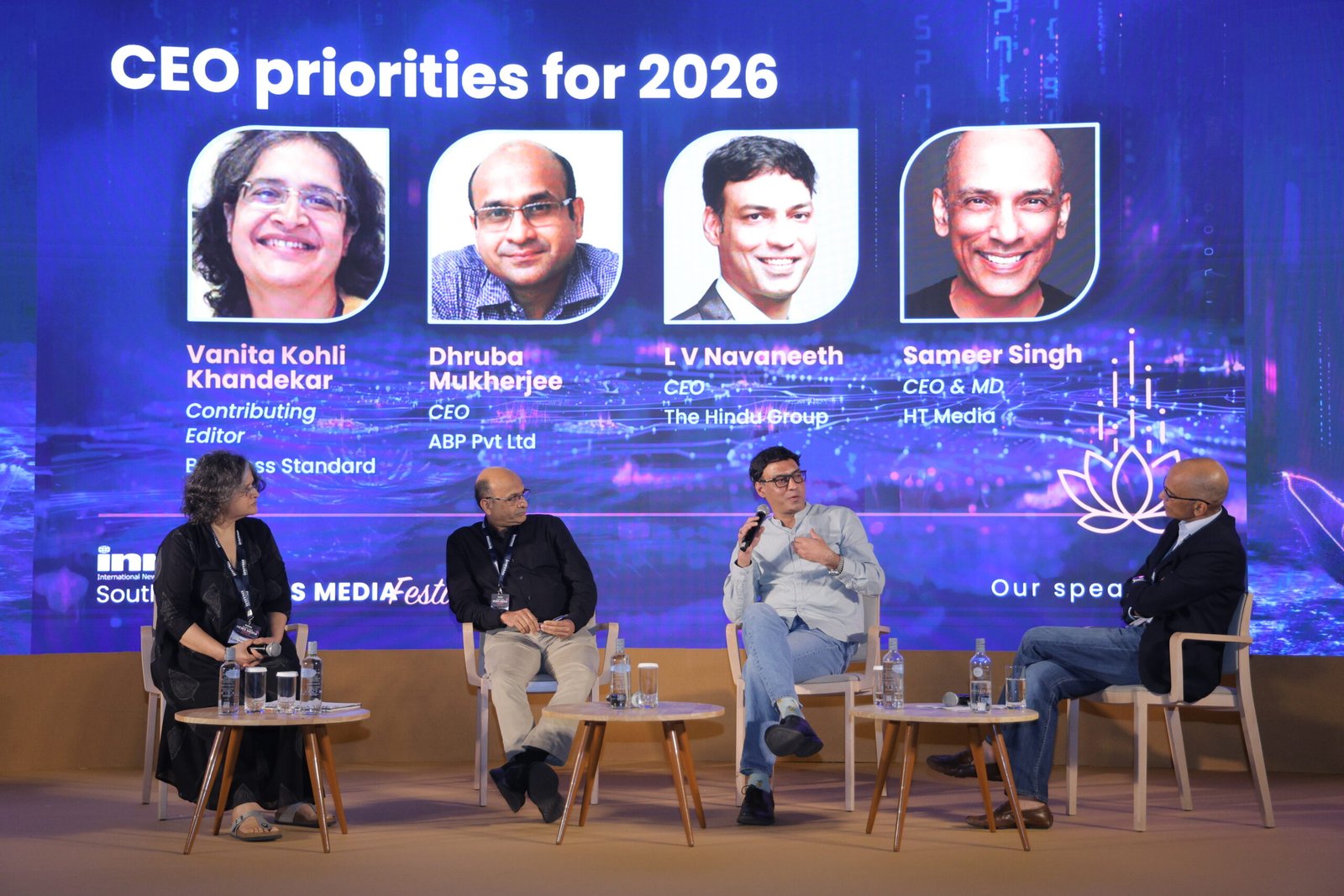
In one of the panel discussions at the International News Media Festival’s (INMA) South Asia News Media Festival held from 20 to 23 July in Delhi, three news media CEOs — Dhruv Mukherjee of ABP Digital, LV Navaneeth of The Hindu Group, and Sameer Singh of HT Media discussed priorities, challenges, and growth opportunities in Indian news media.
In the discussion moderated by Business Standard‘s Vanita Kohli-Khandekar, Sameer Singh identified three key challenges: an aging consumer base, declining digital traffic, and rising costs, especially of newsprint. He sees opportunity in AI-driven consumer data insights and improving productivity/efficiency.

Navaneeth framed The Hindu Group’s business around a “core and more” model — the core is a low-margin print business consisting of advertising and circulation but which constitutes a large percentage of the group’s revenues. The more side contains higher-margin ventures such as events, an English education business (STEP), and book publishing.
He outlined four challenges: navigating print’s cost/revenue volatility while funding journalism, growing the moat business without sacrificing margins, managing cultural differences across business units, and evolving his own leadership style as the company scales.
“The core business is subject to extreme, extreme volatility both in terms of costs and revenues. By nature, it’s a low-margin business. So when severe external pressures hit you, for instance, newsprint import duty, how do you keep that business afloat and continue to invest in what your core product is? Our core product is not the newspaper or the website; our core product is journalism. So, how do you make enough money from the core business to invest in journalism? That’s one challenge.”
“Leadership itself needs to evolve. So, I spend a significant amount of time figuring out how I should grow as a leader and leadership team. So, those are largely my priorities,” Navaneeth said.
Mukherjee highlighted three challenges for ABP: managing revenue/cost uncertainty in print, developing younger audiences while serving a strong middle-aged and older base, and navigating heavy digital investment that gets disrupted by big platforms. He noted a distribution crisis — hawker and delivery networks are shrinking as workers shift to quick-commerce jobs.
“We are facing a huge distribution challenge. The hawker network is under strain. Quick commerce and cCommerce options are opening up for delivery boys and delivery supervisors, and they are deflecting us, or rather leaving us in large numbers and going to these streams,” Mukherjee said.
Growth and innovation in news
Mukherjee mentioned a new vertical that ventured into live concerts targeting Gen Z, citing a profitable, well-received event in Guwahati and Kolkata as a hopeful sign for younger audience engagement. “The vertical is called ‘Way’, W-A-Y, which is apparently a Gen Z term. It stands for ‘Who Are You’ else,” he explained.
Singh discussed AI’s impact: a 2x increase in digital product output using the same coding team, with engineers now spending more time writing PRDs than code. He cited a hackathon that generated 30 AI use cases, 25 of which were implemented — including a “missed ads tracker” that scans ePapers to verify ad placements.
Navaneeth spoke about The Hindu’s digital transformation, noting app engagement (time spent, pages viewed) is roughly 10x that of the website, with subscription conversions also stronger on the app. He emphasized brand trust, citing an event featuring two former Supreme Court judges, and mentioned an upcoming industry-wide campaign linking print with trust.
Singh pushed back on the idea that “trust” exists outside market signals, arguing that trust and engagement together create measurable value — and that print performs well when judged by return on investment.
An audience member asked whether India’s population truly values serious content or merely consumes superficial social media content. Navaneeth argued that if trust in serious content is lacking, it reflects an industry failure to deliver it — while acknowledging India supports multiple content types simultaneously.
Mukherjee emphasized India’s diversity (“many Indias”), noting different segments consume different content genuinely and seriously. Singh pointed to rising purchasing power and growing literacy as structural tailwinds sustaining demand across the content spectrum, from short-form reels to long-form journalism.
Asked to envision their companies in four years (INMA’s 100th anniversary), all three expressed optimism: preserving core journalistic values while formats evolve, with print specifically expected to remain resilient in India for years to come.