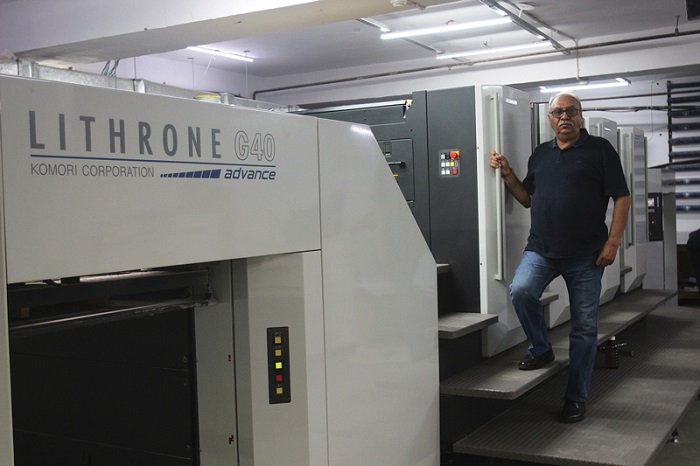
Advantage Offset has installed its fifth Komori at its 13,000 square-foot factory in Delhi’s Naraina Industrial Area. The latest addition, a Komori GL40 Advance 28 x 40-inch 4-color offset press – its fourth after the Covid-19 pandemic – was installed in December 2025.
The commercial printer got its first new Komori Lithrone LA 37 in 2016. A Komori Enthrone 429 20×30-inch sheetfed offset press was installed in April 2022, followed by an Enthrone 429 press in December 2022. A Komori Lithrone G37, a 25×37-inch press, was acquired in November 2023.

Owner Ashwani Gulati has already booked his next purchase – a Komori GL37 4-color press, scheduled to arrive by August 2026. The GL37 is a replacement for the first Komori Lithrone LA 37.
Komori machines are fast and affordable, Gulati said, adding the GL40 Advance has a bigger size of 28 x 40 inches and can print on SBS paperboard up to 800 gsm in thickness. Before the GL40 came, he had to turn down orders requiring printing on over 300 gsm thick SBS paperboard as his previous machines were not equipped to handle this paper thickness.
Gulati acquired a Dominant in 2001 and refurbished Heidelberg machines for years before becoming a Komori customer in 2016. Older refurbished machines have a short lifespan and need to be upgraded with newer ones to increase production, he told Indian Printer & Publisher. “Brand new machines, on the other hand, provide fast production along with faster make-readies and no breakdowns.”
Advantage Offset prints a range of magazines, journals, brochures, catalogs, diaries, calendars, posters as well as books for Delhi-NCR, J&K, and Hyderabad-based publishers. The printer has onboarded Delhi-based academic publishers as clients since our last visit in April 2024. The list includes MBD Books, Competition Success Review, SPD Books, and Wisdom Publications.
Apart from CSR, Gulati prints 12 magazines, including the bi-monthly aviation and defense magazines Vayu Aerospace and Defence Review; Cross Section Media’s Destination India magazine; XBHP Motorcycling bimonthly magazine, and Pracheen Mantra, Hindi monthly. Last year, the Chinese Embassy discontinued its China India Review, which had been printed at Advantage Offset for a long time.
Advantage Offset has a binding and finishing setup with a Heidelberg Polar cutting machine, two Heidelberg Stahl folding machines, a perfect binding machine from Bindwel, a locally made section sewing machine and an imported Aster sewing machine, along with a laminator. It added a Technova CtP in 2021 to replace its previous FFEI Fuji CtP.
The latest ancillary additions include a Bindwel 6-clamp perfect binding machine, a refurbished flow line for pin binding from Muller Martini, and a 40-inch 5-fold Heidelberg folding machine for faster production. Gulati plans to get a refurbished Aster sewing machine in a few weeks.
Impact of GST slabs & US-Israel war on Iran
During our last visit, Gulati talked about the volatility in the paper market due to the Russia-Ukraine war and later the Gaza crisis, which had resulted in reduced margins and higher competition. This time, he talked about the new GST slabs introduced by the government in September 2025.
According to the new slabs, 18% GST is levied on printing inputs such as paper, while a 5% GST is levied on the final printed and/or packaged product(s).
“The new GST slabs have affected the smaller printers, who are left with no other option than to absorb the higher input costs and increase the price of the final printed products. Some publishers we work with are operating on 0% profit,” he said.
On the Gulf war fallout, he said he ran only a third of his production in March and April as customers either put their jobs on hold or canceled them. According to Gulati, a financial year can be divided into three printing periods. May, June and July comprise the lean period when there is little to no academic printing and diary or calendar work.
September to March is the peak season with academic orders, diary and calendar work as well as festive orders pouring in. The peak season is interspersed with short breaks during the festive season of Durga Puja, Diwali and Chhath Puja, when workers are on leave, Gulati explained.
April and August have average production, he said, adding a printer needs to maximize the peak time to meet year-long expenses.
The US-Israel war on Iran, he said, has resulted in a spike in the price of consumables and a shortage of raw material. “There has been a 25% increase in the cost of aluminum plates, another 25% price hike in the cost of ink, and a 100% increase in the cost of chemicals. Overall, there has been a 25-30% cost increase in the printing industry. We are struggling to survive,” he said.
Gulati said his son Pranav has agreed to join the business if he opens a unit in Noida. He is looking for supporting hands and supervisors for this venture.