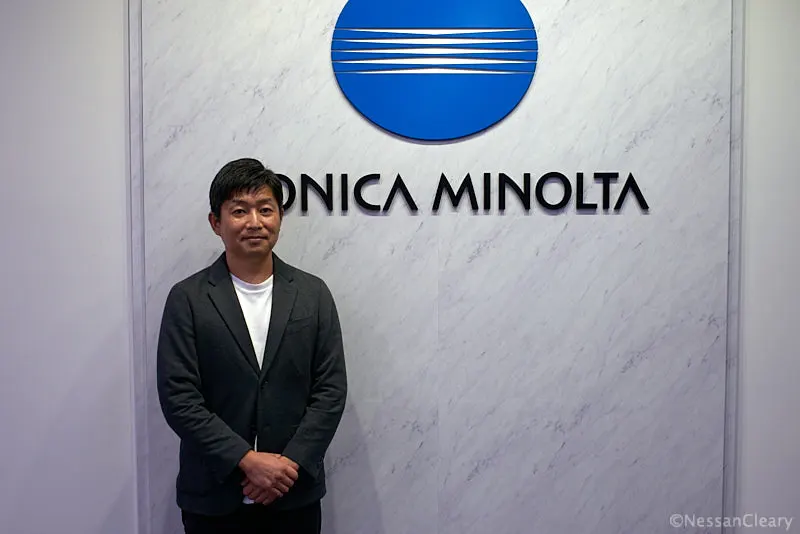
Towards the end of last year, I met Hiroki Inada, general manager of Konica Minolta’s textile business division, and we discussed how he saw some aspects of the inkjet textile printing sector from Konica Minolta’s perspective.
Inada started off by saying that Konica Minolta has enjoyed a good profit in the textile industry over the last three to four years, having undertaken some restructuring in 2019 and 2020 to reduce fixed costs and focus on profitability. This involved cutting R&D costs, but he pointed out, “We have our own technology – the ink and the printhead – so I believe we can develop new products to differentiate against the Chinese vendors.”

And Konica Minolta does have an edge in the form of an inline pretreatment system that can be used with reactive ink. Inada explains, “The inline pretreatment is an alkaline ink. Our head is strong for the chemical resistance. If you put this ink in another head, then it would be easily damaged.” That chemical resistance stems from an earlier push that Konica Minolta made into printing solar panels, where some of the fluids used have a very strong alkaline content. It also helps that the Konica Minolta heads have a strong jetting velocity that allows for a wider-than-average gap between the nozzles and the substrate.
To exploit this advantage, Inada explains that he is concentrating on thicker materials such as towelling, “The thick fabrics need more chemicals in this pretreatment, and it’s very hard to dry and uses a lot of energy, so we think it’s very reasonable to use this inline pretreatment on a thick fabric.”
The main advantage of moving the pretreatment into the printer is that it allows customers to buy untreated materials, which are much cheaper. He adds, “And then we jet the pretreatment by inkjet. Our printer has nine channels for eight colours and one inline pretreatment. So we can print the pretreatment together with the colours. But this works wet-on-wet, so it means there is some breathing [dot gain].”
He continues, “And that technology is very sustainable. So the customer can reduce the number of stocks of pretreated fabrics. And reduce the loss of fabric due to the colour changing.” He adds, “We focus on the fashion market where we can make a profit because of the inline pretreatment.”
This inline pretreatment is suitable for use with canvas and some knitted fabrics. However, Konica Minolta does not generally target home furnishing, which accounts for nearly 50% of the overall digital textile printing market, because the company does not currently offer a wide enough printer to really appeal to the majority of users in that market.
Pigment ink
One of the issues that has limited the adoption of digital print in the textile market is the post-processing, which relies on several washing, steaming, and ironing steps to fully cure the ink and ensure its washfastness. This consumes a great deal of water and energy, which adds cost and is bad for the environment. For this reason, many analysts believe that the printed textile market will eventually adopt pigment ink, which doesn’t have the same post-processing requirements.
But for now, the market is still dominated by reactive ink. Inada puts reactive ink at more than 80% of the market overall, but says that it accounts for 90% of Konica Minolta’s sales, with the rest being disperse, acid and pigment ink. He says that although pigment ink technology is more sustainable, it’s not yet accepted by the market.
Some of this is down to pricing, with pigment ink typically costing double the price of reactive ink per liter. But as he explains, “It’s not just price. There is still a gap in quality, especially hand feel. Most vendors do not like to take a risk on the quality and the colour fastness.”
He points out that existing textile print producers already have the washing and steaming machines, so there is little incentive for them to invest in pigment ink printing, as they will lose the depreciation value on this existing post-print equipment. Consequently, most printer vendors mainly focus their efforts around pigment print solutions for new market entrants.
In this regard, Inada says, “We are opening up new customers by using the pigment solution but the market is only changing gradually. So the volume is not changing much. And many ink manufacturers offer pigment so the demand is very low, but there are many suppliers. So a price war is coming to the market, especially with Chinese ink manufacturers offering very cheap pigment ink prices of less than $9 or $10 per litre. So the pigment ink will become less profitable.”
Naturally, I also asked Inada about the market for single-pass inkjet textile printers. Konica Minolta was one of the first vendors to develop its own single-pass inkjet textile printer with the Nassenger SP1, following the lead established by SPG Prints. A number of other vendors also piled in, but the market quickly reached saturation with users struggling to find consistent volumes of work to justify the cost of these printers. In Inada’s opinion, of those established vendors, only Konica Minolta and EFI are still seriously trying to sell their single-pass printers.
However, a number of Chinese vendors have recently turned to single-pass textile printers, mainly in an effort to differentiate themselves from each other, which has led to severe price competition. But Inada points out that some single-pass printers can struggle with solid colrs, and with fine lines.
Konica Minolta has around 15 SP1 presses installed, with Inada noting, “Our printer has an advantage in stable and long printing. So once a customer uses our printer, they realise its value.” He adds, “We have very good support staff with much experience, so I think the customer can understand the value of our service. If there’s a stop to the machine with a single pass, then the customer loses a lot of opportunity for the business.”
And he says that the market for single pass is still growing, noting: “Recently it’s very hard to install new analog printers in China because of government and other regulations, so they are trying to replace analog with digital printing, which means more single pass.” He says that overall demand is increasing in Asia for single pass: “Lower initial investment costs and lower consumables costs, so the customer has changed their mind with single pass, and they are starting to think about purchasing single pass. Once the customer purchases the single-pass printer, then they can get a lower price of ink because the ink consumption will be greater.”
And as he points out, since it’s mainly the larger customers that can buy a single-pass press, the demand for multi-pass printers is also still growing alongside this.
However, Inada says that in general the textile printer market is subject to trends in fashion, as well as the prevailing economic conditions, “When the economy is going well, the fashionable printed items are in demand, but due to the US tariffs impact and the challenging economy, it reduces the printed volume.”
Inada says that some markets are better than others, with growth in India, Pakistan, and Indonesia. But he also notes that economic conditions in China are leading many Chinese printer vendors to shift their attention to overseas markets, leading to significant price competition, particularly in the Indian market, both for hardware and ink.
The main European market for printed textiles is Italy, but Konica Minolta is also active in France, Spain, Portugal and Turkey, with just one customer in the UK. Inada says that the main issue for European printing companies is to try to reduce the lead time as much as possible, noting, “Some customers try to reduce the lead time of the sampling by using digital technology and by using software design tools.”
He continues, “We are finding difficulty in the European market and Turkey. The EU announced that it will start the new regulations on unsold apparel products, so the vendors need to collect the unsold products. So all the apparel vendors, especially fast fashion, will reduce their orders for printed items drastically in 2025. They need to reduce the stock as much as possible. So they are gradually shifting to non-printed items with solid colour items dyed because printed items have a higher risk of being unsold because of the change in trends.”
However, he adds, “We think that in the long term this will help the digitization of the textile printing market.”