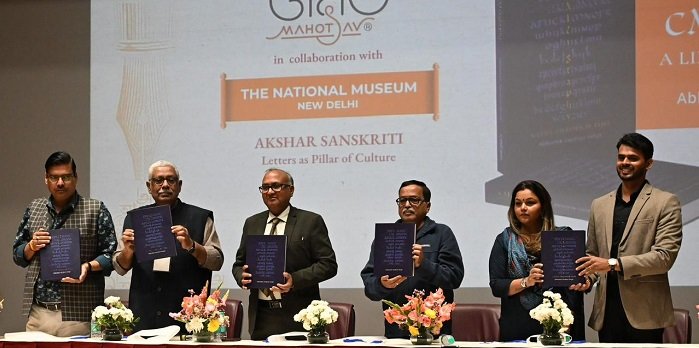
The National Museum, Delhi, in partnership with The Calligraphy Foundation, recently hosted the launch of Calligraphy: A Line Through Time, written by Abhishek Vardhan Singh, executive director of The Calligraphy Foundation. The book was released on 16 August 2025 during Akshar Mahotsav and is described as one of India’s first comprehensive academic volumes devoted to calligraphy as an art form, a historical study, and a pedagogical discipline.
The volume was unveiled by an eminent panel that included Ramesh Chandra Gaur, dean (administration), IGNCA; Manish Arora, head of the department of applied arts, Faculty of Visual Arts, Banaras Hindu University; G V Sreekumar, senior faculty, IDC, IIT Bombay; Padma Shri awardee and master calligrapher Achyut Palav; and Raghunatha Gupta, managing director, The Calligraphy Foundation, along with the author, Abhishek Vardhan Singh.
The event underscored the rising demand for structured academic material on Indian scripts as well as global calligraphic traditions.
Gaur described the publication as a carefully assembled and timely addition to both the cultural and academic landscape. He commended the effort to present the history of calligraphy in a manner that is clear and aesthetically engaging, noting how effectively form, material, and evolution have been woven together. He stressed the need to broaden scholarly engagement with both global and Indian calligraphy so that institutions and learners gain a more comprehensive understanding of writing systems.
To support this research, The Calligraphy Foundation sourced and compiled more than 100 books, with many acquired from outside India, Gaur said. He observed that while this volume largely focuses on Western traditions, a similarly structured academic study dedicated to Indian calligraphy is equally necessary. “You can see Achyut Palav’s books in many universities. When we visited libraries, we found there are very few books on calligraphy available in India. This book is well-written, well-designed, well-planned, well-executed and well-printed. It is rooted in the belief of Gyanam Paramam Dhyeyam (Knowledge is supreme and it doesn’t die),” he said.
Manish Arora noted that the book has the capacity to bring long-awaited pedagogical and technical clarity to the calligraphy community. He pointed out that its structured format, historical foundation, and systematic explanation of tools, forms, and techniques could reshape how students of applied arts and design approach calligraphy within academic institutions. “Abhishek has structured the book in a way that even a common man can understand some part of the history of calligraphy and its present challenges and issues. I am confident this book will find a place in every institution,” he said.
Sreekumar remarked that the publication addresses a longstanding gap in design education. In his view, the book is set to become a dependable reference for understanding letterforms, structural principles, and the evolution of writing systems, making it valuable for students, researchers, and practitioners alike. “We must integrate the Indian knowledge system with modern science, and the same principle applies to calligraphy,” he added.
Achyut Palav expressed strong appreciation for the scope and lucidity of the work. After reviewing the book, he said he felt little need to consult multiple other references, acknowledging the comprehensive manner in which the author has brought together form, technique, history, and cultural context.
Speaking about the book, Abhishek Vardhan Singh reflected on the years of study involving manuscripts, inscriptions, and classroom teaching that informed its development. The publication seeks to reposition calligraphy as a discipline that connects history, design, and cultural memory. It also aims to ensure that India’s script traditions remain relevant within academic frameworks and contemporary creative practice.
Singh dedicated the volume to his father, who mentored him in the art of writing. Calligraphy: A Line Through Time traces a 3,000-year narrative of calligraphic practice. He said The Calligraphy Foundation is now a registered institutional publisher and plans to release 24 handbooks. The foundation, he noted, has received significant support from various organizations through workshops, exhibitions, panel discussions, and book launches.
Calligraphy: A Line Through Time presents historical study, visual documentation, and a structured teaching framework. By charting the evolution of writing from early mark-making to present-day practice, the book seeks to reintroduce scripts as living cultural carriers and encourage institutions to reinforce calligraphy-focused learning within their curricula. “Indian design education has lagged in terms of well-written books rooted in the Indian context. Even today, if you count the number of design books written in the Indian context, it is fewer than 25,” he pointed out.
The book is divided into five sections, beginning with an overview of writing tools, followed by an in-depth exploration of calligraphy, institutional research on the subject, a 3,000-year history of the craft, and finally, its contemporary dimensions.