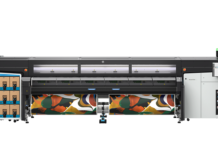
Epson has adopted a comprehensive approach to sustainable textile printing across both industrial-scale and on-demand applications. At the industrial level, Epson’s Monna Lisa series of digital textile printers leverages advanced digital inkjet printing technology to significantly reduce water consumption, chemical usage, and waste compared to conventional analog textile processes.
Epson launched the Monna Lisa ML-18000 — the latest innovation in its flagship series of high-performance digital textile printers in June 2025. The company says it is designed to deliver high-end performance for high-volume production, and offers exceptional print speed, enhanced color depth, and sustainable performance, making it a powerful solution for the evolving needs of the textile and fashion printing industries.

It is ideal for producing high-quality prints on a variety of fabrics, including silk, cotton, polyester, and blends. Its versatility makes it suitable for diverse markets, including haute couture, fast fashion, home textiles, and sportswear. The ML-18000 integrates Epson’s advanced Precision Dot Technologies, including microweave and lookup table technologies that reduce banding and graininess. It’s a multi-layer halftone technology that randomizes halftone dot patterns to reduce visual artifacts and ensure smoother gradations.
Additional features such as symmetrical color alignment, accurate belt position control, and Epson Edge Print PRO X are genuine Epson RIP software, which supports Adobe PDF Print Engine (APPE) – the industry’s leading technology with 16-bit rendering, guaranteed high-speed and high-quality outputs with exceptional detail, clarity, and accuracy—crucial for complex designs and fine patterns.
The printer is supported by Epson Cloud Solution PORT, enabling users to monitor printer performance remotely from a PC or mobile device, helping to maximize productivity. This real-time visibility enhances workflow productivity and enables Epson’s service teams to diagnose issues remotely, ensuring faster resolution and minimal disruption.

“Epson’s DTG and DTF technologies have seen rapid adoption across India, serving distinct but complementary needs within the textile printing ecosystem, ”Satyajeet Satpathy, director – sales and marketing, Epson India, said. “At the industrial end, digital textile solutions such as Epson’s Monna Lisa printers are increasingly being adopted by large textile manufacturers for high-quality, consistent, and scalable production. These solutions enable short to medium run printing with precise color control, reduced setup time, and significantly lower water and chemical usage.”
“On the on-demand side, Epson DTF printers have gained strong traction among small and midscale businesses, startups, and custom apparel brands. DTF enables easy setup, flexibility across a wide range of fabrics, and print-on-demand production. By allowing businesses to print only what is required, it helps reduce fabric waste, excess inventory, and overproduction, while supporting customization, localized designs, and shorter fashion cycles,” he adds.
Together, Epson’s DTG and DTF printers aim to reshape the Indian textile printing industry by enabling more agile, efficient, and sustainable production models.