Capturing the attention of busy passers-by is very much easier said than done in today’s fast-paced world. Rob Fletcher looks at how brands, retailers, and marketers are pushing the boundaries of digital signage by being innovative with interactivity.
It is probably safe to say that digital signage already does an effective job in drawing the eyes of passers-by. After all, it is hard to miss the bright lights of digital signage. Be it the shining screens of Piccadilly Circus or the iconic backdrop of Times Square in New York, digital signs are very much a mainstay in the modern world.

However, the reality for marketers using digital signs is that they need to keep evolving this technology to stand out to consumers, who, more often than not, are distracted by their mobile phones. So, how do you evolve something that already delivers so much? One way is interaction.
In its simplest form, this could be a case of featuring a QR code on the digital sign that the consumer can scan on their mobile device and access additional content such as websites, social media pages, or videos. This technology can form the basis of all manner of interactive campaigns that still very much focus on the digital signage aspect but connect more with consumers and offer them a greater experience.
Here, we look at some recent examples of interactive digital signage in action, setting out how specialists in this area can use these as inspiration and come up with new and exciting ideas to present to their clients.
Eat fresh!
Subway partnered with Ocean Outdoor and its DeepScreen technology to run a highly interactive and innovative campaign in London.
Starting strongly, out-of-home media specialist Ocean Outdoor linked up with sandwich shop chain Subway on a clever project that captured the attention, and praise, of thousands of consumers.
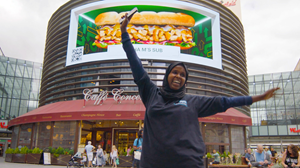
The premise of the campaign was to allow passers-by to create their favorite sandwich using their mobile phone, with a giant version of their sandwich, complete with a list of fillings, appearing on a giant screen at Westfield Stratford City in London. So, how did Ocean Outdoor and Subway go about this?
Referring back to simple QR codes, consumers could scan a digital QR code featured on the sign to unlock the creation page on their phone. They could then create a sandwich in their own time and wait for it to appear on the giant screen above them.
What perhaps made this project that little bit more special was it was the first interactive billboard of its kind to feature Ocean Outdoor’s DeepScreen, which uses the tried-and-test technique called ‘anamorphosis’ or ‘forced perspective’. This mathematically wraps imagery so that, when viewed from a specific vantage point, the illusion of 3D depth is created on flat surfaces.
Add in that Subway ambassadors, hidden within the crowd, then surprised and delighted the public by delivering their personalized Subway sandwich, and you have an excellent example of innovation with interaction.
“This is a first in marketing, trying to find new ways to reach Subway fans and give them a chance to enjoy their Sub just the way they want,” said Angie Gosal, head of marketing for Subway UK and Ireland. Subway always puts customers first and this campaign is another example of this.”
Dom Goldman, chief creative officer from Above+Beyond, the agency that managed the project, also spoke about the importance of making use of new technologies to connect with consumers.
“Embracing new technologies and pioneering ways to interact with audiences is always exciting,” Goldman said. “We’ve seen many great 3D billboards but creating a fully interactive screen with fulfillment baked in is a first.”
Free chocolate anyone?
Scanning QR codes on digital screens allowed consumers to send free Cadbury chocolate to friends and family.
Another campaign that utilized QR codes but pushed this to new levels came at Christmas 2022. Confectionary giant Cadbury invited consumers to scan a QR code on digital screens in locations across the UK, with this taking them to another page where they could nominate someone to receive free chocolate.

Around 120,00 chocolate bars were released gradually every day of the activation, which ran in the weeks leading up to Christmas Eve. People were able to choose from a range of famous Cadbury products including the original Dairy Milk bar, Oreo, Caramel, Fruit and Nut, and Plant bars.
The premise of the project is, again, simple, but highly effective, and one that will live long in the memory of both the consumer who scanned the code and the lucky recipient of the chocolate bar. Scannable QR codes can be used for so much more than simply giving the consumer more information; as this example shows, it can create an effective experience.
“We were thrilled to be celebrating another year of selfless festive giving with Cadbury Secret Santa,” Emma Paxton, senior brand manager for Cadbury Christmas, said. “It was so exciting that more people than ever before were able to become Secret Santas by sending a small gift of chocolate secretly to someone special.”
Interacting with LGBT-QR Codes
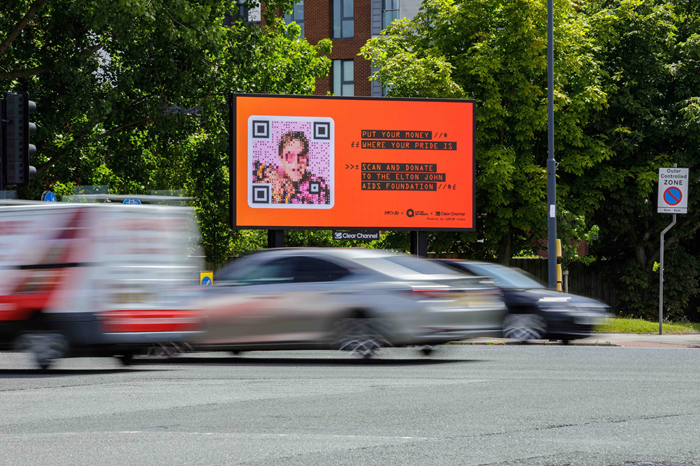
An iconic image of Sir Elton John was transformed into an LGBT-QR Code to encourage consumers to donate to charity using their mobile phones.
While sending out free chocolate is one thing, donating to charity is something else. Clear Channel partnered with Oglivy UK the Elton John AIDS Foundation to turn its digital screens in the UK and Europe into charitable donation points.
Once again, a simple idea that puts a spin on classic QR codes, these iconic black and white images were transformed into ‘LGBT-QR Codes’ for the purpose of the project. An iconic image of Sir Elton John was transformed into an LGBT-QR Code, a new fundraising mechanic that turns functional monochrome QR codes into recognizable design icons.
These digital images appeared in European cities and at Pride marches throughout the summer of 2022, with each LGBT-QR Code taking users to a donation page for the charity.
Jason Jarvis, creative agency account director, and LGBTQ+ Crew lead for Clear Channel UK, says digital out-of-home (DooH) was the ideal choice for a project of this magnitude.
“As a one-to-many medium, OOH is the perfect platform to deliver campaigns that inspire, educate, and support the audiences we serve and represent,” Jarvis said.
Matt Waksman, strategic partner at Ogilvy UK, agreed. He explained: “While the pandemic normalized QR codes, we saw an opportunity to use creativity to transform a traditionally functional format into a new fundraising platform.”
In all fairness, there is so much innovation in this area that we could easily go on and on with examples of interactivity in digital signage. QR codes are clearly a good way to go if you want a simple, yet effective, way of reaching consumers.
However, perhaps the key to a really successful campaign is evolving and putting a spin on older technology to come up with an innovative way of connecting with passers-by.
This article was written by Rob Fletcher for FESPA, a federation of member trade associations in speciality printing. FESPA organizes leading exhibitions and conferences for this community. These exhibitions generate profits which are reinvested for the benefit of the global print community.
(Republished with permission)