Indian printed newspapers, which have mostly thought that they are immune to an overall decline in circulation and readership, are increasingly showing cracks as they confront the need to come up with new ideas. The discussions on AI, audience behavior, advertising, and production have become routine. Publishers may talk about creating value and coming closer to their audiences, but they do not seem to have any real answers, except cutting costs.
They are discussing AI because it is an unavoidable distraction from the real work of producing credible information. They are not discussing that they are, in the main, merely echoing political propaganda and relying on government advertising, election advertising, and that of other institutions and public sector organizations.

In an environment of too many similar publications, it is clear that except where local and regional dailies can impact particular reader demographics, advertisers will almost always opt for the near-monopoly publications in any market. In recent months, even the larger papers have suffered lower ad revenues, and the overall combined circulations of Indian newspapers are at an all-time low – probably less than half of what they were at their peak of above 125 million copies daily. Estimates by experts with their ears close to the ground indicate that the combined circulation of Indian dailies may be in the region of 50 to 60 million copies, currently.
The lack of credibility of the print news media was hinted at in the opening keynote at the Wan-Ifra Indian Printers Summit by Ashwin Padmanabhan, COO, WPP Media (formerly GroupM) South Asia, who spoke about the changing news landscape and what it means for publishers. “Information may be abundant, but confidence in what is real, sourced and accountable is becoming increasingly important,” he said. “The future of news publishing is not just about creating more content, but it’s about creating more value for the audience it serves,” he said.
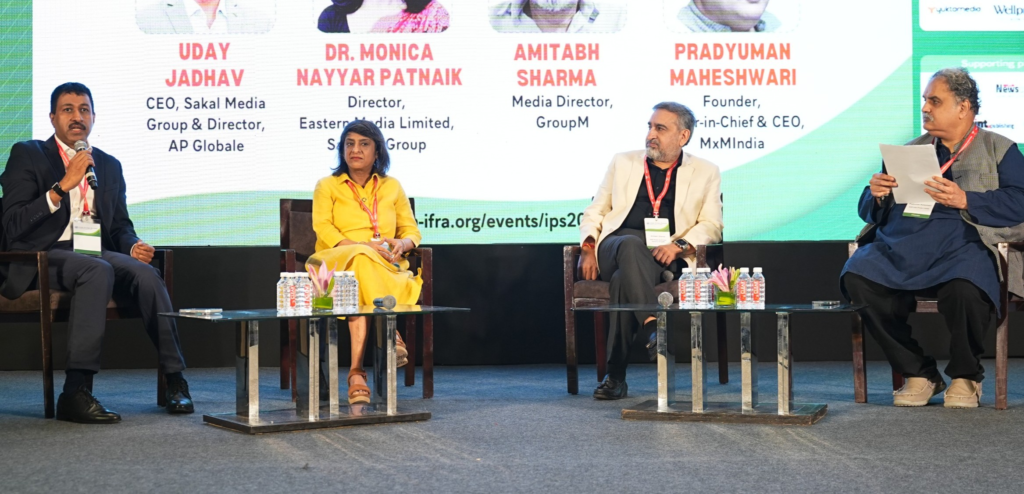
Senior leaders and CEOs discussed how publishers can better understand and monetize their audiences, which is a perennial topic but with no real insights or demonstrable action by the industry in any novel or creative way. Nevertheless, individual newspapers with self-belief keep trying to improve their products within their self-imposed constraints. In Pune, Devika Shreyamskumar, director of operations at Mathrubhumi, suggested audience segmentation by interests rather than traditional demographics.
Ashok Sharma, head of revenue, business strategy and planning at Amar Ujala, said that advertisers increasingly want solutions tied to relevance, action and measurable ROI, which is a familiar theme, but cannot be realized without serious industry-wide investment in research.
Increasing circulation revenues was also a topic of interest at the annual event. Uday Jadhav, CEO of Sakal Media Group and director of AP Global, pointed to the need to reduce publishers’ dependence on advertising. “Today, 70 to 80% of revenue comes from advertising, while only 20% comes from subscription and circulation. We need to flip this revenue model so that 70 to 80% of our revenue comes from subscriptions,” he said.
The newspaper production stream
On the production side of the conference, Debarshi Ray, technical director of The Times of India Group, discussed AI and Industry 5.0. “Industry 4.0 has generated an abundance of machine data. The challenge now is turning that data into decisions. AI can help identify patterns and support those decisions, but successful implementation requires robust processes and clean, usable data before automation is introduced,” he said.
There were other interesting technical presentations, such as the one by one of PPI media’s European customers, who spoke about automated page layouts using the cloud. This solution implies reducing Adobe InDesign licences and overall productivity and cost reduction.
Manroland Goss web systems spoke about the strengthening of its global operations by intensifying its engineering solutions and diversifying into the manufacture of web offset-based commercial, book and packaging presses, and finishing systems for high-speed webfed digital book presses. While the presentation mentioned its recent commissioning of new newspaper presses in South Korea, much of the company’s work is now engineering-oriented: refurbishing, installation, and relocation of web offset presses.
The company, which still has fully owned subsidiaries in many countries, including China and India with about a thousand personnel, recently installed a large used press in Eastern India and refurbished the double-width K&B Colora at Deccan Herald’s Bengaluru plant. Several global projects span similar work, such as relocations of presses in Australia and Africa.
Manroland Goss web systems has turned the maintenance and refurbishment opportunity into a structured offering that includes several automated press monitoring and maintenance technologies as well as the reengineering and replacement of electronics. The presentation in Pune highlighted a structured approach to extending the lifecycle of these newspaper production assets. This is especially important at a time when many of the large Indian newspaper double-width presses from as many as five manufacturers are nearing end-of-life, in terms of automation and electronics, as well as mechanical wear and tear over the past 35 years.
The Japanese and Indian joint venture Katsura Roller India participated in Wan-Ifra for the first time as it has expanded its operations from producing rubber rollers for offset sheetfed presses to web offset presses. While the company can now produce double-width newspaper press rollers at its Faridabad plant, it attempted to understand these requirements from the major news publishers, who still largely import these.
The company has already started supplying its quality web offset rubber rollers to one of the leading Indian newspapers, and is hopeful of gaining traction in the very large footprint of Indian single-width newspaper and book web offset presses. At the same time, it has equipped itself to produce rollers as wide as 3 meters.
Katsura Rollers India plans to serve the needs of maintaining quality production on web offset presses and their refurbishment, since many newspapers are moving press units and machines to optimize production at a time when they are reluctant to invest in new machines. In addition, for large publishers that have to import double-width rollers, the company hopes that by meeting the quality standards that are required, it can help bring down the supply chain and transport costs for rubber rollers. Providing that the quality standards and wear life meet the requirements, it will be possible to reduce the large inventories of imported rollers that are currently necessary.