Newsrooms are going full-on sci-fi. Artificial intelligence (AI) is sifting through millions of records, translating stories, editing videos, and even anchoring news, apart from selling ads. Sounds cool! Except the humans out there reporting can still get detained, beaten, or killed, press card or not. We’ve robots on the desk, but hardly any safety net for the real journalists on ground zero.
First, the tech side. In India, and around the world, journalism and newsrooms are being rebuilt around AI systems. In September, the Indian Express struck a multilingual partnership with OpenAI. The initiative brings reporting in seven languages, from English and Hindi to Malayalam and Gujarati, into ChatGPT with direct attribution.
Bennett Coleman, publisher of The Times of India and The Economic Times, signed a similar deal that allows ChatGPT to display excerpts and summaries, with attribution and links to the original articles.
More creatively, The Hindu used ChatGPT, Gemini and Claude for code generation and natural-language data queries, and to help parse some 22 million image-based voter records in search of deletion anomalies.
Across the world, scores of global news organizations have partnered with OpenAI and other AI companies for editing, video, images, layout, headlines, summarization, etc. Publishers say editorial independence stays intact, with reporting and verification under human control.
Television newsrooms has experimented with synthetic anchors reading the news in regional dialects. Collective Newsroom has even tested voice-masking tools to shield reporters working in dangerous places.
Audiences are shifting alongside. The Reuters Institute’s 2026 report finds that one in 10 people globally, and 16% of those under 35, now use AI chatbots weekly to find news. The industry says AI is an efficiency engine, not a reporter. Interviews, on-the-ground investigation, and judgment remain human work.
Which brings us to the uncomfortable irony or even dichotomy. As journalism acquires its most sophisticated tool yet, the guarantee that a reporter will come home alive, unhurt, and free is eroding.
Attacks on journalists
UNESCO’s latest report is blunt. Since 2006, 1,641 journalists have been killed worldwide, roughly one every four days. In 2024 and 2025, 189 were killed, 20% more than in the previous two years.
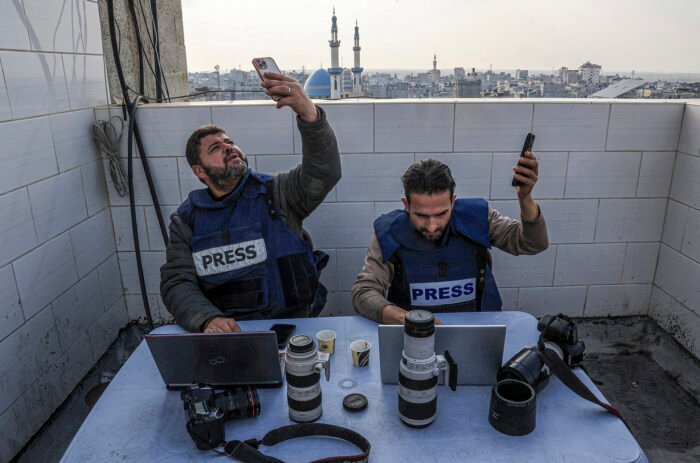
Six of every seven killings went unpunished, and global impunity rose to 86%, the first increase since UNESCO began measuring it in 2012. Drones killed 50 journalists in conflict zones, and 15 died wearing press vests or in vehicles marked ‘press.’
Reuters’ visual journalist Issam Abdallah was killed in Lebanon on 13 October 2023 by Israeli fire. On the third anniversary of his killing, editor-in-chief Alessandra Galloni said the only update from the Israeli military states the incident is “still under review.” Reuters also has unanswered questions about the death of Hussam al-Masri at Nasser Hospital in Gaza in 2025. And these are just two examples.
According to the Committee to Protect Journalists, at least 247 journalists and media workers have been killed across Gaza, Yemen, Lebanon, Israel and Iran since the Israel-Gaza war began on 7 October 2023 and the US-Israel war against Iran on 28 February 2026.
India cannot treat this as someone else’s story. Apart from its alleged complicity in what media and political experts term as Israel’s genocide in Gaza, as an arms supplier, India ranked 157th out of 180 countries in the 2026 World Press Freedom Index released by journalism watchdog Reporters Without Borders (RSF) on 30 April – down six places from 151 in the 2025 index.
More recently, there have been reports of several media professionals – both independent and mainstream journalists – being detained and manhandled while covering demonstrations against the revision of the electoral rolls, mostly in Delhi. Allegedly, the police ignored their press cards, claiming that some protesters had falsely posed as journalists.
The Press Club of India called it “a blatant attack on the freedom of the press.” The Supreme Court of India ruled in favor of letting journalists do their jobs, although some of the detentions came even after the court order.
Over the years, there have been numerous instances of journalists being targeted both by state and non-state actors in India. Who can forget the assassination of Gauri Lankesh? RSF reports that takedowns of journalistic content on social media have risen since early 2026 and a rule change gives platforms just three hours to remove content flagged by the government. India’s Digital Personal Data Protection (DPDP) Act, 2023, and the DPDP Rules, 2025, which threaten press freedom, has been challenged in the courts by journalists. Breaches of these can attract penalties of up to Rs 250 crore.
AI can help a newsroom scan millions of records, reach readers in their own language, and free reporters for harder work. But a machine cannot stand in a protest crowd or absorb a lathi blow. Only humans do that, and they need protection and freedom to do their work. A hi-tech newsroom is worth little if journalists remain unsafe.