IPP Services, Training and Research’s (www.ippstar.org) most recent review of the data of 47 Indian newspaper groups reveals an ongoing recovery from the huge downturn of the pandemic in Financial Year 2020-21. However, the combined revenue of our news industry cohort has not yet reached the peak achieved in FY 2018-19.
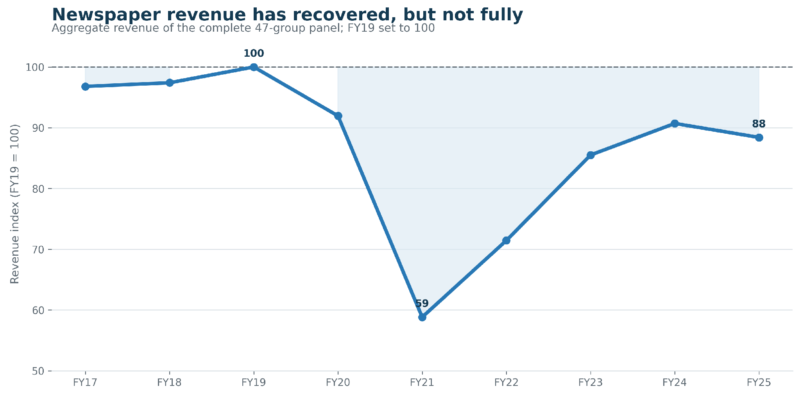
In FY 23-24, the recovery reached 90% of the previous high, but in the following year, FY2024-25 it fell to 88%. In the past five years, advertising returned although print lost ground to digital, circulation was at the price upward, and publishers rebuilt their businesses. However, the data reveals that most news publishers are still working with a smaller revenue base than before the pandemic.

IppStar’s analysis uses nine consecutive financial years for which the numbers were available for the 47 newspaper groups. Its analysis covers total revenue, operating revenue, material cost, employee cost, and profit or loss.
Stable, but flattening growth before the shock
In the years before the pandemic, the combined revenue of the 47 newspaper groups covered in this analysis was broadly stable. It increased slowly between FY17 and FY19, already an important warning: newspaper companies were not enjoying strong topline growth even before lockdowns disrupted circulation and advertising.
The downturn of FY20 became severe in FY21. At the lowest point, aggregate revenue was about 41% below the FY19 level. The fall was much larger than a normal business-cycle decline because printing, distribution, circulation sales, and advertising were all affected at the same time.
Recovery followed by moderation & consolidation
The first stages of recovery were strong, with aggregate revenue growing by about 21% in FY22 and 20% in FY23. Growth then slowed to 6% in FY24. In FY25, revenue declined by roughly 3%. The trend has therefore changed from rapid recovery to a much more difficult period of consolidation.
By FY25, the 47 newspaper groups had recovered most of the pandemic loss, but aggregate revenue was still 11.6% below FY19. Only 15 of the 47 groups had moved above their own FY19 revenue. Put differently, fewer than one in three groups had fully recovered their earlier revenue base.
What this means for the Indian newspapers
Indian news publishers in print, many of whom thought they were an exception to global trends, are currently almost unanimous that old circulation volumes will return. Editions and locations that were viable at the earlier revenue level may not produce the same return today. Capacity decisions must be tied to realistic demand, not only to installed capability or past circulation.
The more useful questions are practical. Which editions make a positive contribution after editorial, marketing, newsprint (and other consumables), printing and delivery costs? Which advertisers can be served across print, digital, events and other channels? Which plants or centers can absorb more useful work without increasing fixed costs? Which products earn reader revenue rather than depending almost entirely on advertising?
Optimistic public industry studies suggest that print media will remain a large and important market in India, but growth will be modest and more revenue will come from non-print activities. This does not make the newspaper organization irrelevant. It makes the productivity of every channel and plant more important.
The industry has moved from emergency recovery to selective growth. Publishers now need to protect the revenue they have rebuilt, improve the return from existing assets and invest where there is a clear customer or cost advantage. The next stage will be won less by simply printing more copies and more by earning more value from every reader, advertiser, edition and production hour.
Top ten groups are:
- Bennett Coleman and Company
- DB Corp
- Jagran Prakashan
- HT Media
- The Malayala Manorama Co.
- Hindustan Media Ventures
- Amar Ujala
- Rajasthan Patrika
- THG Publications
- Lokmat Media
(This is the first part of a 3-part series of IppStar’s 9-year review of 47 Indian newspaper groups.
Next: Cheaper & less newsprint lifts newspaper margins)
References
Crisil Ratings, 19 August 2026: non-print revenue and the print slowdown
Crisil Ratings, 25 July 2024: regional print growth and newsprint costs
EY India, 24 March 2026: FICCI-EY media and entertainment report
PwC India: India Entertainment and Media Outlook 2024-28
Press Registrar General of India: Press in India reports
IppStar’s own research from 2008 onwards