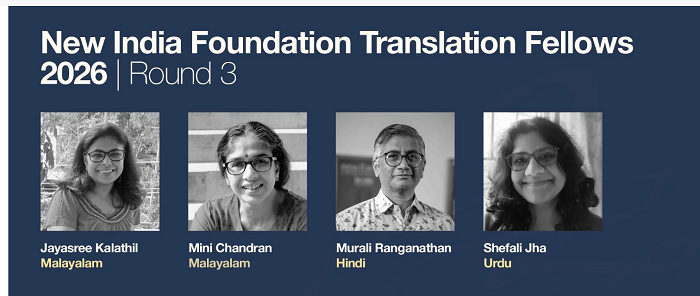
The New India Foundation (NIF) has announced the recipients of its third round of Translation Fellowships following a rigorous selection process. The 2026 Translation Fellows are Jayasree Kalathil and Mini Chandran in Malayalam; Murali Ranganathan in Hindi; and Shefali Jha in Urdu.
Jayasree Kalathil, an award-winning bilingual writer and translator, has received the Fellowship to translate Adimamakka (Children of the Enslaved), the autobiography of Adivasi land rights activist C.K. Janu. It is the history of the indigenous movement for land rights in Keralam. Janu unearths the history of the Adivasi people’s political struggle, missing from the records of Keralam’s much-lauded models of development.

The book contributes to an indigenous understanding of land, rights and politics. Kalathil serves as the managing editor of translated fiction at The Bombay Literary Magazine and a mentor on the ALTA Emerging Translators Mentorship Programme.
Mini Chandran, professor of English at IIT Kanpur, will translate Olivile Ormakal, the memoir of celebrated playwright Thoppil Bhasi – a prominent Malayalam playwright best known for the play Ningalenne Communistakki (You Made Me a Communist). The book spans a short five years – 1948 to 1953 –yet , it is one of the most celebrated autobiographies in Malayalam. It is a valuable addition to the archive of socio-historical texts that document the evolution of Indian states.
Murali Ranganathan, historian, writer and translator, has been awarded the Fellowship for his translation of Tibet Mein Savva Varshby Rahul Sankrityayan. Originally published in 1934, the book is an account of Sankrityayan’s travels in search of the Buddha from December 1928 to June 1930 which started and ended in Colombo. Traveling incognito through India, Nepal and Tibet at a time when foreign entry was restricted, he offers a ring-side view of the tensions between Nepal and Tibet on one hand, and Tibet and China on the other while also parsing the role of the then colonial, but soon to be independent, Indian government.
Shefali Jha, anthropologist and scholar will translate Ibrahim Hussain Jalis ‘Do Mulk, Ek Kahani, an important work of subjective journalism documenting the turbulent political landscape of postcolonial South Asia. The book chronicles key moments in the making of postcolonial South Asia from the vantage-point of a young Urdu writer and journalist. It is an unusual account of the last year of Hyderabad state (1947-48), where the Progressive writer Jalis (1923-1977) tells the story of his brief but intense participation in the politics and activities of the Ittehad-ul-Muslimin, as an anti-Nizam partisan of Hyderabad’s cause, and the eventual destruction of the state.
“This year’s fellows represent the exceptional depth of translation scholarship in India today. The works they have chosen span autobiography, memoir, travel writing and political journalism, and offer a distinct perspective on India’s intellectual and social history,” said Niraja Gopal Jayal, governing board member, New India Foundation.
The Fellowship awards a six-month grant of Rs 6 lakh seach to fellows to translate a non-fiction work originally written in one of ten Indian languages: Assamese, Bangla, Gujarati, Hindi, Kannada, Marathi, Malayalam, Odia, Tamil, and Urdu. The Jury for these fellowships this year included the NIF Trustees, alongside the Language Expert Committee in all 10 languages, comprising esteemed bilingual scholars, professors, and literary translators.
“Some of the most important books about India have been written in Indian languages, yet many remain inaccessible to wider audiences. Through the Translation Fellowship, we hope to support translators in bringing these remarkable works into English, allowing them to travel across regions and generations,”said Srinath Raghavan, governing board member, New India Foundation.
NIF initiated its Translation Fellowship in 2022 to democraticise knowledge and to bring important Indian language texts to a wider audience.
NIF runs three key programmes: the NIF Book Fellowship, a Translation Fellowship, and the Kamaladevi Chattopadhyay NIF Book Prize. NIF also collaborates with the Ashoka Centre for Translation for Bhashavaad, an annual translation conference.
The conference has also initiated a unique, searchable database of translations in India (bhashavaad.in), with 30,000+ entries and counting. Over the past two decades, the NIF Book Fellowship has supported nearly 40 high-quality nonfiction books that explore various aspects of post-1947 India.
These works range from political biographies and cultural histories to memoirs, each offering a distinctive interpretation of contemporary India. The New India Foundation is guided by an esteemed Board of Trustees, including political scientist Niraja Gopal Jayal, historian Srinath Raghavan, partner Trilegal Rahul Matthan, entrepreneur Manish Sabharwal, and Nandan Nilekani (Emeritus Governing Board Member).