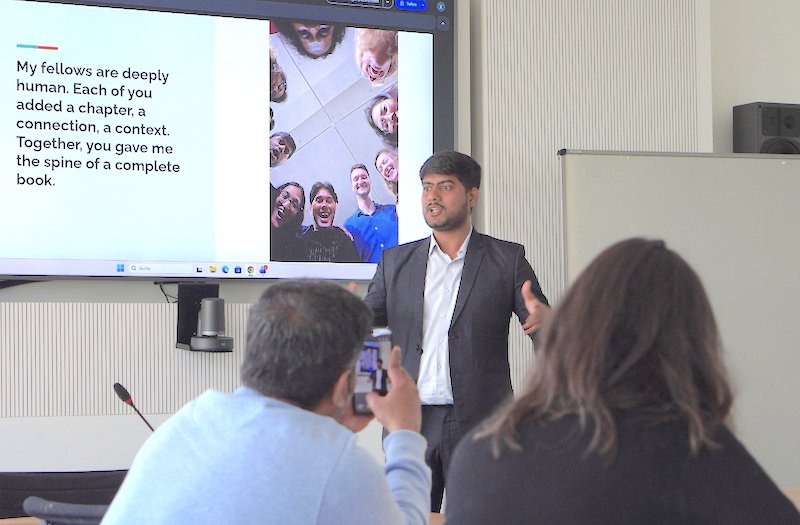
At Deutsche Welle’s headquarters in Bonn, Germany, I recently had the opportunity to present a project that occupied a large part of my professional life over the last year. The project was not about artificial intelligence, subscriptions, audience growth, or newsroom technology. It was about something far more fundamental: trust.
Over the past year, I worked alongside five Indian and six German journalists as part of the Journalism Connect fellowship program. Together, we explored a question that concerns newsrooms across the world: Why are audiences losing trust in media, and what can journalists do about it?

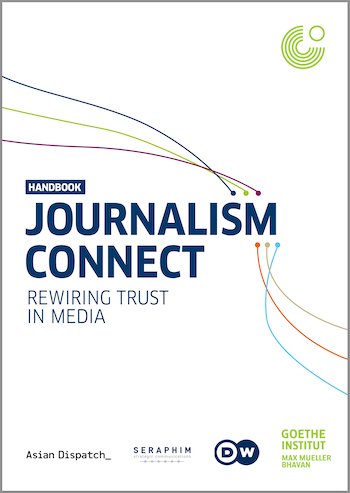
The result of that collaboration was a handbook titled Building Trust in Journalism: Insights and Practical Guidance from India and Germany. While working on the handbook, I realised that trust is often discussed as an abstract concept. We speak about it in conferences, newsroom meetings, and industry reports. We measure it through surveys and rankings. Yet for most readers, trust is not a number. Trust is a relationship. And like every relationship, it is built slowly and can be damaged quickly.
One of the most important lessons from the handbook is that audiences do not necessarily expect journalists to be perfect. They understand that mistakes happen. What they want is honesty, transparency, and accountability. When news organisations make mistakes and refuse to acknowledge them, trust declines. When they openly correct errors and explain their editorial decisions, trust grows.
This sounds simple, but many newsrooms still struggle with it. The handbook highlights several examples from both India and Germany where journalists are trying to rebuild trust by becoming more transparent about how journalism is produced. Instead of presenting news as a finished product, they are increasingly explaining the reporting process itself.
Who was interviewed? How was information verified? What remains unknown? Why was a particular editorial decision taken? These questions matter because audiences today are exposed to more information than ever before. They are not merely consuming news; they are evaluating it.
Another insight that stayed with me is the importance of listening. Traditionally, journalism has been organised around broadcasting information. Newsrooms produced content, and audiences consumed it.
That model is changing. Readers increasingly expect participation. They want opportunities to ask questions, challenge assumptions, contribute information, and engage in conversations. Trust cannot be built through one-way communication.
Many successful initiatives featured in the handbook demonstrate that audience engagement is not an optional activity sitting on the margins of journalism. It is becoming central to journalism itself. I was particularly fascinated by examples where journalists stepped outside the newsroom and met communities directly. Sometimes trust grows not through a brilliant investigation or a viral story, but through simple human interactions.
People trust people before they trust institutions. This may be one of the most overlooked lessons in modern journalism. The handbook also explores a difficult reality: trust is not distributed equally. Different communities experience media differently. Historical, cultural, political, and social contexts influence how journalism is perceived.
As a result, there is no universal formula for building trust. What works in Berlin may not work in Bihar. What succeeds in Mumbai may fail in Munich. However, one principle remains constant: audiences value journalism that demonstrates genuine public service.
Throughout the project, I found myself reflecting on my own newsroom experiences in India. Like many journalists, I entered the profession believing that producing accurate information was enough. Accuracy remains essential, but today it is only part of the equation. Audiences increasingly want to understand not just what we know, but how we know it. They want evidence, context, transparency, and authenticity.
In many ways, this represents a return to journalism’s original purpose. Before news became an industry, it was a public service rooted in relationships between journalists and communities. Technology has transformed how news is distributed, but it has not changed the human need for trust. If anything, the digital age has made trust more valuable than ever.
Presenting these ideas in Bonn was a memorable experience. But the most meaningful part was not standing on stage. It was the year-long collaboration with fellow journalists from India and Germany, each bringing different perspectives yet confronting remarkably similar challenges. The future of journalism will undoubtedly involve new technologies, new business models, and new platforms.
But after spending a year studying trust, I am convinced of one thing. The future of journalism will ultimately depend on something that cannot be automated, scaled through algorithms, or purchased through marketing budgets. It will depend on whether audiences believe that journalists are working in their interest.
Trust is not a metric. It is a relationship. And relationships must be earned every day.
Reproduced by permission of the author, Janardan Pandey.