At a recent INMA South Asia webinar, Puneet Kukreja, business head of The Economic Times Digital, explored how ET Digital is building deeper audience relationships through products and services that go beyond journalism while still using the trust factor as the foundation.
“The future of media is not about how many people read you. It’s about how many people can’t imagine their day without you,” Kukreja said during the session.

Kukreja explained how ET Digital began a major industry shift nearly two years before generative AI became a mainstream disruption. “We realised that most media are no longer indispensable,” Kukreja said.
According to him, the challenge was not merely about attracting readers for 15 to 20 minutes a day to consume news. Instead, ET Digital wanted to become more deeply embedded in the everyday decisions and anxieties of business professionals. That shift fundamentally changed the company’s approach to revenue.
Traditionally, publishers have depended on advertising and subscriptions driven largely by content consumption. However, Kukreja revealed that ET Digital’s fastest-growing revenue stream over the past year has come from “transactions” (products and services that readers actively pay for because they provide direct value).
“We don’t want to solve just one use case in a reader’s life. We want to create multiple reasons for people to come to ET,” he explained.
AI as an enabler, not a threat
While much of the publishing industry debated if AI threatens journalism, ET Digital has taken a more pragmatic approach. “We strongly believe AI is going to be an enabler,” Kukreja said.
Rather than using AI merely to summarize or rewrite content, ET Digital has focused on integrating AI across product creation, operations, workflows, audience understanding, and monetization.
Kukreja showed a brand video, which was conceptualised, scripted, and produced in just one day using AI tools.
More importantly, the organization encouraged internal teams to actively experiment with AI tools and workflows. “AI cannot be a side project. It needs to be integrated in all work,” he emphasised.
According to Kukreja, the cultural adoption of AI across teams has been one of the hardest organisational challenges during the transformation. “It is easy to start a new AI initiative. What is difficult is embedding AI into existing workflows with the same people doing the same work 10x faster,” he said.
Revenue growth despite declining traffic
One of the major insights was ET Digital’s claim that although its traffic has declined by nearly 35% over four years, overall revenue has doubled during the same period.
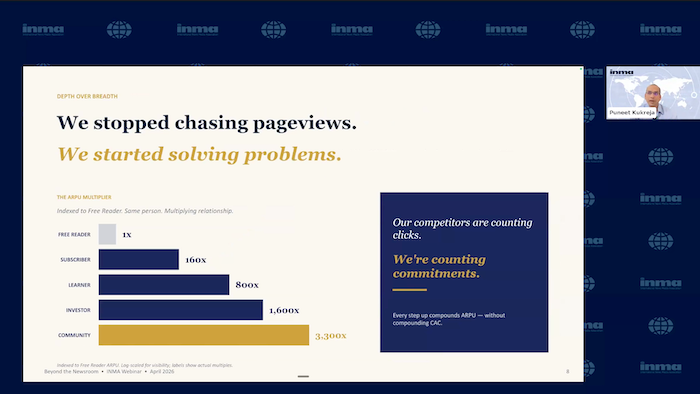
The company no longer considers monthly active users or page views as its primary performance metrics. Instead, ET Digital now focuses heavily on ARPU (average revenue per user).
Kukreja said advertising alone cannot sustain media businesses in the long term. “Reader revenue is going to contribute more than 60% of total revenue in the next couple of years for us,” he said.
He explained that traditional ad-led models often monetize vastly different readers at similar CPMs or RPMs. In contrast, ET’s new strategy attempts to identify high-value loyal users and serve them with products that create measurable utility.
During the Q&A session, several participants asked whether ET Digital’s strategy could work for smaller publishers or regional media brands.
Kukreja maintained that scale alone is not the starting point. Instead, he argued that publishers must first identify what their audiences already trust them for. “The first thing is trust. Without trust, nothing is going to happen,” he said.
He encouraged publishers to conduct deep audience understanding exercises, build small MVP-led products, and identify gaps where they can create better value than existing alternatives.
Importantly, he cautioned that such transformations are slow and iterative. “For us, it took five years. It is a slow process of iteration and learning,” he said.
As AI commoditises information and search-driven traffic becomes less reliable, publishers are increasingly realising that journalism alone may not be sufficient to build sustainable digital businesses. Instead, trusted media brands may need to evolve into platforms that solve deeper audience needs — whether through education, financial tools, communities, events, networking, or professional utility.