North America accounts for roughly one-third of the global softwood supply. On the surface, that scale suggests the region should play a central role in meeting future demand. But a closer look reveals a much more nuanced – and uneven – picture.
A latest market report, “Global Softwood Roundwood Supply Outlook”, examines how softwood supply across North America may evolve to 2035. The headline conclusion is straightforward: growth is expected, but it will be neither uniform nor unconstrained.

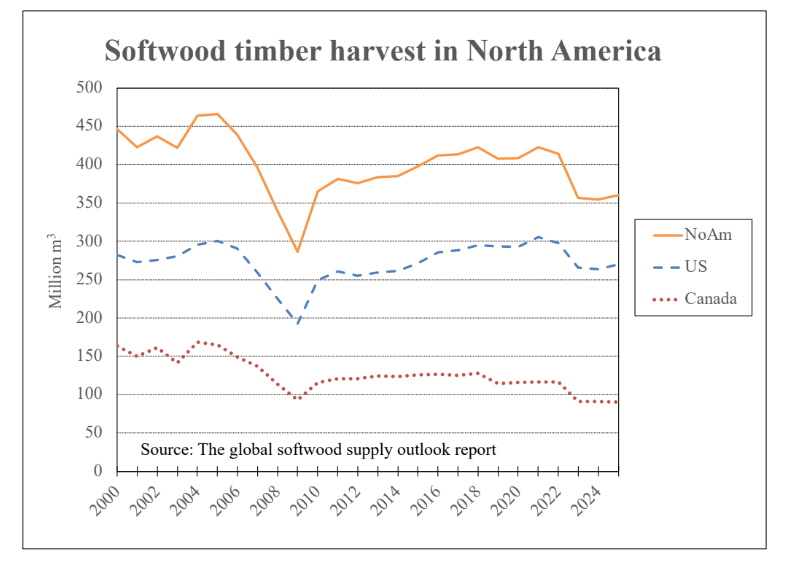
Over the past 25 years, softwood timber harvests in North America have fluctuated dramatically, ranging from a peak of 470 million cubic meters in 2005 to a low of 290 million cubic meters during the Great Recession in 2009. Over the past five years, roundwood supply has fallen by almost 15%, with the biggest decline in Canada.
The region’s supply base is concentrated in three distinct sub-regions – the US South, the US Northwest, and Canada – each with its own dynamics, cost structures, and structural limitations. Understanding these differences is critical for anyone assessing future wood availability, pricing, or investment opportunities on the continent.
The US South stands out as the most flexible and competitive supply region. It combines a large, privately owned forest resource with relatively low costs and a history of productivity gains. In recent years, harvest levels have remained well below biological growth, leading to a build-up of standing timber. This raises an obvious question: how much of this potential can realistically be mobilized?
The answer is not simply a matter of biology. While there is clear room to increase supply, doing so will depend on factors such as market demand, labor availability, infrastructure, and the processing industry’s capacity. Cost competitiveness in the region is also closely tied to forest owner returns, which have remained relatively weak for much of the past two decades.
Further north and west, the picture changes considerably. In the US Northwest, softwood supply has declined over time, shaped by a combination of environmental constraints, changing land use, and increased exposure to natural disturbances, mainly wildfires and insects. While the region remains an important source of high-quality sawlogs, future supply growth appears more limited.
Canada presents another distinct case. Despite vast forest resources, the availability of softwood roundwood has been on a downward trend for years, particularly in British Columbia. Reductions in allowable harvest levels, combined with rising costs and concerns over long-term industrial competitiveness, have reshaped the sector. While there are signs of potential stabilization, the outlook remains closely linked to policy, market access, and investment conditions.
Taken together, these regional dynamics suggest that North America’s contribution to future global supply growth will be meaningful – but not transformative on its own. Even under favorable assumptions, increasing supply will require productivity gains in some regions, stronger markets, and continued investment across the value chain.
For industry participants and investors, the key issue is not just how much wood is available, but where it is available, at what cost, and under what constraints. The full study explores these dynamics in depth, including regional supply projections, cost structures, and implications for future log prices.
This report is the first in a new series examining global softwood supply and pricing to 2035. It provides a detailed, data-driven assessment of North America. During May and June, two more reports will be available, covering Europe, Latin America, and Asia-Pacific.
The studies are conducted by Glen O’Kelly, O’Kelly Acumen (Stockholm, Sweden), and Håkan Ekström, Global Wood Trends (Seattle, USA).