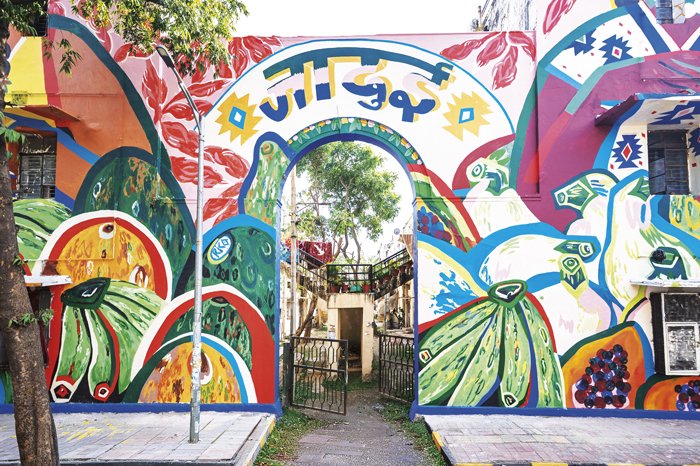
For the last ten years, Lodhi Colony in New Delhi has stood at the crossroads of everyday life and artistic expression, where walls, streets, and neighborhood rhythms have evolved into a living, open-air landscape. To mark a decade of India’s first public art district, the Lodhi Art Festival from 1–28 February 2026, the St+art India Foundation and Asian Paints, celebrated their sustained vision of public art that brings color, creativity, and engagement into the heart of everyday urban life.
Lodhi Colony is a central government housing colony designed by Walter Sykes George between 1941 and 1943. The Lodhi Art District sits between Khanna Market and Meherchand Market within the non-gated residential neighborhood developed in the 1940s and 50s. What began in 2015 with just three murals, has since evolved into a pioneering public art district changing how public art is encountered in the urban realm of India.

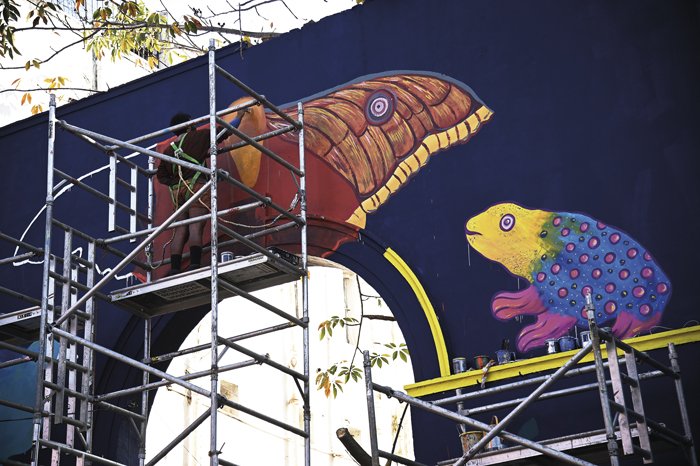
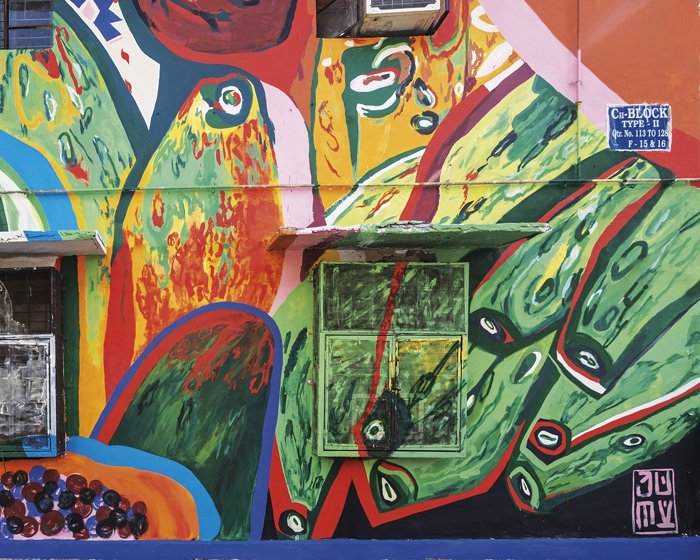
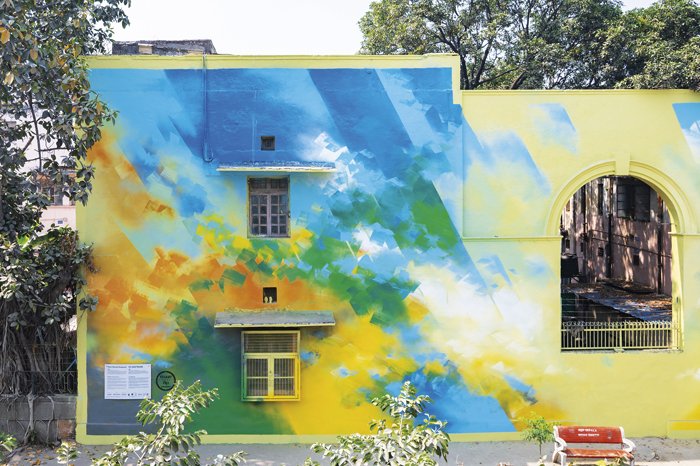
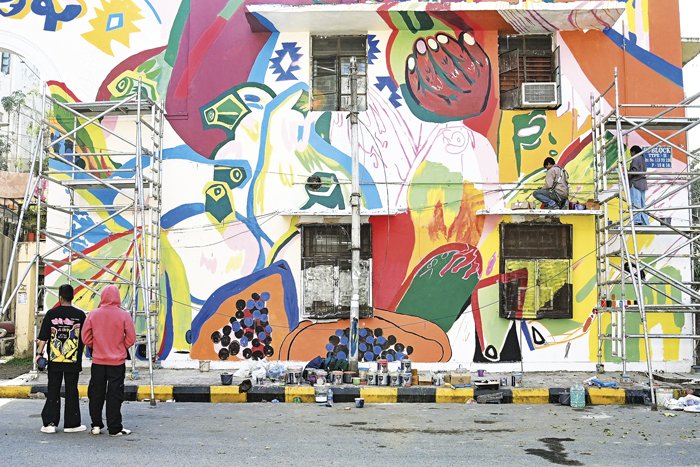
Curated around the concept Dilate All Art Spaces, the 2026 edition expands the definition of what an art space can be: not a bounded venue, but a lived ecology shaped by movement, memory, routine, and shared attention. The 2026 edition introduced six new murals by Indian and international artists, each shaped by distinct practices while collectively engaging with Lodhi Art District as a shared public canvas. These works reflect the district’s continued commitment to dialogue, collaboration, and long-term presence in the city.
The participating artists included JuMu (Germany), Pener (Poland), Raissa Pardini (United Kingdom) with the late Hanif Kureshi (India), Elian Chali (Argentina), Svabhu Kohli (India) alongside Ram Sangchoju (India), and a collaborative mural by Suso33 (Spain), Tarini Sethi (India), and Ishaan Bharat (India).
In an interaction during the festival, Thanish Thomas, festival director and co-founder, St+art India Foundation, said, “In 2015, street art in Delhi was still largely read as either decoration or disruption. Lodhi helped shift that reading by staying. Once the work becomes part of daily navigation, it stops being an event and starts becoming a reference point. Over the decade, audiences have widened too. Residents, students, photographers, tourists, and even policy stakeholders now treat the district as a civic asset, not a novelty. The biggest change is that murals have entered Delhi’s cultural vocabulary in an ordinary way. They are used to give directions, to mark memory, to anchor a neighborhood’s identity.”
On the challenges in transforming Lodhi Colony into a 24/7 open-air museum, Thomas said that the first challenge was trust as this is a lived neighborhood, so every wall is someone’s home frontage, someone’s daily view. We had to earn permission through repeated conversations, not one-time approvals.
The second challenge, he said, was logistical. Permissions, safety, scaffolding, traffic movement, and maintenance all become complex when you’re working in the public realm. The third challenge was curatorial. “A district is not a gallery where you control pacing and lighting. The street is noisy, layered, and unpredictable. You have to create work that can hold attention without demanding it.”
The Lodhi Art District has served as a model for other public art projects across India in numerous ways, proving that public art can be built as long-term cultural infrastructure, not as one-off beautification. Thomas added that the approach became the foundation for its other art districts and city projects.
“It showed that if you commit over years, you can create a public collection with curatorial continuity, not a scatter of unrelated walls. It also demonstrated that partnerships matter. The model works when civic bodies, residents, institutions, and a long-term vision partner can stay with the project through time.”
The local residents and community members have engaged with or adapted to the murals over the last decade in multifarious ways. “At first, the engagement was largely observational, people watching the walls transform. Over time, the murals became part of routine life. Residents often act as informal stewards, they flag damage, guide visitors, and they offer feedback,” Thomas said.
Another important layer is labor. Many artist assistants on the projects have been residents of the Lodhi colony itself. That changes the relationship completely, because the making of the district is also local work, local skill-building, local pride, he added.
The new 2026-themed murals address climate change and waste management. Giulia Ambrogi, chief curator and co-founder of the St+art India Foundation says that Delhi’s environmental crises are not abstract, they show up as heat stress, air toxicity, water anxiety, and the visible economies of waste.
“The 2026 murals respond to these realities through different visual languages, some direct, some symbolic, some rooted in ecology and others in urban systems. The point is not to “illustrate an issue,” but to stage a public conversation in a place people already inhabit. In Lodhi, a mural is encountered mid-stride. That makes it a powerful space for public reflection without preaching,” Ambrogi said.
The rickshaw project takes Lodhi’s visual language off the wall and puts it into motion, she adds, “It treats the rickshaw as a mobile public surface, part transport and part street-level encounter. The painted rickshaws draw cues from some of Lodhi’s most recognizable murals, translating color, typography, and graphic motifs into a moving format. It also brings attention back to the labor that powers the city. The district becomes interactive in a literal way because the art begins to circulate through everyday routes.”
The legacy of Hanif Kureshi
The 2026 festival also honored the legacy of co-founder Hanif Kureshi who passed away in September 2024. Ambrogi says that Hanif shaped Lodhi’s relationship with the street. He understood that public art in India has always existed through typography, signage, hand-painted languages, cinema walls, and local graphic cultures.
Kureshi’s vision, she said, wasn’t to import a ‘street art aesthetic,’ but to work from the street outward. “In 2026, we honored that by continuing to treat the district as a living public collection that holds design, language, and social meaning together. His legacy is also structural. The way we curate, the way we think about the city as an audience, and the way we value vernacular visual culture remains deeply informed by him.”
Dilate All Art Spaces
The concept of ‘Dilate All Art Spaces’ is a way of saying that public art cannot be limited to the wall, cities are made of thresholds, corridors, markets, staircases, waiting points, movement routes. “Dilating art spaces means treating these everyday zones as cultural infrastructure, not leftover space. It also means widening the idea of who public art is for. If it is encountered in routine life, it naturally reaches across class, age, language, and familiarity with art. That approach is relevant for India because public life here is dense, layered, and shared. Public art has to work with that complexity,” she said.
Ambrogi then talked about the significance of making art accessible in ‘non-official’ public spaces versus traditional ‘white-cube’ galleries. The white cube offers control, public space offers reality. In the street, art is encountered without preparation, without social codes, without the quiet that galleries depend on, she said, adding that it changes what art can do. It becomes less about permission and more about presence.
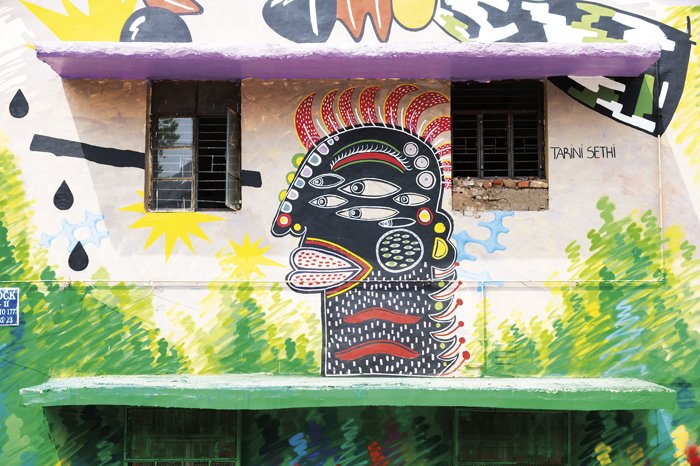
Accessibility here is not simply entry-free. It is the ability for art to be part of someone’s day without requiring them to opt in. That is why public art matters in a city like Delhi, where culture has always circulated through streets, bazaars, parks, and everyday visual life, she added.
Choice of artists & themes
According to Ambrogi, the earlier focus was on establishing the possibility of a district and inviting artists who could hold scale and public visibility. Now the criteria is more layered. “We consider how a work will sit beside existing murals, how it responds to architecture, and how it adds to the district’s long-term conversation. Themes are also approached differently. We do not look for topicality alone, but for practices that can hold complexity and remain relevant over time. We also value collaboration more now, between artists, between disciplines, and between institutions.”
There is a tangible shift in footfall and visibility in the area, she said, adding Lodhi is now a destination, which has naturally influenced local businesses around it. You also see informal micro-economies emerge – rickshaw drivers, shopkeepers, guards, and residents often become navigators for visitors ask them where certain walls are, what is new, what is worth seeing. That kind of everyday guiding is a strong indicator that the district has been absorbed into the locality’s own functioning.
Lodhi’s Lutyens-era complements the artworks
Lodhi’s architecture is not a blank canvas – The Lutyens-era typologies, the proportions of façades, the rhythm of balconies, the arches, enclosed courtyards and green corridors all shape how a mural is read, Ambrogi said. “Many works respond directly to these elements, either by extending across edges, using recesses as part of composition, or treating the building as a spatial object rather than a flat wall. Curatorially, it also affects placement. You have to think in terms of sightlines, walking speed, and how a mural appears through trees, parked cars, morning light, and seasonal shifts.”
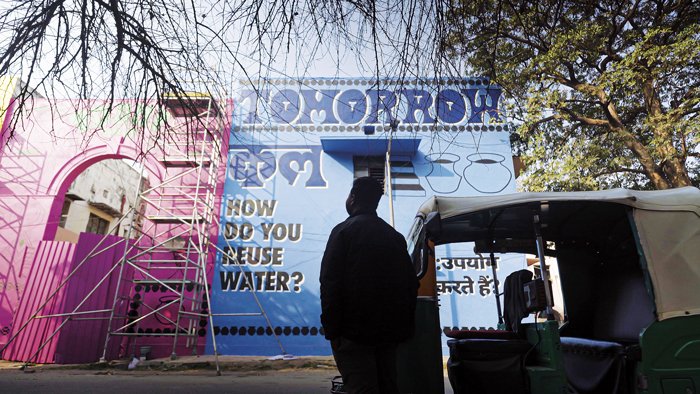
On the long-term partnership with Asian Paints and government bodies like CPWD, Thomas states that an art district cannot be sustained on enthusiasm alone, it needs long-term partnership. Asian Paints brought continuity, scale, and a shared belief in color as a public good, including product performance that matters when works have to last for years outdoors. “Government bodies such as CPWD, along with other civic stakeholders, enabled the administrative conditions for openness, permissions, coordination, and long-term functioning. That combination, a vision partner committed over time and public institutions willing to collaborate, becomes a replicable model for other cities,” he explained.
On balancing the ‘ephemeral’ nature of street art with the need for preservation and maintenance, he said, “Street art is always in conversation with time. Weather, pollution, sun exposure, and the city’s own wear, shape how a mural ages. We accept a degree of ephemerality as part of the medium, but a district also carries responsibility. We maintain works through periodic restoration, material upgrades, and careful documentation. Conservation is approached as care rather than freezing. The goal is to let the district live, while ensuring that key works remain legible and safe in the public realm.”
Future vision
According to Thomas, the next phase for the St+art India Foundation following this year’s decadal milestone is about deepening the district model and expanding thoughtfully. The foundation wants to strengthen how art districts function as long-term cultural nodes, with more programming, learning formats, and collaborations that extend beyond murals.
“We also want to continue building in other cities, but always context-first, not by replicating Lodhi’s aesthetics. The core focus remains sustained public culture, work that can hold the street’s complexity, and partnerships that allow public art to remain a consistent part of urban life.”