Epson recently published a mid-term business plan through 2028, the first phase of a longer-term corporate vision for an engineered future that covers the company’s outlook through 2035. It’s an ambitious plan that will see Epson changing from a printer manufacturer to a technology innovation and engineering company, with a particular emphasis on its inkjet technology.
Junkichi Yoshida, Epson’s president and CEO, introduces this report, noting that it will address “global geopolitical risks, environmental issues, labor shortages and other societal challenges.” He writes that for this first phase, “we will redesign our business portfolio with a focus on growth domains and resolutely advance our transformation toward capital-efficient management.”

The plan envisages Epson growing its revenues for its industrial activities from 1.4 trillion Yen (7.5 billion Euros) in 2025 to 1.7 trillion Yen (9.2 billion Euros) in 2035. The industrial sector includes inkjet solutions, micro-devices, Epson Atmix (alloy powder), and robotics, plus commercial and industrial printing. This assumes a CAGR of 7% and that the profit ratio can rise from 45% to 70%.
The report also includes a quick review of the previous business plan – Epson 25 Renewed – which covered the period from 2021 to 2025. Epson had targeted a return on invested capital of 7% but only achieved 5.1%. Equally, the company had aimed for a return on sales – which measures the profit from sales revenue – of 7% but had to settle for 5.4%.
Nonetheless, in this period, the main growth came from sales of inkjet printheads, including expansion in the Chinese market. Other highlights included establishing a manufacturing site in India, setting up a sales company in Dubai to improve sales in the Middle East and African regions, and acquiring Fiery. Epson also uses 100% of renewable electricity across the group.
The target for this first phase of the latest business plan, up to 2028, is for a return on invested capital of 8%. To achieve this, Epson plans to transform the company from the ground up over the next two years to focus on greater efficiency and to prioritise investment into growth areas.
But what exactly does that mean? For a start, Epson plans to cut 26 billion Yen (140 million Euros) in fixed costs. The company has already optimized its workforce and cut its manufacturing sites from 17 to 14 and now plans to move some back office functions from Europe to Latvia, and from the US to Mexico. Epson reckons it can save 4 billion Yen (21.6 million Euros ) in indirect costs at its overseas plants and 2 billion Yen (10.8 million Euros) by standardising its global IT infrastructure.
Naturally, the plan involves targeting emerging markets for further business growth, notably South America, Southeast Asia, the Middle East and Africa, as well as increasing design and production in countries such as India, Indonesia and China.
Epson also aims to redefine its business segments into four main areas. These include office and home printing, plus visual and lifestyle, which covers everything from watches and wearable products to PCs. These are both seen as stable bases with modest growth potential. Consequently, most of the immediate growth is planned to come from the Precision Innovation segment, which includes inkjet, micro-devices and Atmix. Finally, there is the Industrial and Robotics segment, which is earmarked to generate robust growth in phase 2, i.e., after 2028. This includes commercial and industrial printing as well as robotics. This should see further investment into Epson’s inkjet assets.
To this end, Epson has 560 billion Yen in operating cash flow, with 100 billion Yen set aside for strategic investment such as mergers and acquisitions, and a further 180 Yen billion for investment in the two main growth divisions, Precision Innovation and Industrial and Robotics. Between 2026 and 2028, Epson also plans to pay a minimum of 3% dividends on equity, around 80 billion Yen (432 million Euros), with a further 80 billion Euros earmarked for repurchasing shares.
Ultimately, Epson sees its Industrial business rising from 45% in 2025 to 60% by 2028, with the Return on Invested Capital increasing from 5.1% to 8%. The return on sales should increase from 5.4% to 8%. Epson hopes that most of this growth will come from leveraging its own technology, particularly the printheads. And it’s worth noting that the inkjet solutions business did treble its revenues between 2015 and 2025.
The idea is to broaden the inkjet portfolio to include drive boards and image processing, sensing and consulting as well as ink. This should allow Epson to expand the number of markets it addresses, including electronics, energy and bio markets, with its inkjet technology.
As part of this, Epson says that it will expand its portfolio of high-productivity products and use Fiery to expand its print workflow solutions. Epson sees some growth in the home and office printing markets, but mainly as users shift from laser to inkjet.
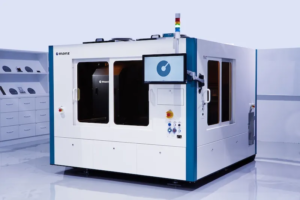
Epson also sees a role for inkjet beyond traditional printing. The company recently announced that it has started a strategic collaboration with Manz Asia, which is based in Taiwan, for semiconductor manufacturing. Manz Asia established a new R&D lab in November 2024, where it uses Epson inkjet printheads in the development of semiconductor manufacturing equipment. In March 2026, the two companies signed a memorandum of understanding with a view to developing a next-generation semiconductor manufacturing process with inkjet and building the facilities for mass production. This will lead to an inkjet-based additive manufacturing approach to building semiconductors.
Shunya Fukuda, chief operating officer of Epson’s IJS Operations Division, commented, “We believe that digital additive manufacturing by inkjet will be an important technical foundation that supports the evolution of semiconductor packaging. Using the high-precision discharge technology and mass production application know-how we have cultivated in the field of display and printed electronics, together with Manz Asia, we have established a scalable manufacturing platform that connects the laboratory to mass production. I will build it. We will contribute to the sustainable development of the semiconductor industry.”
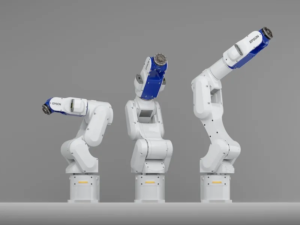
Epson also has a significant robotics division and is looking at ways to expand this. I’ve previously covered Epson’s plans to combine robotics with inkjet for direct-to-shape printing. Just last week, Epson announced a new CX-A series of 6-axis industrial robots. These build on Epson’s expertise in SCARA – Selective Compliance Articulated Robot Arm – which is normally used for industrial assembly tasks. The CX-A series are available in 18 different configurations and has a compact footprint so that they can be easily integrated into existing production lines. They are aimed at industries such as automotive, electronics, medical, logistics, plastics and metal processing.
Epson also plans to expand the use of its crystal and semiconductor technologies to create more energy-efficient micro-devices. This includes crystal units as used in Internet of Things equipment, and high precision oscillators, used in AI and data centres, as well as battery management systems in electric vehicles and temperature compensated crystal oscillators, which are used in GPS timing systems.
One of the most interesting aspects of Japanese companies is that they often emphasise their place within society. Epson is no different, including the line: “In an age of constraints, Epson will engineer the sustainability of industry and society through a process of meticulous thinking and continuous experimentation.” This is in stark contrast to most Western companies, where the aim is usually just to make as much money for the shareholders as possible. Epson concludes its report by stating: “We will enhance productivity and reliability, delivering value across industry as well as in people’s learning, work and lifestyles.”
Only time will tell how successful Epson is with this, but it’s interesting to see the scale of the ambition. You can find further details from corporate.epson.