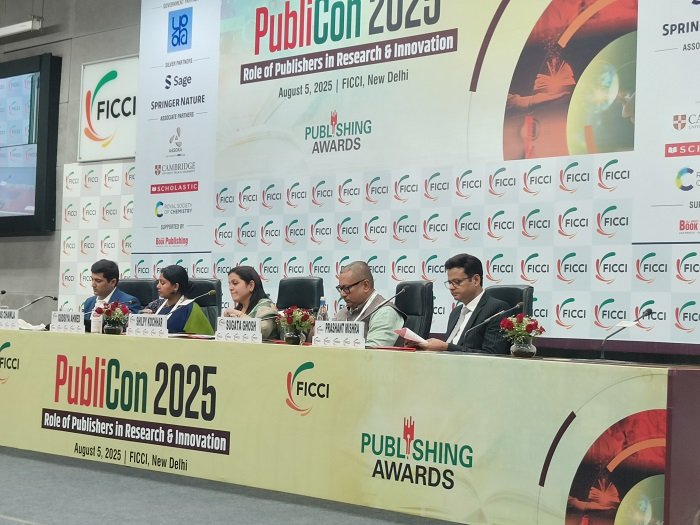
The Federation of Indian Chambers of Commerce (FICCI) organized PubliCon 2025, its annual event for the publishing industry, on 5 August in Delhi. The theme of this year’s publishing conference was the role of publishers in research and innovation.
Neeraj Jain, chair, FICCI Publishing Committee and managing director, Scholastic India, said in his welcome address that PubliCon aimed to facilitate more research in the right direction and ensure greater participation within the industry in research.

The organization, he said, does not want to focus on the publishing industry from a myopic point of view but rather as a knowledge ecosystem. Jain said the National Education Policy (NEP) is an example to illustrate this point. “The way the publishing industry and policy makers have come together to implement the NEP is remarkable,” he added.
Ranjana Aggarwal, scientist at Council of Scientific & Industrial Research (CSIR), ministry of science and technology, echoed Jain’s point of view and said good research leads to innovation. It is heartening to see that Indian languages are being recognized, Aggarwal said.
According to Aggarwal, a few points need to be adhered to while carrying out research and innovation – Does the research drive social progress, solve real-world problems, enhance quality of life and global collaboration?
A panel discussion on challenges for STM (science, technology and medicine) publishers followed. Qudsiya Ahmed, head of publishing, academic, Cambridge University Press; Sugata Ghosh, deputy managing director, Sage South Asia; Vikas Chawla, associate director publishing, Wolters Kluwer India; and Prashant Mishra, managing director – India and South Asia, BMJ Group, took part in the discussion moderated by Shilpy Kochhar, head – business development and communications, Biotechnology Industry Research Assistance Council (BIRAC).
Kocchar gave an overview of BIRAC, saying the organization had enabled more than 500 start-ups across India in the Biotech sector. “Publishing is an ocean of knowledge and the rigor determines the course of knowledge transfer. We need to find a balance between speed and rigor for STM publishing, which has its priorities and challenges,” Kocchar said.
Research publishing has to impact the masses, Kocchar said, adding innovation digests, innovation comics, and textbooks such as The Symphony of Innovation: Start-ups, Ecosystem, Collaboration and Risk Capital can be used to achieve this end. The affordability of knowledge also needs to be kept in mind.
According to Ghosh, in India, the government controls 98% of the education sector and this means that money or funds for research and innovation will flow from it only. “It depends on the government’s role, responsibility, and desire to make India a part of the scientific world. While the government takes a dominant role, private players will have to play the second fiddle,” he said.
Mishra said scholars need to look at already available research in a specific sector before starting their own research. While the APC (age-period-cohort) model dominates the research publishing industry, the government needs to support researchers and fund APCs. “We need to train our researchers in the manner research needs to be conducted. We need to co-create and co-develop a tiered targeted model that works for India,” he said.
While the BMJ Group has just started on its publishing strategy for Indian journals, he said they we will ensure Indian research is given due respect when it comes to the global arena.
Ahmed said while regular efforts need to be made to indigenize science and technology education, academic research and textbook writing also need to have local flavor and context. The education landscape in India is evolving rapidly. “We need to find familiarity or ground to commission local resources,” she said.
Cambridge University Press is making efforts for Indian research to travel and be consumed outside India, Ahmed said, the organization is providing a platform to women scholars in science as well as those from marginalized sections. Cambridge University Press engages with universities outside Delhi to globalize ourselves and make ourselves as local as possible, Ahmed said.
Chawla talked about the artificial intelligence’s (AI) impact on STM publishing. “AI is a friend and enemy at the same time. The kind of disruption it is causing is giving us a hard time in research publishing,” he said.
While AI is impacting authors’ and editors’ roles, Chawla said they are working with journals to create guidelines for AI-use for the research publishing industry. “AI needs to be used responsibly and awareness needs to be created about its judicious use,” he concluded.