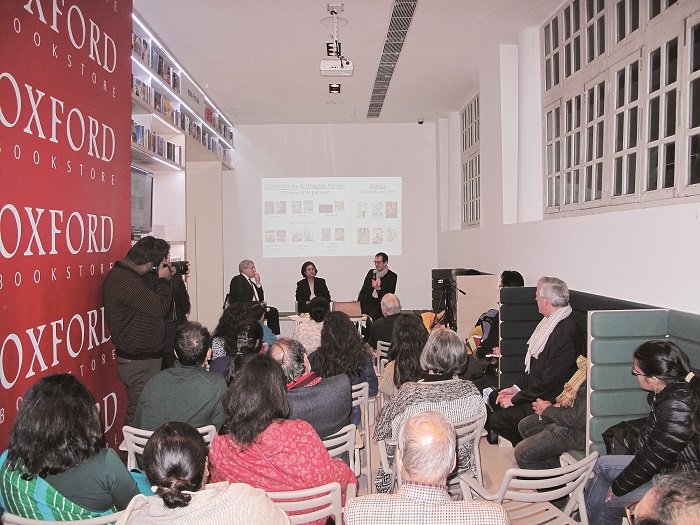
The German Book Office (GBO) recently organized a two-hour professional meet at the Oxford Book Store in New Delhi to discuss illustrated non-fiction books, comic books, graphic novels, coffee-tables and children’s books. The meeting, divided into four panel discussions, involved representatives from renowned publishing divisions in India and abroad and dealt with illustrated books. The GBO representative, Prashsti Rastogi, began the proceedings with an introduction to the essence of the meet and spoke at length why such discussions are necessary to energize the publishing industry discourse.
The first discussion, involving Bipin Shah of Mapin and Kate Mascaro of Flammarion, covered a number of challenging areas that foreign publishers face in India today. Both Shah and Kate delved into the subject of costly and complex image rights and thin margins on standalone books. They felt that the interest level on local language editions for image-led titles evokes little interest. Book-seller discounts are high, which is another barrier that needs to be tackled in addition to distribution challenges.

The next discussion, deliberated by Dipa Chaudhuri of Om Books International and Etienne Bonnin of Glenat, focused on the need to enhance reader experience, use technology and augmented reality. They felt it is important for publishers to identify their readers and find their specific markets. It is also necessary to adapt the content to the international market and establish a good online presence; in this, according to Dipa and Etinne, the writer’s own social media skills can create a considerable impact. Sometimes, it might become necessary to repurpose the content and load the backlist.
Simultaneous launch of multiple titles could make better business sense, as per Pranav Johri of Rajpal Publishing and Jean-Francois Richez of Laroussel. Talking about reader demography, they said that young readers form a powerful segment of the market and the content of books should address them adequately. Johri also observed that Print on Demand (PoD) is not suitable for illustrated books and publishers need to choose very carefully what they want to publish. He observed that the youth are increasingly getting attracted to books with mythology themes and the titles are driven more by reference rather than publicity.
Priyanka Malhotra of Full Circle then joined So Taniuchi of Bayard to discuss some more aspects of children’s books. Priyanka spoke about the popularity of Tota Books among children in India and also echoed Johri’s observation about mythology being a great attraction point for children. So spoke about book trailers by Bayard as a very effective method of promoting children’s books and both participants said that it is important for parents to encourage their children to read conventional hard copy books rather than depend just on digital platforms.
It is also necessary to adapt the content to the international market and establish a good online presence . . . the writer’s own social media skills can create a considerable impact. Sometimes, it might become necessary to repurpose the content and load the backlist.
Concluding the discussion, Miriam Hofheinz and Michael Drueiscke of PubPort shared their unique experiment with outsourcing printing for European publishers in India. Unlike organized overseas businesses that usually set up operations in India, Miriam and Drueiscke chose to set up their operations as individual expatriates like any other local entrepreneurs. They explained that it is a long learning process as the printers here need constant goading, failing which they miss out on important instructions by clients. Another major challenge in India is distribution, which prevents them to offer their full range of services but they are hopeful of getting around this problem in the years ahead.