In the first half of this story on this year’s Japan Inkjet Technology Fair in Tokyo, I wrote about how collaboration and partnership are at the heart of this event. In this regard, the organization behind JITF mirrors the reality of developing modern inkjet print systems as a joint effort that involves many different players.
Enn Kerner, a board member with Engineers Europe, picked up on this theme in his presentation. He noted that inkjet is becoming a platform for digital manufacturing, asking, “What kind of skills will the next generation require?” He pointed out that the most important thing is managing the full value chain, not just speed and print quality, and that the value chain extends beyond brand owners to the end owners who will use the products. He concluded that there are a number of challenges that have to be overcome for any print project. These include the substrates, the inks, which are the main drivers that give a product its value, the printheads, controllers and software and the production system.
Most of these different elements were represented amongst the various exhibitors at JITF. Obviously, one of the main components within an inkjet system is the printheads, so not surprisingly most of the main Japanese printhead manufacturers were also present.
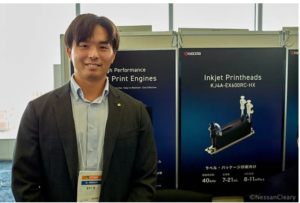
The major news from the event was Kyocera’s announcement of the HX variant of its 600dpi KJ4A EX, which I’ve written about in a separate story. Essentially, Kyocera has redesigned the structure of this head to improve the fluid channels and allow for a higher ink viscosity, up from 6 – 7 mPa·s in previous models to a much more usable 8 – 11 mPa·s. That allows for the highly opaque white inks that are typical in labels and packaging, as well as the much denser clear or varnish inks that are increasingly used to add textured effects, and the adhesive binder that is used to apply metal foiling effects.
I also chatted with Kazumi Honda of Memjet, who showed off samples that broadly cover all the usual applications where water-based inks play, including transactional, corrugated and carton board packaging as well as labels. Interestingly, Honda told me that Memjet has continued to extend the lifetime of its heads, which are currently said to be good for up to 8 billion droplets. The plan is to take this to 10 billion droplets next year and up to 15 billion by 2030, at which point it will be arguable if we can still regard these heads as disposable items. I’ve already covered this in more detail.
The Epson stand seemed to be busy throughout the event, mainly because Epson showed samples produced on its Direct-to-Shape ContourJet printer. I’ve previously covered this as a prototype here, and as a commercial product here. Naturally, Epson also discussed its range of PrecisionCore printheads, which I’ve already written about extensively.
Konica Minolta also took a stand at JITF but mostly highlighted the KM1024i-SHE-HM-LV, which I’ve covered earlier. This head is a variant of the earlier KM1024i printhead but has been adapted to be highly resistant to solvents so as to address the growing markets for displays, semiconductors, and other electronics products.
Ricoh has continued its interest in valvejet technology, showing off its Gelart printhead. This has just eight nozzles but can lay down a large amount of fluid. It can handle high-viscosity fluids such as paint, with Ricoh highlighting a car painting application.
Shane O’Neill, business development manager for Fujifilm Dimatix, spoke at one of the conference slots. He began by saying, “We have been doing this inkjet stuff for quite a few years now.” But he went on to note, “What we are seeing more and more is people looking at different applications, particularly around the digitization of manufacturing processes.”
He pointed out that in some markets inkjet had become commoditized but that inkjet for industrial uses was very hard to do. He cited sand casting as an example where the Furan chemistry that is widely used is very aggressive, saying, “We worked for two to three years to work out how to make our head robust enough for that industry.”
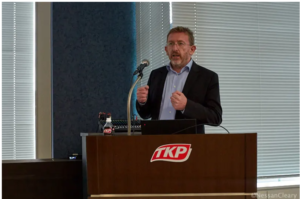
He described the recently announced Starfire PhaseMaster printhead that has been developed for hot melt inks. I’ve already written about this in more depth, but essentially this head combines features from Dimatix’ existing Galaxy HotMelt printhead with features from the Starfire family to create a new head that’s also suitable for graphic arts applications such as coding and marking, as well as printing direct to screens for screen printing. It can also work across industrial uses such as additive manufacturing and printed electronics for etch-masking applications such as photovoltaic cells, where Fujifilm is already seeing some demand for this head.
O’Neill went on to say, “Everyone is talking about high viscosity and there’s lots of opportunities there but also lots of challenges.” He continued, “Whatever product we deliver to the market needs to be reliable and sustainable. As we move into more industrial environments, it’s more aggressive fluids and more challenging environments with lots of dust and dirt. For products like solar panels and ceramics, the people we are working with don’t understand inkjet very well. There is a lot of opportunity, but we are in competition with other technologies to provide a solution. And if we promise them that everything will be fine, then we will do ourselves a disservice because they will struggle for several years to implement an inkjet solution. If we can prove that inkjet is up to digitization of the manufacturing process, then we will all benefit.”
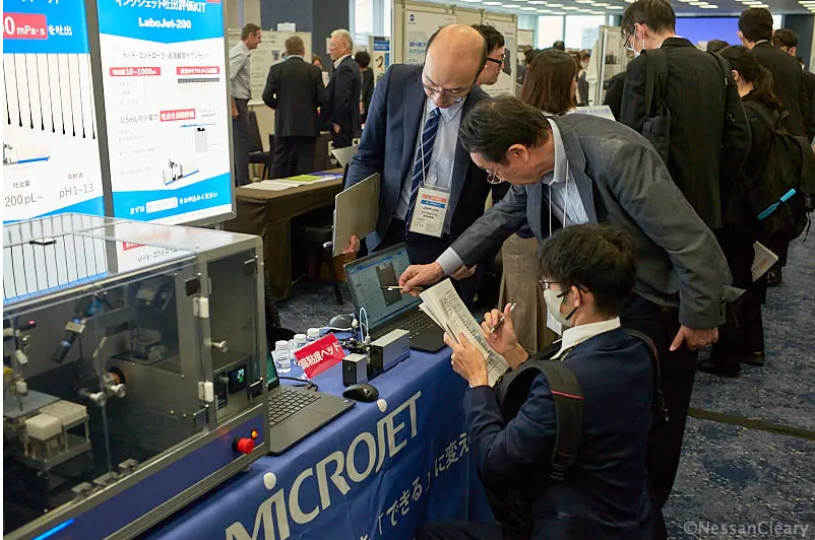
The change in venue also came with an extra new event, the Japan High Viscosity Project, which took place the day after the main JITF. I’m going to come back to the JHVP event in much more detail with a separate story later this month. But I think it’s fair to say that this subject has piqued a lot of interest, and I had many discussions around high viscosity at the JITF, which I’m going to cover here since those discussions were part of the JITF and some of those people did not go on to attend the JHVP.
Thus, I met with Jorge Palomero from the Digital Technology Lab within Torrecid. This company, which began in the ceramics market, mainly makes inks, as well as some additives, coatings and glazes. He told me that the ceramic inkjet market is moving from oil-based inks to water-based inks, mainly for environmental reasons: “The oil-based technology creates a lot of odour and in Europe the production plants are too close to population areas. And the water-based inks have better integration with the glazes, which are also water-based.” He added that there is also a desire to add further functionality and more pigment and that the water-based inks can handle this heavy loading much better than oil-based inks, noting: “So we are developing for high viscosity.”
He defines high viscosity as up to 20 mPa·s but says that his group can jet up to 45 mPa·s using Seiko printheads and has also managed to jet 60 mPa·s fluids in lab conditions. He notes: “And this is helping to stabilize the functionality because high viscosity means more reliability.”
There was some discussion as to whether or not there is any advantage to be gained from using fluids above 35 mPa·s. But Aliasgar Eranpurwala, head of sales for Seiko Instruments, says that where that might be debatable for UV-curable inks, there’s a clear benefit in higher viscosity water-based inks. He says, “With water-based inks, we are reducing the water content and jetting all the functional components, which does make a big difference.”
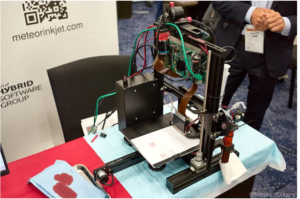
Clive Ayling, managing director of Meteor Inkjet, doesn’t see the development of high viscosity inks as a big issue from a drive electronics point of view, noting, “By and large it’s the same work as we do as for low viscosity. It might push the boundaries a little bit if you need a lot more voltage, but we already know that. We already talk to the head vendors about this.” He continues: “The biggest change you need to make to an inkjet printhead such that it can work at high viscosity is to change the size of the chambers that feed the ejection chambers.”
He says that the main reason that printheads struggle with high-viscosity fluids is to do with maintaining the flow of the fluids, adding, “If there were new applications then that would be more interesting.” And he pointed out that some applications, such as wax 3D printing, that are struggling might then become more common.
Meteor Inkjet showed off an alpha version of its nozzle health system, which I’ve covered earlier this year. This works by sending a specific signal to the printhead and then measuring the impulse response back from each nozzle. This allows it to identify issues such as wetting, blockage, or air ingestion before they have caused any artefacts on the print. The idea is to reduce blockages within the nozzles to increase the overall reliability and lifespan of the printheads, something which will become more of an issue as inkjet technology moves into more industrial environments.
BYHX, which also develops drive electronics, showed a number of different boards for both scanning and single-pass uses. This includes boards that can support up to 16 Kyocera heads or 32 Ricoh Gen6 for scanning applications. In some cases, for single-pass printing, each board will support just one head, such as Konica Minolta and Kyocera 1200 dpi, while other boards will support two heads, such as the Dimatix Skyfire. The difference largely depends on how much data each head needs.
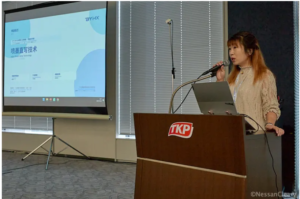
Chelsea Chi, overseas department manager for BYHX, used a conference presentation to explain that BYHX was founded in 2006 in China and is a one-stop supplier of electronic drive boards for printheads, including the waveforms, stating: “The waveform decides whether a drop lands in the right place and we tune ours ourselves.” She went on to say that where the company initially only supplied the Chinese market it is now increasingly looking to international markets and seeing requirements such as securing intellectual property and having the right certifications in place.
She suggested that the drive electronics could play a part in jetting high-viscosity fluids, noting: “For decades inkjet has lived in a narrow strip from 5-20 mPa·s.” She went on to say that many companies now wanted to print ceramics and conductive circuits, adding: “The material must become an ink first, but once it’s an ink the rest is ours.” She suggested that BYHX could deliver a wider material window in terms of fluid viscosity with more functional inks, allowing for higher pigment loadings and lower VOC emissions. She explained: “Our waveform works like noise-cancelling headphones. A camera reads every drop where it lands, how big it is, if there are satellites, and then the waveform adjusts by lowering the voltage.”
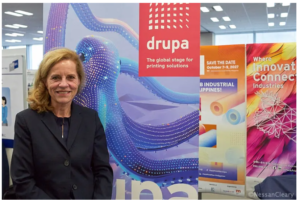
As noted, international cooperation is a major part of the JITF, which was underscored by Messe Düsseldorf also taking a stand at JITF. Sabine Gelderman, the director of Drupa for Messe Düsseldorf, explained that Japan remains a very important market for Drupa, adding, “So JITF is a very nice platform for us to understand where the industry is heading and to meet with our key partners.” She went on to say: “And we have a very nice relationship with Ohno. He’s a very good ambassador for Japan, and it’s nice to see that he has been able to gather the who’s who of the industry.”
Inevitably this story is a small snapshot of all the activity happening at the JITF, which covers a wide area from the traditional Japanese washi paper to printing on flexible films for packaging. I’ll come back to the subject of high viscosity inkjet with a separate story on the Japan High Viscosity Project that followed on from JITF. In the meantime, readers can find all my stories related to this year’s JITF by searching for ‘JITF2026’, and can find further details at ohno-inkjet.com.
(First published in the Print and Manufacturing Journal. Republished with permission)