If it is genuine literature, it expresses more than it knows. – CLR James
In recent years, the configuration of the Frankfurt Book Fair’s Indian exhibitor/scene has changed considerably. The traditional majority of public and private publishing houses and distributors has made way for an even larger majority of service providers to the publishing industry. This reflects an overall shift toward a more professional, business-minded culture of the Indian presence at this fair.

Whereas exhibiting in Frankfurt has become less and less interesting or feasible for most of the Indian publishers, their place has gradually been taken over by service companies, from premedia and printing houses to a variety of digital technology providers. And, for the first time this year, their largest cluster of tech companies busted in from Chennai.
Out of the 64 exhibitors from India, 23 companies presented workflow automation systems, AI-driven translation software, eBook, EPUB and XML conversion platforms, AI content detection software, management information systems, and other technologies and services related to book production and its logistics. Next to tech companies from Puducherry (Integra), Noida (Spring Time), Bangalore (Drillbit) and Haryana (Hubhawks), the exhibitors from Chennai included Ailaysa Technologies, Amnet ContentSource, C&M Digitals, Exeter Premedia Services, Hudsmer Business Solutions, Lumina Datamatics, OGAI Technologies, S4Carlisle Publishing Services, and Transforma.
Many of these hired the smaller “workstations” – branded cubicles instead of entire booths. In addition, 11 printing houses had booths at this year’s fair, as well as 21 publishing houses and 9 supporting organisations (NBT, Chennai International Book Fair, language institutes, and academies). Not accounted for in these numbers are the companies renting tables at the Literary Agents & Scouts Center and the Publishers Rights Center.
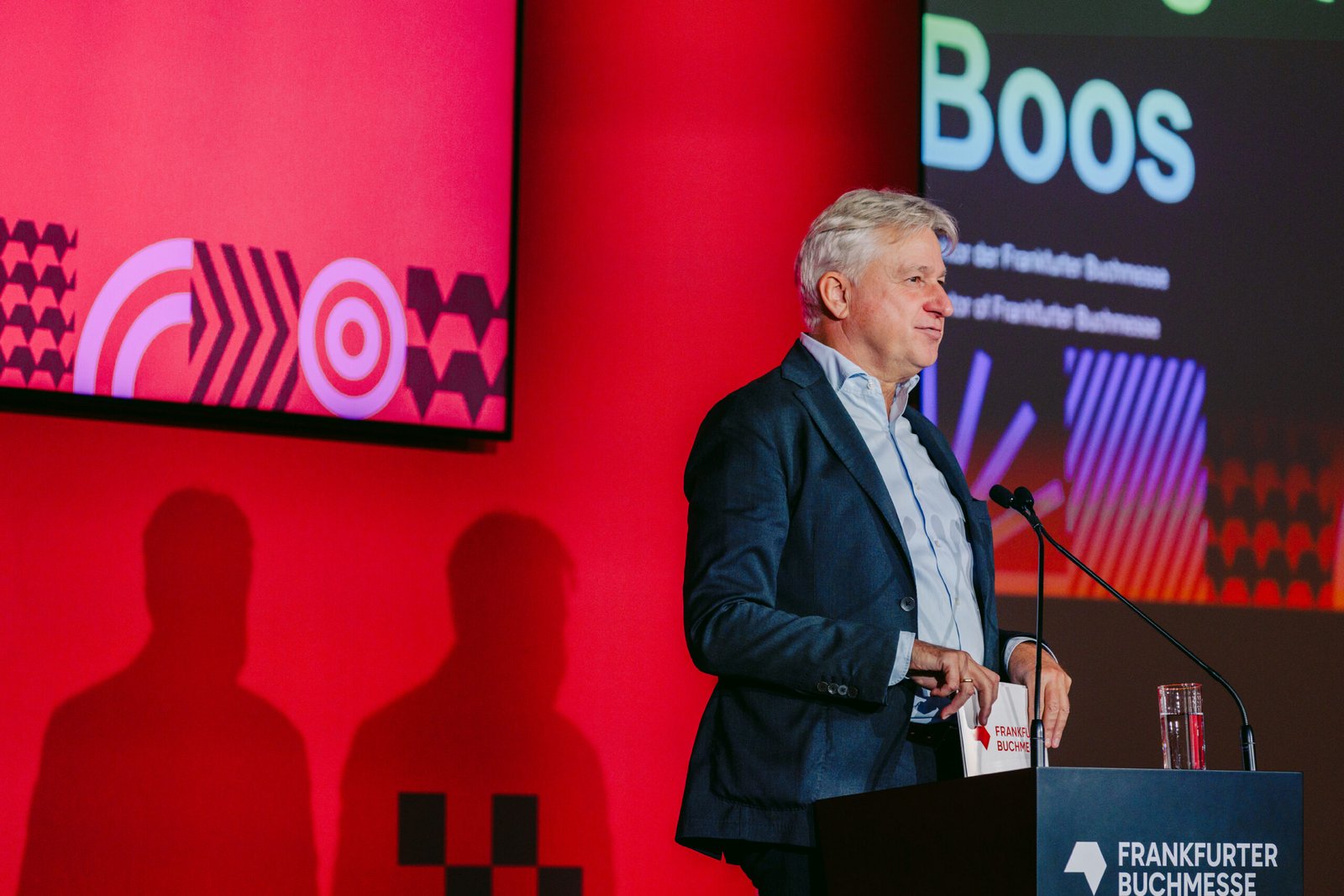
At the fair’s opening press conference, FBF director Jürgen Boos, German Publishers and Booksellers Association chairman Sebastian Guggolz, and historian Jill Lepore set out the book industry’s overarching themes. Boos asserted his belief “in the power of stories, the importance of the printed word, and the freedom to publish. Freedom to publish determines which stories can still be published today, which perspectives reach people, and which conversations a society has.”

Sebastian Guggolz stated that “the problem of reading competence cannot be compensated by AI, which delivers answers at random. This should alarm not just us as a book industry, but also the whole of society.” Guggolz urged “immediate intervention” from world leaders, without authors and publishers “having to sue first.” While adding: “The key counterbalances to the loudspeakers of our time and to the pressure to conform are, and always will be, books.”
In her keynote, historian and Pulitzer Prize-winning author Jill Lepore warned against a world in which our future is handed over to a tech mogul elite. “We meet here on the knife-edge of history,” Lepore said. “The sum of human knowledge that is contained in the world’s books has been swallowed whole by machines owned by corporations. These corporations propose that these intelligent machines do the work of reading and writing and even of thinking for us. For all the wonders and marvels of these machines, for all the promise they hold for the discovery of new knowledge, their development threatens the arts and letters, freedom of thought, democratic societies, and if the warnings issued by the tech moguls themselves are to be believed, even humanity itself.”
Constitutional democracy “depends on books, and reading, on writers and printers, on the freedom of the human mind,” she concluded. “No democracy can thrive without a literate electorate. It is an inheritance as precious as it is precarious.”
Due to unfinished building inspections, the two levels of Hall 6 had to be kept closed. As a result, international exhibitors had to be squeezed into Hall 4.2 and the Festhalle space. The Literary Agents & Scouts Center and Publishers Rights Center, both sold out again, moved from Hall 4.2 to Hall 1.2. The Comics Business Center and the workstations from Hall 6.2 were moved to Hall 3.1.
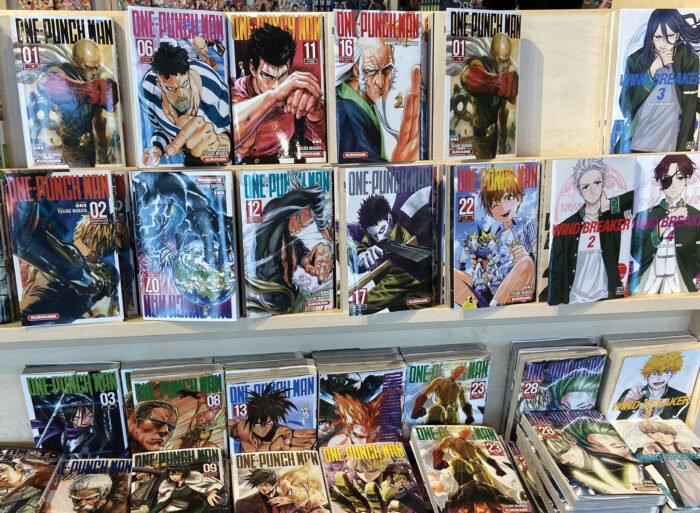
Highlights at this year’s FBF were presentations and discussions on AI, cross-media projects, and rights trading in the comics and graphic novels sector. Manga and cosplay were signposted in relation to their adaptation in films, TV series, and video games. For the first time, the FBF Global Network support program was dedicated to comics, graphic novels and visual stories, connecting and training publishers, editors and rights managers from 14 countries. They visited publishers in Hamburg, presented their titles at a joint stand at FBF, and organized the rather fashionable feminist exhibition “Sheroes. Comic Art from Africa” at Frankfurt’s Weltkulturen Museum.
Daybreak in Gaza
Frankfurt Calling also has been a major focus this time. As FBF’s cultural policy program, it addressed industry-relevant social and political issues at events held on eight stages across the fair with the intention to reach a broad, international audience. One of the discussions developed around the book Daybreak in Gaza, presented by its co-editors Matthew Teller and Palestinian librarian Mahmoud Muna. Two other stages featured the Latin American and Asian book markets with daily programs including market reports, insights into what books are selling in these regions, and interviews with authors and illustrators.
It has been the fair’s last edition for Jürgen Boos, FBF director for 21 years. He will be succeeded by Joachim Kaufmann, who has held various positions at Penguin Random House and within the Bonnier Group, where, among other things, he has been responsible for Bonnier’s expansion into new markets such as Poland and China. In view of the dwindling exhibitor and visitor numbers at FBF, he will have a tough job in continuing to defend Frankfurt as one of the international publishing industry’s main licence trade platforms.
236,000 visitors, of whom 119,000 were trade visitors, attended the five-day fair. As to the exhibitors, the book industries from Asia-Pacific occupied 8% of the booths, 320 out of the total of 4,000 (2025: 472 out of 4,350), including 64 from India, 78 from China and Hong Kong (2025: 186), 39 from South Korea, 28 from Japan, 28 from Singapore, 26 from Thailand, a total of 20 from Taiwan, the Philippines, Malaysia, Indonesia, and Bangladesh, and 37 from Australia and New Zealand.
After its initial rise, what is the significance of the gradual drop of FBF exhibitors from Asia? This year’s sudden drop of FBF exhibitors from China and Hong Kong may be explained by the situation in the Middle East, but, all in all, after their initial rise, the numbers from Asia have been dropping gradually over the past few years. It remains to be seen what this means in the longer term.
The next Frankfurt Book Fair has been scheduled for 6-10 October, 2027, highlighting Chile’s book industry.