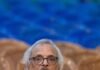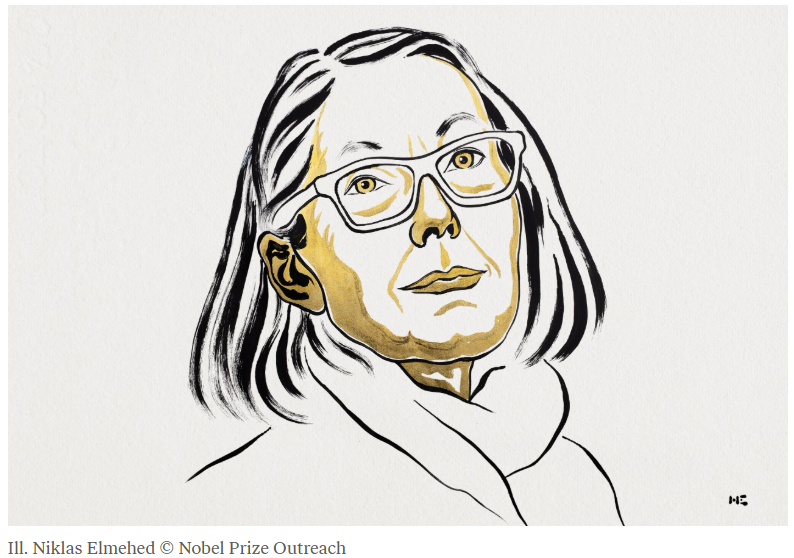
The Nobel Prize in Literature for 2026 has been awarded to the Canadian author Anne Carson, “for her bold and inventive oeuvre that, in playful dialogue with the classical tradition, has created new forms for contemporary literature,” the Swedish Academy announced.
Anne Carson has, throughout her entire career, combined poetry writing with translation work and teaching at various universities. Almost all her literary production has centered upon the intersection between the philologist’s obsession with words and the poet’s desire for new meaning. She has identified the etymology of words as the starting point for all her work.

The award contains a prize amount of 12 million Swedish kronor (~£900,000). Carson said she will go out and walk in the woods so that she does not have to answer the phone.
Her first reaction after the Nobel announcement
Jenny Rydén: Hello, this is Jenny Rydén from the Nobel Prize.
Anne Carson: Oh, good. Okay, we got it. Go ahead.
JR: Okay, thank you so much. First of all, many congratulations!
AC: Thank you. It’s pretty crazy.
JR: How are you feeling right now and how did you receive the news? Can you set the scene for us, please?
AC: I’m just eating crackers and drinking a cup of tea. Nothing really dramatic yet. It’s still morning. So just sitting in the kitchen reading the London Review of books and drinking tea. I noticed the floor needed sweeping, so I leapt up to do that. Then there was all these phone calls, which I kept turning off because I just always turn off the phone when it rings.
Robert Currie: I’m the husband, and you owe me because I’m the one who made her actually call back your number.
AC: Yeah, he answers the phone. I usually turn the phone off. He answers it and then makes me call back. Just seems a little insane. I think you’re all insane.
JR: Why does it feel crazy and insane? You didn’t expect this?
AC: Well, who would expect it for heaven’s sakes?
JR: You said you were in your house, and where is that?
AC: It’s in Reykjavík, on the sea. So looking out on the Arctic. Sorry I’m not being very dramatic for you. Just a normal day here.
JR: Have you given any thought about what this Nobel Prize means to you?
AC: No, I haven’t. We’re just thinking of ways to give the money away. We have a friend who needs a house, and we always give a lot to Doctors Without Borders. Yeah, stuff like that.
JR: How will you celebrate this unexpected news?
AC: We’re going to go out and walk in the woods so that we don’t have to answer the phone, to be honest. Then we’re going to hear the quiet.
JR: Nice. Talking about you as a writer and your work; for someone who maybe doesn’t know you that well, how would you describe your authorship?
AC: Inadvertent, is how I would describe it. Always trying to do something else.
JR: If someone who doesn’t know you that well and would like to know more about your books and your work, where would you suggest they start?
AC: I don’t know. It’s about anywhere. Most people read the autobiography. I’ve read it, it seems accessible. But I don’t know. Start in the middle, I always say.
JR: Speaking of starting; when you start on a new book project, how do you start off and what does your writing process look like?
AC: Start in the middle. It’s the only rule I have.
JR: How so?
AC: Well, whatever you take that to mean, find the middle, start there.
JR: Do you have any sources of inspiration that you go to?
AC: Homer.
JR: So you’re a teacher in classics and have used a lot of these stories to put in a more modern context. Why do you think this is relevant for people today?
AC: It isn’t. I don’t think I’m interested in relevance. I’m interested in us being relevant to them.
JR: I’ve read that you said that it’s important for you to avoid being bored, boredom. Why is that?
AC: Well, nobody likes being bored, do they? Do you not avoid it?
JR: Why is it so important to you, you think?
AC: Well, it’s not so important. It’s just a criterion of what I do next in the day, you know, sweep the floor, read Homer. It’s a matter of avoiding boredom a lot of the time. Life is boring.
JR: You think?
AC: Do something with it.
JR: That’s a good piece of advice. And if someone is aspiring to be a writer, do you have a message for them?
AC: No, the same one, start in the middle.
JR: I can hear your phones are ringing in the background. Thank you so, so much for taking the time. Congratulations again.
AC: Thank you very much.
JR: Bye-bye now.
AC: Bye-Bye.
Who is Anne Carson?
Anne Carson was born in 1950 in Toronto, Canada. In 1981, she published her doctoral thesis in Classics entitled Odi et Amo Ergo Sum, and has, throughout her entire career, combined poetry writing with translation work and teaching at various universities. Almost all her literary production has centered upon the intersection between the philologist’s obsession with words and the poet’s desire for new meaning. She has herself identified the etymology of words as the starting point for all her work. Her translations from Classical Greek may be regarded as independent works in their own right. Among these is her interpretation of Sappho’s poem fragments, If Not, Winter (2002), along with tragedies such as Sophocles’s Electra (2001) and Antigone (2015) and Euripides’s Bakkhai (2015).
In her long essay Eros the Bittersweet (1986), Carson lays the foundation for her subsequent authorship. With its brilliantly rendered meditation on Eros being the essence and driving force of the poem, the book draws heavily on a compound adjective from Sappho that defines Eros as pain and sweetness combined. It is this distinction, the distance between the lover and the beloved, that gives Eros strength and sets the poem in motion. Carson achieves this in her writing by constantly bringing in different voices that play off against each other. In Eros the Bittersweet, she speaks of a ‘stereoscopic vision’ that allows her to ‘hold in equipoise two perspectives at once’. A case in point is the essay Economy of the Unlost (1999), in which Carson sets the sixth century BC Greek poet Simonides of Keos against Paul Celan, and in Men in the Off Hours (2000), in which she aligns the historian Thucydides with Virginia Woolf. It is through such, often unexpected, literary constellations that Carson has broken away from lyrical poetry bound to the narrative self and inspired new forms of contemporary literature. This method of writing leads to playful and ironic works that move not only between classical and modern poetry but also between different genres and artforms.
In the 1990s, Carson published a series of notable works. Among these is ‘The Glass Essay’ in Glass, Irony, and God (1995), which demonstrates the potential of the long poem where genre boundaries are seen to blur. While the work is written in verse form, it is also a long story about grief and unrequited love, in which the first-person narrator, a woman who has been left by her husband, visits her lonely mother in the desolate moorlands. On the journey there, she takes with her the works of her favourite author Emily Brontë, whose own moorlands and inner world are intricately woven into the text. Constructed around three lonely women sitting at a kitchen table, the long poem, which is also a reading of Brontë, is thus transformed into an essay about abandonment. The poetry needs the story, and the story is in turn dependent upon the leaps and scene shifts of the poetry, which Carson employs with such virtuosity.
The same decade saw the publication of another work, often heralded as Carson’s greatest, entitled Autobiography of Red: A Novel in Verse (1998). This demonstrates her eminent ability to actualize the classical literary tradition. With a precise feel for contemporary idioms and experiences, she takes as her starting point poem fragments by the sixth century BC Greek poet Stesichoros concerning the winged red monster Geryon. While the myth describes how Heracles, in fulfilling one of his labours, kills Geryon and steals his cattle, Carson recasts the terrifying giant as a tender ‘hero’ devoted to his mother, in what becomes a modern Bildungsroman. The young Geryon, having earlier been subjected to sexual assaults at the hands of his brother, falls in love with the smug and boorish Heracles. What happens when you love someone who will ultimately destroy you? It is an age-old question in this spectacular form of epic poetry with its great lyrical qualities.
Carson once described boredom as her arch-enemy, and it is a state she confronts with drastic humour and wit. The Beauty of the Husband: A Fictional Essay in 29 Tangos, published in 2001, tells of a cutting and sardonic row with a deceitful husband, its twenty-nine episodes each opening with lines of verse by the romantic poet John Keats. Keats’s sublime words about beauty being truth are, in brutal yet playful fashion, juxtaposed with this exhausting relationship drama.
An unforgettable work of Carson’s is Nox (2010), written in memory of her brother Michael, who was mysteriously absent prior to his death in Denmark in 2000. Palpable here is a deep sense of loss that works its way up from below. The result is a creation as sculptural as it is literary, an epitaph in the form of a box containing an accordion-fold-out of pictures, letters and other written texts dedicated to her dead brother. There is moreover a third voice that provides temporal depth in the shape of the Roman poet Catullus, with his famous elegy 101 in honour of his own departed brother, who like Michael died on foreign soil. Present also is Carson’s moving translation of the poem.
Throughout her entire authorship, Carson with a light touch explores the possibilities of writing, a process by which the literary sketch has become of particular value to her. Bearing witness to this is Float (2016), a work consisting of twenty-two chapbooks on different subjects, capable of being read in any order. Another is Wrong Norma from 2024, a diverse combination of texts with a strongly performative aspect in which Carson crosses over into various artistic and academic fields. Her collaborations with visual artists and choreographers and with opera and theatre directors demonstrate the freedom with which she relates to literary expectations and rule systems. It is this that lies behind the outstanding importance her work since the 1990s has had for the international art and literature scene.
(Text courtesy the Nobel Prize website)