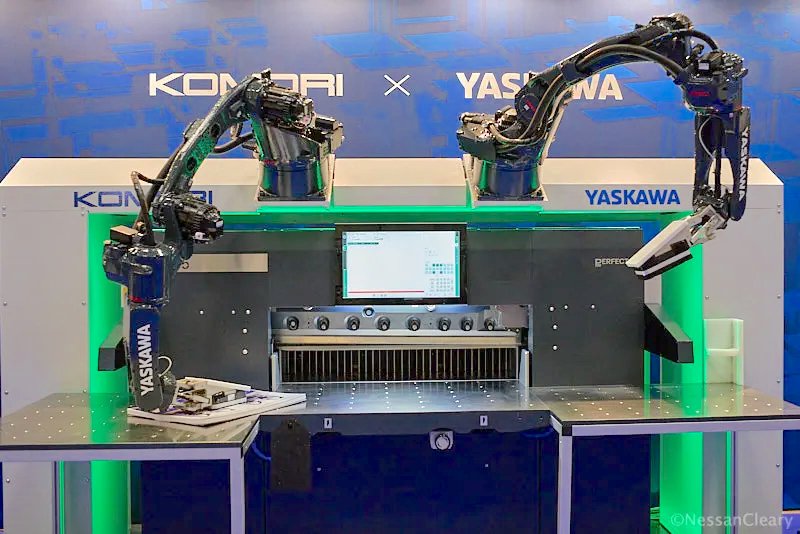
Komori has shown off a robotic concept to automate the process of picking up sheets and feeding them into a guillotine, which would eliminate the health and safety risks of human operators working around cutting equipment.
Jacob Hummel, chief commercial officer for Komori EU, says, “We are addressing a very specific bottleneck in all print shops. The presses are very fast, so now the stack needs to be precut or cut as the final product, but regardless, it goes to the guillotine. And we know it’s hard to schedule a downstream process with a cutting step in the middle because we don’t really calculate the time it takes an operator to handle the sheets. With this, we know exactly how long it takes and can schedule accordingly.”
The solution is being developed with Yaskawa, which specialises in developing robotic and factory automation equipment. Peter Wahlin, design engineer from Yaskawa’s Robotics division, says, “The main target is that we go from lifting the paper by hand to keeping it automated in the flow, to reduce the bottlenecks in the process.”
He points out that the biggest challenge for printing companies is to remain profitable, adding, “You must get a high throughput and you can do that with automation.”
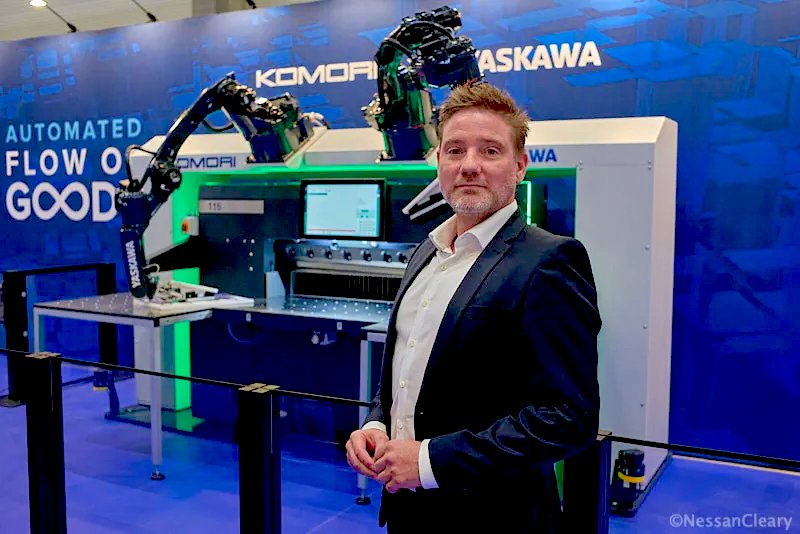
The solution shown involves two robotic arms from Yaskawa working together to feed sheets into a Komori guillotine. Hummel says that it can also work with a single arm but that using two arms makes for a faster system. The robots can pick the sheets up, move them around the table, and line them up precisely before feeding them into the cutting unit.
The robotic arms are themselves attached to a frame around the guillotine, with the frame being the smart device that contains all the controllers and power supply. This makes it easier to retrofit to existing guillotines, providing they meet basic technical specifications to control the cutting process.
Hummel says that the customer also needs to be able to supply Komori with JDF. The guillotine itself does not have to have been designed for JDF as the smart frame can handle this, and will control the guillotine as a slave unit. That said, it’s also still possible for an operator to intervene and run jobs manually.
Henrik Christiansen, CEO of Cool Graphics Automation and consultant to Yaskawa, says that there are some things that cannot be done manually on a sheet cutter, such as cutting on a diagonal, where it would be hard for a person to do once, let alone consistently across batches, adding, “And I’m sure that when we go out to customers there will be a bunch of ideas that we never thought about.”
For now it’s a proof of concept, but Komori and Yaskawa are looking for print shops that want to work with them. Hummel says that it should be available in the second half of 2027, noting, “The missing link right now is the work we are doing with software components that will do the translation to convert the data to the robot language.” He says that the steps needed to transport the paper stack to the guillotine and lift it to the cutting table are already complete
Komori is also planning to offer an optional camera system. Hummel explains, “We can detect paper curl and adjust the cutting sequence. But we will also be able to detect the PDF and see which job it is.”
It’s worth noting that Komori already sells some robotic systems from its MBO division, for placing stacks of folded signatures onto a pallet, though the arrangement with Yaskawa is separate. Yaskawa is also looking at other robotic solutions, all involving different options for moving paper around a print shop, though Hummel would only say, “We are working with Yaskawa to find gaps in the market.”
You can find more information on both companies from komori.eu and yaskawa.eu.com.
First published by the Printing and Manufacturing Journal on 9 November 2026. Republished by permission. www.nessancleary.co.uk