In its 87th Annual Report for 2025-26, the Indian Newspaper Society (INS), the apex body representing the country’s print media industry, has flagged a set of challenges as the industry undergoes a significant transformation driven by technological innovation, changing consumer behavior, and evolving advertising dynamics.
According to the report, seen by Indian Printer & Publisher, the changes range from a persistent customs duty on imported newsprint to the growing dominance of global tech platforms over digital advertising revenue and falling print advertising. Though the industry’s overall advertising business contracted last year, pockets of resilience, particularly in English dailies, offered a silver lining.

Newsprint cost and supply
In the report, INS urges the government to withdraw the 5% customs duty on imported newsprint, arguing there is no justification for the levy as it threatens the viability of newspapers. Compounding the problem, the geopolitical turmoil — specifically in West Asia — has worsened supply-chain uncertainty and pushed up both the availability and price of newsprint internationally, the report states.
Domestically, the picture isn’t much better. The industry, the report states, is grappling with quality issues in locally manufactured newsprint, production constraints, mills converting capacity to packaging-grade paper instead of newsprint, and a shortage of glazed newsprint (GNP) and lightweight coated (LWC) paper below 70 gsm.
INS says it issued press statements on this issue in February and March 2026, specifically calling out gaps between claimed domestic production capacity and actual supply.
Speaking separately at the society’s 87th annual general meeting, outgoing INS president Vivek Gupta explained the importance of newsprint. “For print media, newsprint is not simply just another industrial raw material. It is indeed one of the most essential inputs.”
Domestic production, he said, covers only about half the industry’s requirement, leaving publishers exposed on capacity, quality and specialized grades alike. Renewing the society’s call on the government, he said, “On behalf of the members of the society, I once again urge the government to withdraw the 5% customs duty on newsprint.”
Ad rate hiked, no matching budget
After nearly four years of lobbying, the Ministry of information & broadcasting this year notified a 26% increase in government advertisement rates for print media, based on the recommendations of the 9th Rate Structure Committee.
The INS welcomed the move but pointed out that the overall government advertising budget allocated to print has not grown in step with the rate hike, effectively limiting the real benefit. The society says it continues to push authorities for a rise in the ad budget itself.
The report’s advertising data point to a year of contraction and changes. INS member publications reported total advertising business of Rs 14,773.74 crore in 2025, down 3.54% from Rs 15,316.39 crore in the year 2024.
Accredited advertising agencies, the single largest revenue source, held roughly steady — down only 0.63% (Rs 8,229.73 crore to Rs. 8,178.15 crore) — cushioning the overall decline.
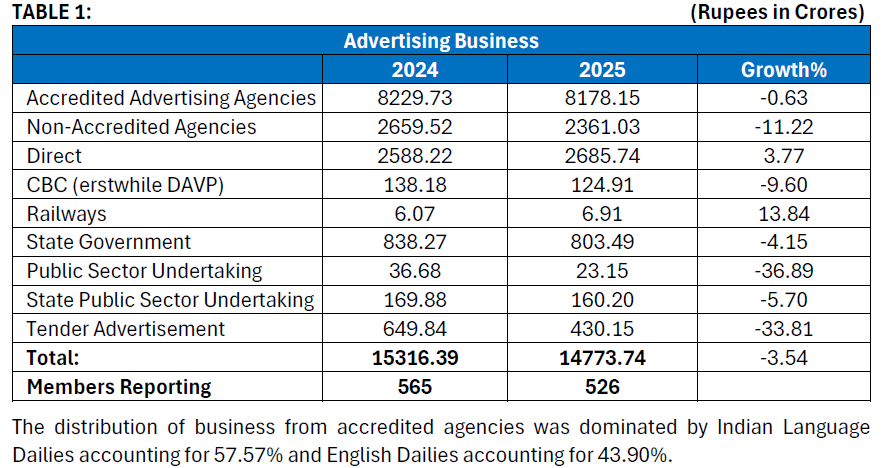
Tender advertisements fell nearly a third (-33.81%), from Rs 649.84 crore to Rs 430.15 crore. Public PSU advertising fell even more steeply on a percentage basis, down 36.89%, though from a much smaller base (Rs. 36.68 crore to Rs. 23.15 crore). Non-accredited agency business dropped 11.22%, and state government advertising fell 4.15%. CBC (erstwhile DAVP), the central government’s own advertising arm, also declined 9.60%.
In contrast, direct advertising grew 3.77% (Rs. 2,588.22 crore to Rs. 2,685.74 crore) and Railways advertising rose 13.84%, though both remain relatively small contributors overall.
The number of members actually reporting advertising data fell from 565 to 526, a drop that may itself be a symptom of industry consolidation or reporting fatigue.
Accredited-agency business
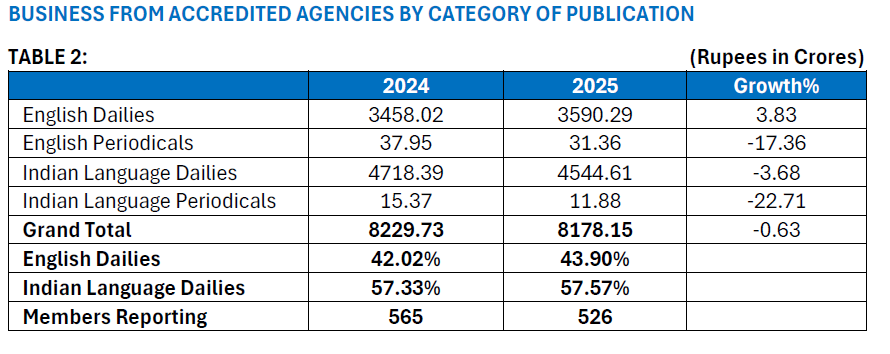
The report digs into the Rs 8,178.15 crore of accredited-agency business specifically. English dailies were the only category to grow, up 3.83%. Their share of accredited-agency business rose from 42.02% to 43.90% — a meaningful gain in a shrinking pie.
Indian language dailies, despite remaining the larger segment by value (57.57% share, up marginally from 57.33%), saw revenue fall 3.68.
Periodicals — both English and Indian language — were the weakest segment by far. Indian language periodicals were down nearly 23% and English periodicals down over 17%.
In fact, falling advertisement share (which has been partly cannibalized by digital), as well as circulation fall, has been a key problem grappling the print media industry since the steep pandemic fall of 2020. Though things are back on track comparatively, the print media is nowhere near its old self. In our previous issue, we reported how IppStar’s 9-year review of 47 Indian newspaper groups reveals that India’s newspaper industry is still recovering from the pandemic shock, as its combined revenue has not yet reached the peak of FY 2018-19.
Taking on Big Tech
The report touches upon its complaint to the Competition Commission of India (CCI) against global technology platforms, which INS says capture a disproportionate share of digital advertising revenue despite publishers bearing the cost of producing original journalism.
The CCI has found, at a prima facie level, that the allegations of abuse of dominant position merit examination under the Competition Act, 2002. An outcome is still awaited.
Gupta referred to the issue in his address. “A large share of digital revenue generated by their original news content is increasingly captured by a handful of global technology platforms that neither produce content nor bear any editorial responsibilities,” he said, adding, “Big Tech companies like Google and Meta have zero journalists.” He urged readers and policymakers to “support the source that creates the news content.”
Press freedom
The report registers INS’ deep concern over continuing incidents of attacks, intimidation and harassment of journalists and media staff across the country, and urges authorities to act to protect the safety and independence of the press.
Invoking UN secretary-general António Guterres’s 2026 World Press Freedom Day message, Gupta said, “When journalism is undermined, crises become far more difficult to prevent and resolve,” and “all freedom depends on press freedom… without it, there can be no human rights, no sustainable development – and no peace.”
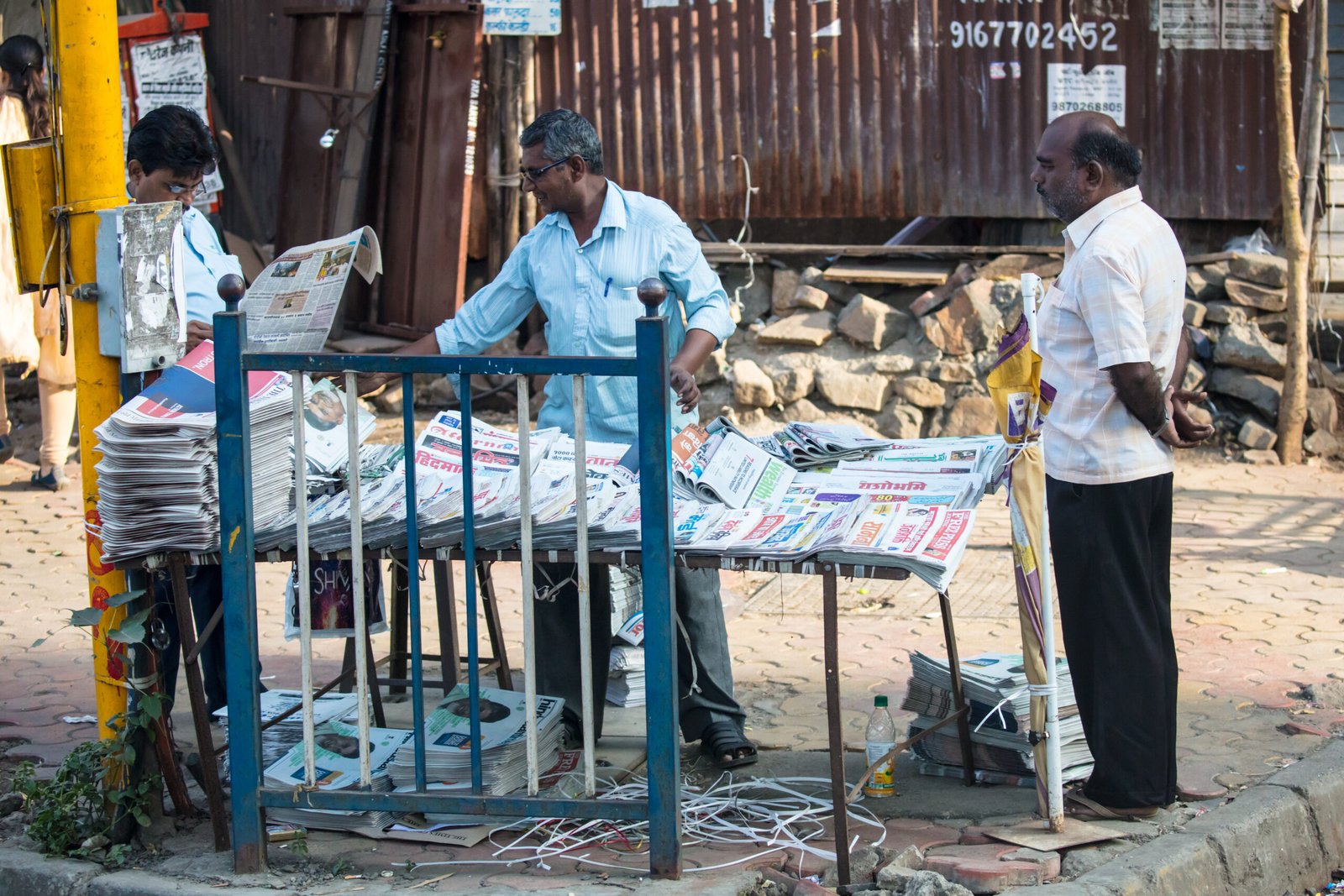
Gupta also flagged a growing operational concern: the shrinking pool of hawkers and delivery agents who form the industry’s last-mile link to readers – an issue constantly highlighted by print media leaders at various conferences and fora. “Today the availability of hawkers is becoming a serious concern for the industry,” he said, calling for “a need for skill development and a stronger ecosystem for our distribution partners.”
Resilience amid crunch
Despite the challenges, INS highlights the “resilience” of an industry serving as a check against misinformation.
“During the year under review, the Indian print media industry continued to demonstrate remarkable resilience and relevance amid a rapidly evolving media landscape. India continues to be one of the largest newspaper markets in the world, with publications in multiple languages reaching millions of readers across urban, semi-urban, and rural regions.
“The industry serves as a vital pillar of democracy by ensuring access to verified credible information. At a time when misinformation and unverified content proliferate across social media platforms, the trust and authenticity associated with professionally curated news articles have become more valuable than ever,” the report states in its overview.
The INS leadership also struck an optimistic note in closing the AGM. “We have watched every technological revolution and have seen every prediction of the decline of print,” Gupta told members, adding, “The future of Indian print media is not behind us. It is still ahead of us.”
The AGM elected Karan Rajendra Darda of Lokmat as the new president of INS for the term 2026-27.