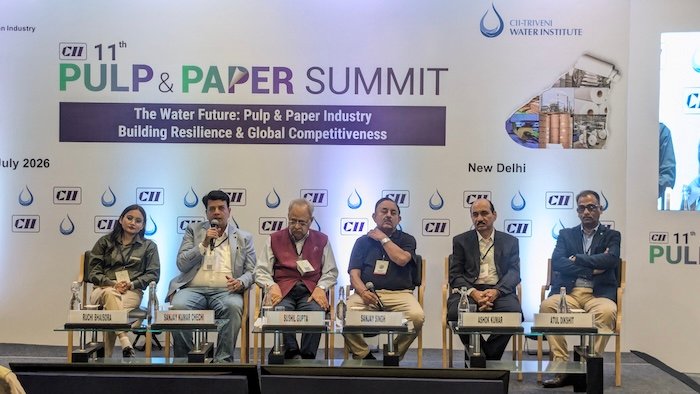
At the 11th CII Pulp and Paper Summit, on 17 July 2026, at India Habitat Centre, industry leaders and mill operators discussed how water conservation, fiber recovery, energy optimization and smarter technologies are becoming increasingly interconnected in the quest for a more competitive Indian pulp and paper industry.
Discussions pointed towards a broader transition in which water, fiber, energy, chemicals and waste are being treated as interconnected parts of the manufacturing process. The summit’s agenda brought together water management, resource efficiency, technological innovation, and circularity across agro-based, recycled, and integrated pulp and paper mills.

A recurring message across all the sessions was that the next stage of improvement will not come from a single technology. Instead, mills will need to combine process optimization, better segregation of water streams, improved fiber recovery, advanced treatment technologies, digital monitoring and mill-specific solutions.
Beyond one-size-fits-all solutions
The challenge varies considerably across the industry. Agro-based mills, integrated pulp and paper operations and recycled fiber-based mills have different raw materials, process conditions and water chemistry. Consequently, technologies that work effectively in one mill cannot automatically be replicated in another.
This was particularly evident in the discussions around closing water loops. Increasing reuse and recycling can reduce freshwater withdrawal. However, it can result in the accumulation of COD (Chemical Oxygen Demand), BOD (Biochemical Oxygen Demand), salts, non-process elements and chemicals, affecting drainage, foam formation, corrosion, scale and ultimately paper quality and process stability.
As Apurba Biswas from Emami Paper Mills noted, there cannot be a “tailor-made technology for the whole industry”; each mill requires solutions tailored to its specific processes, products, recycling potential, technical feasibility, regulatory requirements, and economics.
The same point emerged during the question-and-answer session when participants sought a standard technology roadmap for water recycling. The response was straightforward, “No two mills are similar.” Rather than prescribing a single solution, the industry needs to evaluate available technologies and select the best and appropriate combination.
Some of the most compelling examples at the summit were not necessarily large-scale projects. They demonstrated how relatively focused changes on the paper machine can generate substantial savings. Deepak Jindal, senior general manager – environment, Naini Papers, presented examples ranging from using treated water in pump-sealing applications to replacing conventional wire-and-felt showers with more efficient systems.
In one case, optimizing wire cleaning reduced water consumption from 620 cubic metres per day to 550 cubic metres per day, while improving the moisture profile. A similar intervention on press felts resulted in water savings and longer intervals between caustic washes.
Such interventions underlined an important point: resource efficiency does not have to come at the expense of productivity. Better cleaning, improved moisture profiles, longer equipment life and reduced downtime can create operational benefits alongside lower water consumption.
Jindal highlighted the importance of converting waste streams into productive resources. Naini Papers established an in-house waste-to-energy boiler to deal with rejects containing plastics and other materials recovered from waste paper. According to his presentation, the facility generates around 2 to 2.5 MW of power while addressing a disposal challenge. “The waste has resulted in generation of energy,” Jindal said, adding that the mill had moved from paying for disposal to generating value from the waste stream.
Wastewater treatment to resource recovery
The discussion reflected a changing approach toward effluent treatment. Instead of considering ETPs purely as a compliance cost, several speakers argued for extracting greater value from wastewater and its by-products.
Case studies included the conversion of biogas into compressed methane for use in paper manufacturing, recovery and reuse of treated water, and the use of RO permeate in applications where lower-TDS water can provide maximum process benefits. However, the economics of advanced treatment remain a major hurdle. Technologies such as RO, ZLD(Zero Liquid Discharge), and evaporation can help improve reuse and remove dissolved contaminants, but high capital and operating costs, particularly energy consumption, limit wider adoption.
The speakers concluded that the industry faces a balancing act, meeting increasingly stringent environmental expectations while remaining competitive in a market already under pressure from imports and narrow margins.
The smart mill and the future
The session discussing ‘Technologies for Enhanced Water Efficiency in Integrated Pulp & Paper Mills’ expanded the conversation beyond conventional water treatment, examining AI, IoT, digital twins, online sensors and real-time monitoring. The potential lies not merely in collecting more plant data but in using it to predict water quality, optimize chemical dosing, identify anomalies and make faster operational decisions.
The larger opportunity, therefore, is to move towards a more integrated view of paper mill operations. Water conservation can improve fibre recovery, better washing can reduce chemical carryover, improved screening can support recycling, and digital monitoring can make these systems more responsive.
The summit also highlighted how far the industry has already progressed. Speakers pointed to significant reductions in specific water consumption over the past decades, driven by process modifications, reuse, recycling, ETP upgrades and adoption of best available practices. Yet the next phase will be more complex, as further reductions require managing pollutant build-up and preserving product quality.
The most important takeaway was that sustainability and competitiveness can no longer be treated as separate objectives. In the concluding moments, the speakers noted that the industry must look at its manufacturing systems more holistically and explore how resource management can be transformed ‘into a profit centre instead of a cost centre.’
For India’s pulp and paper sector, that may define the next stage of its journey; using less water is important, but using every resource more intelligently may prove even more critical.