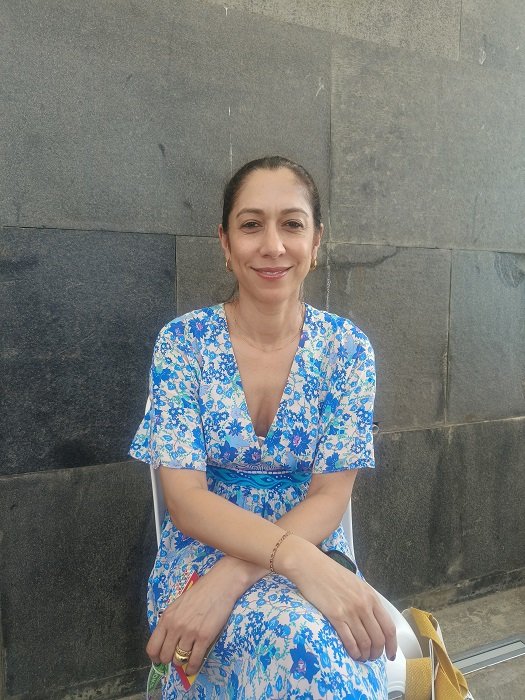
Journalist and author Kavita Puri speaks about her acclaimed book Partition Voices, the oral history genre, seminal works on the partition and much more. Edited excerpts from a conversation with Priyanka Tanwar.
Indian Printer & Publisher (IPP) – Tell us about your experience at the Kerala Literature Festival.

Kavita Puri – It’s my first time, and I loved it. It’s wonderful to see the crowds engaged in all the sessions, the bookshop brimming with people, and the school children. It’s democratizing.
As the sessions are in English and Malayalam, they reach a wider audience. I did some book signings and met some people. It’s been interesting for me because Kerala was not affected by the Partition. I wanted to know what people knew and how interested they were in the subject.
IPP – Tell us about your book Partition Voices.
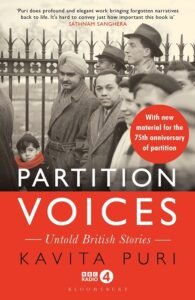
Kavita Puri – My book, Partition Voices, contains oral testimonies of people who lived in Britain but experienced India’s Partition. I interviewed them during the 70th anniversary of the Partition in 2017. These were really elderly people. In Britain, Partition doesn’t really ring a bell. Children don’t learn about the British Empire in school as well as the monumental sufferings experienced by Indians at that time.
It all began as a radio project with the BBC and involved interviewing people who lived through that time. I realized that stories of the partition were all around us in Britain. The people who migrated from the Indian subcontinent in the post-war years were those who lived through the violent event. In most cases, it was another migration to Britain to make a new life. They kept their stories to themselves as they had to make a new beginning. Aanchal Malhotra had written a similar book called Remnants of a Separation about the oral history of the partition, viewed from India and Pakistan.
IPP – How different and how similar are both books?
Kavita Puri – Aanchal is a great friend. My book, written in 2017, looked at the experience of people in Britain. Her book, which came out around the same time, primarily focused on Indian and Pakistani families. She did it through the prism of objects.
There’s a third person in all of this, Anam Zakaria, who’s been doing similar work in Pakistan and Bangladesh (1971: A People’s History from Bangladesh Pakistan and India). We remain in touch because we are doing the same work in the places we live.
It’s different because, obviously, in Britain, there is the diasporic experience. It’s also similar because, fundamentally, silence pervaded these memories for decades. Often, it was the third generation that prompted these memories to come out at a time when the generation that lived through it was about to fade away. So, those who experienced the partition didn’t voice their feelings at all. They didn’t do it in England for many reasons, partly because they were immigrants there. They didn’t want to look back.
They faced racism in Britain. They were fighting together—Hindus, Sikhs and Muslims—for equal rights. Their children, who were born in Britain, didn’t learn either about partition or the British Empire in India. What is similar in my, Aanchal’s, and Anam’s experiences is that partition memories are bound in honor and shame. There were perpetrators of violence within their own families— those who saw and remained bystanders. For all these kinds of complex reasons, people didn’t speak.
In Britain, there was an institutional silence because people just didn’t know about the partition around that time. There was no public space to talk about what happened. Now, people are more aware of the partition. When I say people, I mean the British South Asians as well as the white British. They were shocked and couldn’t believe that the border was drawn in haste.
Among the younger generation in Britain, there is a hunger to learn about the colonial past. The British South Asians, particularly the second and third generation, were moved by the past. It started a lot of conversations within families. The British were interested as there are many families with a colonial history. They asked their grandparents about what life was like here.
In Britain, we now have the South Asian Heritage Month, which began after the 70th anniversary. It culminates on the 15th of August.
IPP – What research went into writing the book?
Kavita Puri – My interviews with survivors of the partition were my core research. I interviewed many of them again. I did research around partition, including speaking to Aanchal and other people in the oral history field.
The hardest job was finding those people who were not only willing but also healthy enough to speak and had a good enough memory.
IPP – Aanchal decided to write the book after learning about her grandmother’s story during the partition. Did you have a similar experience?
Kavita Puri – Yes. My father left Lahore to live with his grandparents in Moga. That’s all I knew. He was 12 when he left. He never talked about it. I tried to speak to him. He would talk about everything else—about life in Lahore and growing up in India. But he wouldn’t talk about that little bit in between. I thought there would be many more like my dad. I realized when I was doing my fieldwork that there are stories of partition pretty much in every single South Asian family, directly or indirectly. We just had no idea about the trauma – this longing for the place that they may have left and this nostalgia for the land that there was their land once, but which now lies across a border.
IPP – What challenges did you face while doing that research?
Kavita Puri – I never approached the interviewees myself. I didn’t think that was appropriate because these were very traumatic interviews. I did call-outs on public radio and on the BBC. We contacted faith leaders and South Asian organizational groups on the ground. Often it was the second or third generation who contacted us and said, ‘I think my grandparents or my parents may have a story. Why don’t you ask them?’ My team or I would speak over the phone first. We would always interview them in their home because they were relaxed. They were surrounded by their family. They felt safe. I never pushed them.
The one story I couldn’t get to, and I think we will never get to now, is the story of women. I did not speak to anyone who experienced sexual violence. We know many women did. That was a great shame for me.
IPP – There’s a host of partition literature in India today. Would you like to talk about that?
Kavita Puri – Urvashi Butalia’s book (The Other Side of Silence: Voices from the Partition of India) was a seminal book when it came out in the 90s. Nobody had ever done what she had done before. She laid the groundwork for people like me, Aanchal, and Anam. She collated the stories of people who had lived through that time.
When you talk about partition, the statistics are so overwhelming. But behind every single number is a story. That’s what she was trying to get at from the prism of women, which is even more under-reported. So, her book was about focusing on the lived experience, which is extremely important.
For a long time, the story of partition was told by a kind of dramatic actors — Nehru, Gandhi, Jinnah, and Mountbatten. It is important, but that’s just one story. That did not look at how that line affected the lives of thousands, if not millions of people.
We’re now living in a time where the generation that lived through it is dying. We won’t be able to interview them further. So, the archive is extremely precious.
Our studies will shift again. I suppose we’ll be looking at the generational trauma or what has been carried on. It might not be trauma; it might be a generational nostalgia for that other place. In that nostalgia is a hope for the future, that the partition generation remembers as a time before borders where people coexisted.
It’s important to remember that time. We listen to those partition survivors and what their testimonies tell us. For every story of horror that I heard, I heard another story of neighbors and strangers who helped to save the lives of others.
If we remember those stories, if we remember where people lived side by side—Muslim, Sikh, and Hindu—we can begin to understand this monumental thing that happened to all – not just India, Pakistan, or Bangladesh.
In that shared trauma and nostalgia, we can move forward.
The British also have to come to terms with what they did. That can begin with acknowledging it and teaching it in schools. I would always recommend Aanchal Malhotra’s two excellent books, her work of fiction, and Anam Zakaria’s work on recording survivor stories from Pakistan and Bangladesh.
Everybody knows Khushwant Singh’s books, Bapsi Sidhwa’s Ice Candy Man and Manto’s short stories. Those are books that I go back to many times. I would say, keep buying history books; read buy books that challenge your view of things, question things.
What I’ve seen at KLF is just this love of books, of learning. We’re living in an increasingly polarized time. But books don’t have borders. Words don’t have borders. They open our minds.