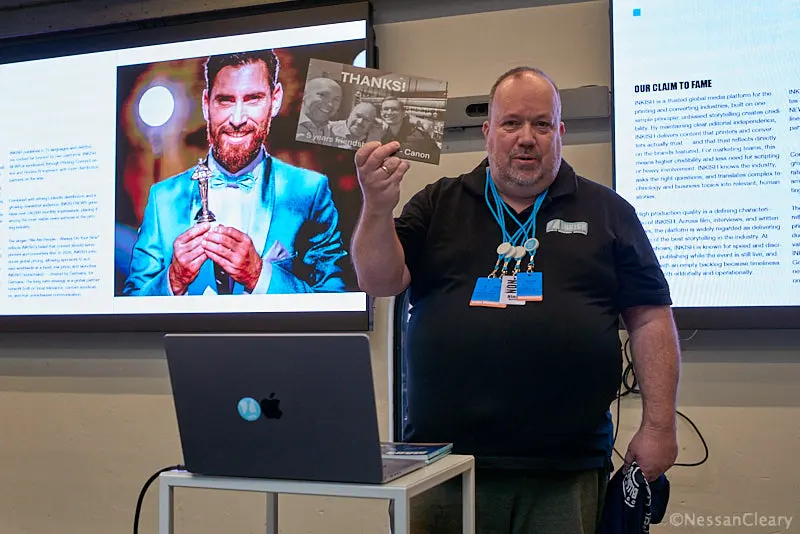
Earlier this year, I was a guest at the Non-Event in Copenhagen, for reasons that I will come to, and which gave me a chance to see how this event functions and its place within the wider printing industry.
The Non-Event is hosted by the Danish publishing house Inkish, which has grown rapidly in the last few years into an international phenomenon with a number of different arms, from videos of print service providers to print publications and a news website. I generally avoid writing about the activities of media companies because I don’t want to get caught up in the competition between different groups; instead, I aim to work independently for as many of these companies as I reasonably can. But the Non-Event is interesting in its own right.

At first, I mistook the title of the Non-Event as a quirk of Danish humour, but it is actually very accurate. It truly is a non-event because nothing really happens and that’s kind of the point. Instead, the main purpose of the Non-Event is to let people network with others in the industry, free from any kind of schedule or other obligations. Morten Reitoft, editor-in-chief of Inkish, says that people can meet and talk and make connections that will lead to business opportunities, telling attendees: “Here we can talk to each other and build on collaboration. We try to make it free for everyone to feel comfortable. But it’s you who makes it a success.”
And it seems to work as I witnessed first hand several conversations where people found a common interest and were able to discuss the possibility of collaborating further, and of course, I also talked with people about future stories. Reitoft says that in the past, this has led to partnerships between companies and even to new products being sketched out.
The day before
People start arriving the day before the Non-Event for a pre-event with presentations covering all the different aspects of the Inkish portfolio. Reitoft told attendees: “We work with almost all vendors, which allows us to be unbiased. And we appreciate the friendship we have with you. We can speak openly because we know that we are not talking to everyone else. Hopefully, we have built up the credibility in the market where people know they can talk to us without jeopardising their business.”
Inkish recently partnered with the Mexican publisher Revista El Impresor, which is headed by Nayelli González Menéndez. She explained that there are around 24,000 printers in Mexico, which are mainly small businesses and mainly using offset and digital equipment: “Packaging and labelling are the most valuable areas. Digitalisation is growing a lot since the last year.” She added: “There was a big break in the pandemic, but last year it began to grow again.”

She says that many of these printers are micro businesses with just one or two staff, or small businesses with an average of five employees, adding, “I think there is a lot of diversity in the market.” Interestingly, she doesn’t believe that any of those companies are interested in merging to become bigger, as has happened in Europe.
Reitoft says that the GDP in Mexico grew by 60 percent last year, mostly driven by the middle class. He notes that books and newspapers are still big, as well as commercial and promotional printing, but not photobooks. He adds that emerging markets like Mexico are now choosing new automated finishing kit where in the past they might have bought second-hand equipment. Ironically, he says that Mexican printers have picked up work from the US as printed products are not generally affected by the tariffs.
Pat McGrew, who works as a consultant to the print industry and also writes for Inkish, picked up on this theme, noting that the US tariffs have also hit consumables and particularly paper supplies. She added: “The tariffs have frozen some people into paralysis as they try to decide ‘should I buy this equipment or not’” She says that around 10,000 printers will shut this year in the US, with some buying others to grow and survive and others just going out of business.
Reiroft notes that while American printing houses are hit by tariffs on imported equipment, Canadian and Mexican printers have been able to invest in new equipment to undercut them. However, McGrew pointed out that changes to the tax code make it easier for printers to depreciate older equipment and invest in new kit. It’s also possible for American printers to secure financing from Europe, where rates are lower, to fund investment in equipment in the US, which makes for a much more nuanced view of the effect of changes within the US.

I won’t go through all the presentations because Inkish is perfectly capable of marketing its own business. That includes the online Printing Connect directory through to targeted magazines, country-specific websites – including a new German site – and a broad range of different video reports. Reitoft says that people consume media differently so that broadly similar content can be reused, such as for videos or podcasts.
He concluded: “B2B is bullshit. It’s always B2P – business to people, because people buy from people.” This then is the essence of the Non-Event, to meet with other people in the industry free of any obligations or constraints.
Find a city
Each Non-Event has its own theme, which this time was urbanisation. Reitoft pointed out that at least 80 percent of the planet’s population – some six billion of us – already choose to live in cities. Interestingly, he also says that most people think they work around 50 hours a week, though for many of us it’s closer to 27 hours per week, adding, “So there must be other things that they are doing.” A lot of the time is taken up by travelling around the cities.

Thus, the first presentation was from the Danish architect Rune Veile, co-founder of the Urban Power consultancy, who argued for making better use of buildings by combining multiple uses together. He began by saying, “Single-family houses are a very inefficient way of living because they generate a lot of CO2.” He went on to highlight a number of issues, including demolishing buildings – noting “we need to be very clever in renovating old buildings” – and showing a number of projects to repurpose existing buildings. Other problems include traffic, flooding and how to make the best use of space in a small country. He argued that optimising buildings can minimise these issues: “So we can build more densely, and build on top of other buildings to make the cities more liveable.”
He continued: “Our solution is to combine multiple functions in one area, with offices, schools, houses and gardens all built in a single space. In this way, we can create a whole city in one building.” He added: “We believe that if we can change these buildings with very simple things and add to them, then we can create something new and drive innovation and build a fantastic place to live.” And he pointed out: “People can live in quite small housing units by having shared cooking areas and shared gardens. This is quite a Danish way of living, but it’s becoming more popular.”
He was followed by Rikke Thykier, co-founder of the Danish company Amolia, which upcycles textiles by making new products. She says that it’s hard to sustainably recycle textiles, adding: “Upcycling means that you use the material you already have so you don’t have to recycle. Textile recycling usually means shredding stuff to make things again.”
Many Danish companies have a legal obligation to show how they are disposing of waste items, including items such as work uniforms. That gives Amolia a free supply of material, and in return, the companies get back a report showing they have fulfilled their commitments, backed up by a nice story of the new products. Amolia works closely with the healthcare sector, with Thykier noting: “In healthcare, the quality is very good and they throw so many pieces out, especially uniforms. So I could make lots of the same products.”
All the items are examined at a central warehouse in Denmark to see what they can be made into, and the patterns are cut out. The pieces are then sent to Poland for sewing before they are returned for sale in Denmark. The final products have labels detailing how they have been upcycled.
In some cases, the hospitals buy the new products back. A good example is a tote bag made from a white doctor’s coat, which saved the hospital from having to buy plastic bags for staff to carry items safely around the hospital.
She says that around 60 percent of the hospital uniforms can potentially be recycled – depending on wear and tear, adding: “We also work with hotels and restaurants where we use table cloths. We don’t have to dye these and can use 90 percent of these products.”
She says that she could work with printed items such as banner materials, which, in theory, should be simple but depend on whether or not the products are contaminated with ink, which can’t be used where those new products might come into contact with skin. That would rule out items like large-format display banners other than offcuts for clothing products.
There’s very little scope to upcycle the new products a second time around, so at that point they do have to be recycled.
Honoree Awards
The afternoon session kicked off with the Honoree awards, which highlight three individuals each year who have made a difference to the print industry. Previous winners have included Jacob Aizikowitz, who helped create the groundbreaking XMPie personalisation software; Pat McGrew, who I first met when she worked at Kodak and who has since gone on to offer consultancy services whilst also writing about the industry for the likes of What They Think and Inkish; and my friend Naresh Khanna, editor of both Indian Printer and Publisher and Packaging Southeast Asia, who is as much a philosopher as a journalist.
For this year, the first award went to Ferdinand Ruesch, who took over the family firm Gallus, oversaw its acquisition and continued growth with Heidelberg and has been a board member and brand ambassador for Heidelberg. The second honoree was Laurel Brunner, who worked for the legendary Seybold Publications before setting up her own title – Spindrift, which I edited for many years – while also contributing to the technical committee on printing for ISO and helping to develop some of the standards that define the print process. The third award went to yours truly.
The awards were followed by an interesting panel discussion from a number of American printers. Paul Gardner, director of growth for Alphagraphics Sandy, based near Salt Lake City in Utah, who described how that company changed from a small copy shop to a full commercial printer. He explained that over the course of 11 years, the company then went from being 70 percent offset to 80 percent digital, noting, “The offset has been fairly static, but the growth has been on digital. And we have moved into labels and packaging.”
Rosemarie Breske Garvey, president of Blooming Color, explained how her company has remained one of the largest printers in the Chicago area over the course of 35 years. She noted that the internet has shifted how people buy print: “So we were in the right place at the right time.” Adam Seiz, vice president of business solutions for Bennett Graphics, said that the biggest challenge for him is finding someone with the skills and expertise to run an offset press, adding: “The average age of our bindery is 60 years old so that’s a looming problem.”
Bernd Zipper from the ZipCon consultancy and Online Print Summit closed the event with a tongue-in-cheek look at 2026 as seen from the future. Back in the current timeline, there were a number of useful takeaways from the non-event. There’s clearly a need for networking events, even as people question the cost of staging trade fairs.
Such networking is good for individuals looking for their next opportunity, but it’s equally good for companies, helping to forge new partnerships. So the real value of the non-event is that it strips away all the layers of marketing, of hype, of products and IP, and corporate identity – right down to the individuals that turned up – and then it was up to those individuals to make connections. And since these things often require a degree of discretion, I’m going to leave it up to my fellow participants to share whatever they got out of this.
Otherwise, one of the other things that I learned is that Copenhagen in the winter is really cold.