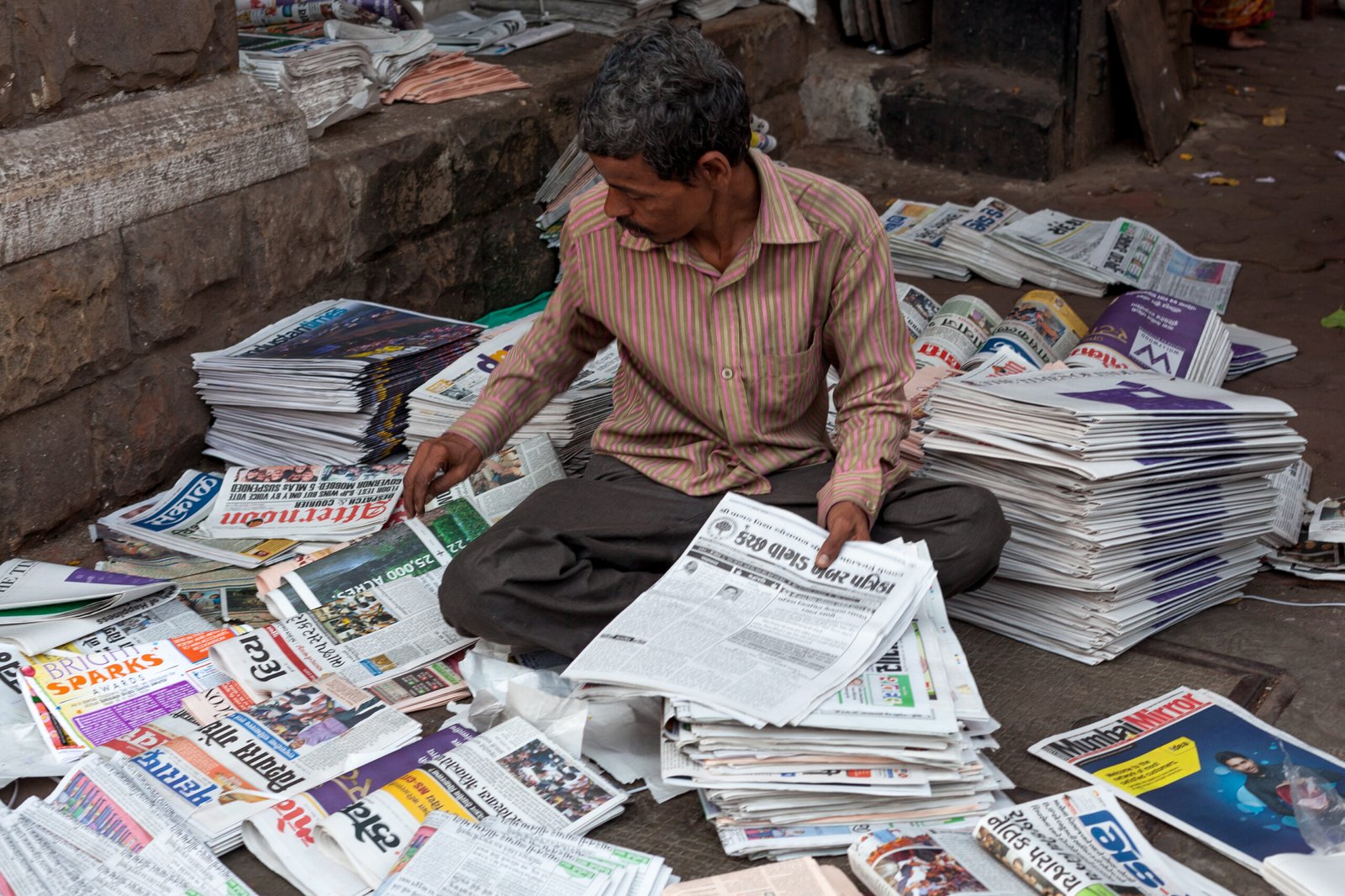
While one hears of printed daily newspapers in the West as being endangered, if not extinct, the thought that India is different or an exception is most likely a delusion. The combined daily circulation of Indian newspapers is approximately 60 million copies, half of what it was about a decade ago. Sources suggest that the decline in circulation has bottomed out for some leading dailies, but there is no clear information about smaller dailies.
The crux of the problem may be the sycophancy and dependency of the mainstream media on government and politicians, and the fact that many newspapers are owned by politicians. It seems entire swaths of the population in every demographic have given up on any balanced coverage of either the politics or the economics of the country and are now depending on the fast-growing digital creator economy.

The revenues of the leading new media groups are mostly flat, and though profits have risen, these are attributed to benign and lower raw material costs, mainly from the reduction in copies and pagination. Since 80% of Indian daily news media revenues come from just the largest 20 publishers, their slight increases in profits recently merely confirm that a handful of the big dailies are cannibalizing the ad revenues of mid-sized and smaller dailies.
While a major vernacular daily publisher says that the printed newspaper business will survive for another ten years, like several others, he describes new challenges in distribution and presents the need for various forms of adaptation by the industry, including authoritative circulation data and better ways of influencing media planners. Apart from improvements and even the creative development of new products, it generally takes a long time in India to close down a business. In this sense, a decade of continuous decline in which a few may adapt and survive seems like a valid scenario.
However, rude shocks await the idea of a gradual decline, accompanied by digital news monetization and new products. Recent reports suggest that the dreams of increased web traffic and monetization of digital news platforms have been put asunder by AI-driven information and news. Kanchan Srivastav, in her 20 May 2026 article on exchange4media, suggests that a steep drop in traffic has upset the applecart of brands funding the ecosystem in which Google sent traffic to news sites providing content.
Using April 2026 Press Gazette-Similarweb data, the article says global and Indian publishers are seeing a steep fall in referral traffic from search and social platforms, caused by AI disruptively altering content discovery, distribution, and audience behaviour. Only six among the world’s 50 largest English-language news websites managed to record annual web traffic growth, while 44 publishers, including several of India’s biggest digital news brands, saw traffic decline. Further, 47 out of the 50 publishers recorded month-on-month traffic declines in April.
Srivastav writes, “Global news brands such as Reuters.com (-14%), Forbes (-23%), CNBC.com (-38%), WashingtonPost.com, NPR, BusinessInsider, Telegraph, DailyMail.co.UK (-41%), USAToday.com (-23%), RT.com (-23%), CNN.com (-11%), and Fox News (-10%) were among the worst-hit compared to last year. The publications whose traffic grew during this period include AlJazeera.com (257%), Mirror.co.UK (17%), and NBCnews.com (9%).
“Several established Indian publishers reported sharp year-on-year declines. Hindustan Times saw traffic fall 50%, followed by The Indian Express (-33%), News18 (-26%), and Indiatimes (-8%). India.com recorded the steepest decline among Indian publishers, with traffic dropping 66% year-on-year.”
The article goes on to quote Nandagopal Rajan, CEO of Indian Express Digital, who calls this steep fall the defining challenge facing publishers today: “Multiple factors have contributed to the sharp decline in traffic globally over the past year. While Google’s core updates affected visibility across the board, the larger disruption has emerged from the integration of AI into search itself.”
In addition to the crisis in web traffic and monetization, there is the vast sea of 2.5 million emerging Indian creators and influencers broadcasting news content and entertainment and already influencing more than 30% of consumers and US$ 250 billion in consumer spend, according to the BCG’s ‘From Content to Commerce – Mapping India’s Creator Economy’ report of May 2025.
According to the same report, while India’s consumption expenditure is expected to double from US$ 2 trillion in 2024 to US$ 4 trillion in 2030, creator-influenced consumption is expected to triple from $350-400 billion to US$ 1,000 to US$ 1,200 billion by 2030. In the same time frame, the creator economy is expected to quintuple from US$ 20-25 billion to US$ 100-125 billion.
MoneyControl has recently reported that as few as 8% of content creators are financially viable, tending to be those turning themselves into brands and businesses. However, these 2,00,000 are a significant number, and growing. Simultaneously, the printed and digital news media are shrinking – gradually in circulation, suddenly in web traffic, and surely in ad revenues and the number of businesses.
Note: This article has been slightly corrected for style and for the number of influencers who can be said to be earning a viable income, on 23 May 2026 at 1557 hours India time – Editor