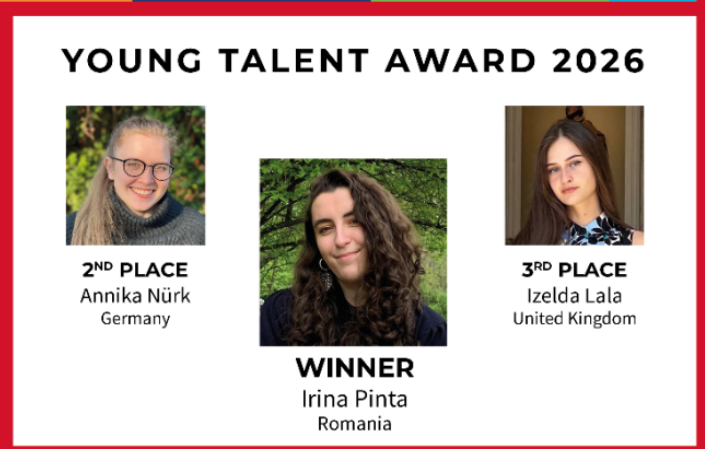
Intergraf has announced the winner and runners-up of the Intergraf Young Talent Award 2026, celebrating ideas of young people in print. The first prize was awarded to Irina Pinta from Romania. Annika Nürk from Germany won second place, and Izelda Lala from the United Kingdom was awarded third place.
Established in 2017, the Intergraf Young Talent Award provides a platform for the next generation of print professionals to share their perspectives with industry leaders across Europe. Each year, an expert jury selects the most insightful and original submissions that explore the future of print and communication.

The 2026 award theme explored a timely question: “What opportunities do you see for print in a hyper-personalised future?” Participants were invited to reflect on how the graphic industry can evolve in an increasingly personalised, automated, and data-driven communication environment, while addressing issues such as innovation, customer experience, privacy, ethics, and cross-media integration.
The first-place winner of Intergraf’s Young Talent Award 2026, Irina Pinta, highlighted the unique strengths of print in a world saturated with digital communication. In her submission, she argued that hyper-personalization rewards relevance rather than simply speed, positioning print as a medium capable of creating stronger emotional engagement, trust, and memorability. She emphasized the growing importance of personalized print in omnichannel communication strategies, packaging, and customer experience, while underlining the importance of sustainability and responsible data use in the future of personalized communication.
Irina pointed out, “I see print becoming sharper, smaller in volume perhaps, but bigger in value. I see it becoming the premium layer of communication: more targeted than mass mail, more memorable than digital clutter, and more trusted than the average algorithmically assembled message. I see opportunities in personalized direct mail, in connected omnichannel campaigns, in packaging that becomes interactive and intelligent, and in transactional print that finally stops being treated as dead paper and starts being used as live communication. Most of all, I see an opportunity for print to stop apologising for existing. The future does not belong only to the fastest channel or the cheapest impression. It belongs to the channels that can create relevance, trust, and impact.”
This year’s second-place winner, Annika Nürk, explored how hyper-personalization could transform publishing and print products. Her paper examined opportunities in personalized children’s books, adaptive non-fiction, modular storytelling, and premium print editions. Annika argued that print’s physicality and permanence give it a unique advantage in a highly digital world, allowing books and printed products to become meaningful personal artefacts rather than disposable content. She also highlighted the role of digital printing, print-on-demand, and web-to-print technologies in enabling scalable personalized production.
The winner of third place, Izelda Lala, focused on the psychological and experiential dimensions of hyper-personalization. Her submission examined how print can create stronger emotional connections through customer experience, data-enabled print, and cross-media integration. She highlighted the growing issue of digital fatigue and argued that print offers familiarity, reassurance, and trust in an increasingly automated environment. Izelda also explored the role of print in sensitive and secure communications, noting the enduring importance of physical print for privacy, ethics, and reliability.
Irina Pinta will present her winning ideas at the Print Matters 2026 conference, taking place on 5 June 2026 in Budapest, Hungary.