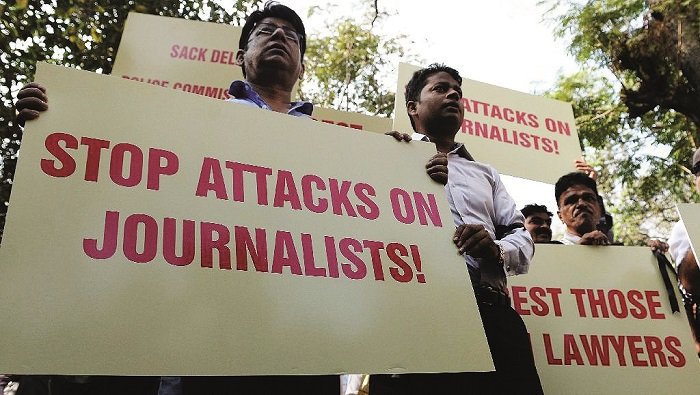
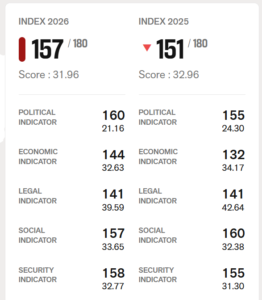
India ranked 157th out of 180 countries in the 2026 World Press Freedom Index released by journalism watchdog Reporters Without Borders on 30 April – down six places from 151 in the 2025 index. In 2024, India was in 159th place. India’s overall score also fell from 32.96 last year to 31.96 in 2026.
India is behind its neighbors – Pakistan ranked slightly better at 153, Bhutan was at 150, Nepal much higher at 87, Sri Lanka 134, and Bangladesh at 152. China was, however, behind India and ranked 178.

The Indian government has, in the past, dismissed international rankings of freedoms in India as misinformed, propaganda-driven and unscientific.
Norway topped the list, followed by the Netherlands, Estonia, Denmark and Sweden. Saudi Arabia, Iran, China, North Korea and Eritrea were at the end. India is one slot below Palestine, where scores of journalists have lost their lives in Israeli attacks.
According to the index, the average score of all 180 countries and territories on their indices has never been ‘so low’ in 25 years. For the first time in the history of Index, over half of the world’s countries now fall into the “difficult” or “very serious” categories for press freedom.
The RSF says that the index’s analysis highlights an alarming deterioration in the conditions for journalism in many parts of the world, despite some isolated improvements, as 100 out of 180 countries and territories have seen their press freedom score decline.
The index’s legal indicator has declined the most over the past year, a clear sign that journalism is increasingly criminalized worldwide. In the Americas, the situation has evolved significantly, with the United States dropping seven places and several Latin American countries sliding deeper into a spiral of violence and repression.
“By providing a retrospective of the past 25 years, RSF isn’t just looking back — it’s looking squarely at the future with a simple question: how much longer will we tolerate the suffocation of journalism, the systematic obstruction of reporters and the continued erosion of press freedom? Although attacks on the right to information are more diverse and sophisticated, their perpetrators are now operating in plain sight. Authoritarian states, complicit or incompetent political powers, predatory economic actors and under-regulated online platforms are directly and overwhelmingly responsible for the global decline in press freedom,” says Anne Bocandé, RSF’s editorial director.
“Given this context, inaction is a form of endorsement. It’s no longer enough just to state principles — effective measures to protect journalists are essential and must be seen as a catalyst for change. This starts with ending the criminalization of journalism: the misuse of national security laws, SLAPPs, and the systematic obstruction of those who investigate, expose and name names. Current protection mechanisms are not strong enough; international law is being undermined and impunity is rife. We need firm guarantees and meaningful sanctions. The ball is in the court of democracies and their citizens. It is up to them to stand in the way of those who seek to silence the press. The spread of authoritarianism isn’t inevitable,” Bocandé says.
India landscape
In the political indicator, India ranked 160 with a score of 21.16. In the economic indicator, India’s rank was 144 with a 32.63 score. The other ranks are legal indicator (141 – 39.59, social indicator (157 – 33.65), and security indicator (158 – 32.77), which Indian Printer and Publisher has seen.
“With a rise in violence against journalists, highly concentrated media ownership, and outlets with increasingly overt political alignment, press freedom is in crisis in ‘the world’s largest democracy,’ ruled since 2014 by Prime Minister Narendra Modi, leader of the Bharatiya Janata Party (BJP) and embodiment of the Hindu nationalist right,” the report states in its India section.
The report describes India’s media landscape as abundant in a country of 1.4 billion inhabitants and 210 million homes with TV sets.
“India has nearly 900 privately owned TV channels, half of which are dedicated to news. Doordarshan, the public TV broadcaster, operates in 23 languages and reaches millions of viewers. Around 140,000 publications are published in more than 20 languages, including some 20,000 daily newspapers. Their combined circulation totals more than 390 million copies.”
According to the report, online news, particularly on social media, is favored by a younger population and has overtaken print media as the main source of news. Radio news broadcasting remains a state monopoly, with the national public broadcaster All India Radio (AIR), which, together with Doordarshan, is part of the public broadcasting group Prasar Bharati, it says.
Giving a political context, it says, “India’s media has fallen into an ‘unofficial state of emergency’ since Narendra Modi came to power in 2014 and engineered a spectacular rapprochement between his party, the BJP, and the big families dominating the media.”
“Reliance Industries group’s magnate Mukesh Ambani, a close friend of the prime minister, owns more than 70 media outlets that are followed by at least 800 million Indians. The NDTV channel’s acquisition at the end of 2022 by Gautam Adani, a tycoon who is also close to Modi, signaled the end of pluralism in the mainstream media,” the report says.
India, the report says, is one of the world’s most dangerous countries for media professionals. “Journalists who are critical of the government are routinely subjected to online harassment, intimidation, threats and physical attacks, as well as criminal prosecutions and arbitrary arrests,” the RSF report says.
India’s media are primarily funded by advertising revenue, the main source of which is the government, which has spent billions of dollars of public funds on advertising, the report says, adding that both central and state governments put pressure on the media to censor their content, through this funding, on which many small media outlets depend.