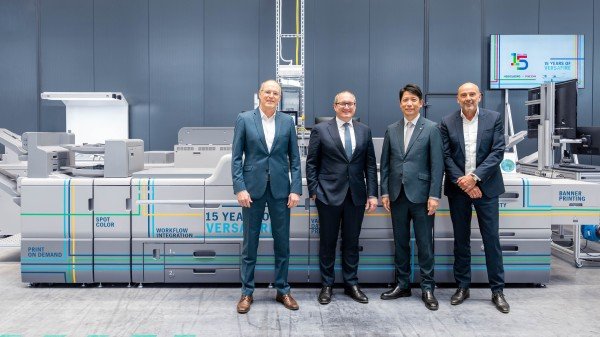
For 15 years, the successful partnership between Heidelberg and Ricoh has stood for strength and sustainable market success in industrial digital print. With the introduction of the first Versafire digital printing systems in 2011, Heidelberg took a strategically decisive step into the fast-growing digital print market and has since consistently established itself as a leading system integrator for hybrid print production.
Since then, the third generation of the Versafire portfolio is now successfully established worldwide in the commercial market. More than 3,500 systems sold and over two billion pages annually underline the high market acceptance and industrial performance of the technology.

Success and strategic milestones
The start of the partnership between Heidelberg and Ricoh in digital print marked a significant milestone for both companies: from the very beginning, the goal was not to view offset and digital printing in isolation, but to fully integrate both technologies into a shared production environment.
To this end, Heidelberg has integrated the Versafire systems into the Prinect workflow via the digital frontend (DFE) developed in-house, thus positioning them specifically as a complement to offset printing – enabling maximum flexibility, economical short runs, and individualized print products. Print shops use it to produce a wide range of print products such as flyers, brochures or personalized applications.
Jürgen Otto, chief executive officer at Heidelberg, says, “Our long-standing partnership with Ricoh is a success story for Heidelberg in digital print and a good example of successful technological cooperation to open up new market segments. Today, the Versafire systems, which are perfectly tailored to the needs of the printing industry, exemplify our claim as a full-service provider and end-to-end system integrator of hybrid print production.”
David Schmedding, chief technology and sales officer adds, “Over the past 15 years, we have worked with Ricoh to consistently industrialize digital printing and fully integrate it into our digital ecosystem. For our customers, the integration means maximum flexibility, highest process reliability and a clear future perspective in hybrid production printing.”
Koji Miyao, president, Ricoh Graphic Communications, says, “We are delighted that this enduring partnership has helped support the adoption of agile digital production for so many print service providers. We look forward to many more years of cooperation together.”
Eef de Ridder, deputy general manager, Global Sales Division, Ricoh Graphic Communications, adds, “As one of the few partnerships between offset and digital suppliers that have flourished we remain committed to helping clients make the right technology choices and flourish for many years ahead.”
Clear customer benefits
The partnership focuses on added value for print shops:
*Maximum flexibility in runs and applications – from “run one” to medium volumes.
*Wide range of substrates – ideal for high-quality print products in the commercial sector.
*Individualization and personalization on an industrial scale.
*Seamless integration into Prinect and the Heidelberg digital ecosystem – with end-to-end color management, automated workflows, and a uniform operating logic.
The Versafire systems from Heidelberg print shops thus provide optimal support for hybrid print production, in which offset and digital printing are efficiently combined – a decisive competitive advantage.
Heidelberg as a system integrator
With the Prinect Digital Frontend (DFE) from Heidelberg, all production steps from job creation to the finished product are standardized and automated. The result: a workflow solution for hybrid print production with digital and offset printing. This consistent integration makes Heidelberg unique in the market and enables customers to achieve efficient, repeatable, and economical production across all technologies.
The cooperation between Heidelberg and Ricoh is long-term and will be strategically expanded. The continuous development of software, automation, and services will further strengthen Heidelberg’s position as a leading provider of integrated, hybrid printing solutions as well as Ricoh’s as an innovative force in digital production technology.