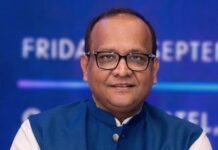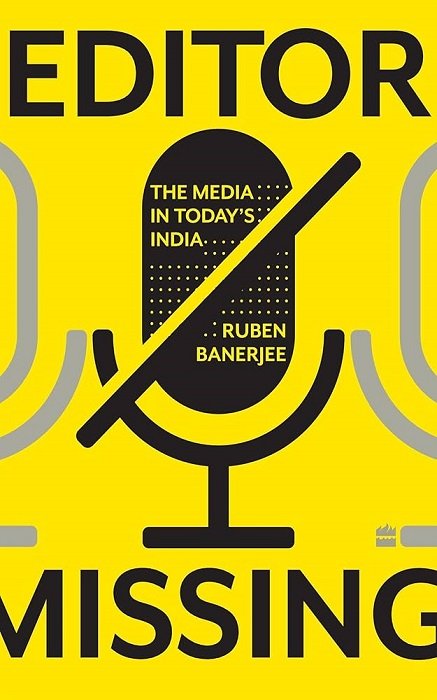
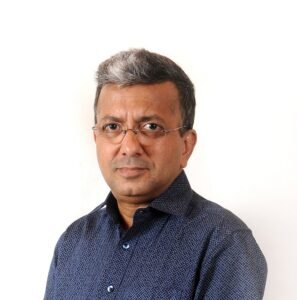
Veteran journalist and Outlook’s editor from June 2018 to September 2021, Ruben Banerjee went on to author Editor Missing: The Media in Today’s India, published by HarperCollins India, 2022, pp 252. In an email interaction, Banerjee says the title refers to the allegedly provocative May 2021 Outlook magazine cover that called out the government’s handling of the second Covid-19 wave.
Banerjee says he and his editorial team never felt that the Outlook cover was provocative. “It was a legitimate cover, if you remember, the cover captured the conditions during the Covid second wave – no oxygen, no hospital beds, patients dropping dead in parking lots. . . To be honest, the reaction to the Outlook ‘Missing’ cover even had us somewhat taken by surprise. We knew we had a good cover. It was truthful, bold, and objective. But we were not expecting that the cover would become the most talked-about magazine cover of the past decade.”

As an editor, he was thrilled, “Sadly, my owners did not share my excitement. The cover rubbed the government the wrong way, and one of the owners’ sons called to say that they are under immense pressure: a kind of pressure that they cannot handle.”
They didn’t say at that point that his days were numbered, he recounts, adding that they appeared to be polite and backing him. But within a few weeks, things changed. “I was categorically told that we cannot do strong political covers – no more cover stories such as the one on Stan Swamy, or the misuse of anti-terror laws to lock up political opponents. Enough hints were dropped that going forward, we should be doing only soft stories: art, literature, poetry,” he recalls.
At that point, Banerjee realized that his editorship of Outlook was drawing to a close and that his epitaph was being written. In his book, he describes editors merely as paper tigers serving only at the pleasure of the promoters. He questions how an editor can maintain authority in a newsroom when the ‘sword of Damocles’ from the management is permanently visible. Editors are an unenviable lot these days, he says, “Most survive in their jobs because they are the owners’ hatchet man or woman. They do what the owners want them to do, including sucking up to those in power.”
While acknowledging that there are a few truly independent editors, he says they are “in a hopeless minority” or “an endangered species.” It is not easy to be an editor currently, “Your fairness, objectivity, and news sense could get you the respect of your editorial team, but they are precisely the qualities that most owners don’t want in you. I dare not say all owners are bad. But most are. So, it is bad times for editors with a spine.”
Deep rot in journalism in India
Beyond political pressure, Banerjee writes about the structural “diseases”– such as shrinking revenues and increased competition that are killing objectivity in Indian journalism today. According to him, the news media model is such that most news organizations are no longer looking to cover news. Instead, they are constantly looking at their books and checking their profitability. He says veteran journalist P Sainath was spot on when he recently said in a speech that, “the larger the news organization, the poorer is its news coverage.”
Banerjee writes, “When media owners are realtors, traders, and businessmen with varied interests – from hotels, insurance to car batteries, the downslide is not entirely unexpected. It has progressively gotten worse since our politicians have turned hostile to criticism. To keep those in power happy, we are competing to be sycophants and racing to the very bottom. Every day is a new low.”
A firm proponent of ‘all-sides journalism,’ Banerjee says, “I still believe it is very important to give space to all views, however different or divergent they may be. My red lines have been simple: give space to all opinions as long as they are not abusive or are not an open incitement to violence. Present all sides, and then, as an editor, take an editorial stand explaining the rationale behind your stand. If one side is lying, nothing stops the editor from calling their bluff.”
Big city editors and interior reporters
In Editor Missing, Banerjee writes sympathetically about state and local reporters who face poor pay and local power plays. Local journalists – in the state capitals or far-flung districts – are at a serious disadvantage and are prey to the 3Ps: poor or no pay, poor protection, and are at the mercy of local politicians. Though these journalists are the media’s real foot soldiers, they are far away, and not too many editors are bothered about them, he writes.
“Look around, and you will see that most editors have desk backgrounds. Nothing wrong with that, but since few started out as field reporters, they do not understand the problems that are faced on the ground. Without support, pay, or protection-wise, we are pushing many journalists to become small-time contractors and extortionists. The soul of Indian media is being badly compromised,” he observes.
The practical need to stay employed in a shrinking market
On the need to stay employed in the current media landscape, Banerjee says, “Yes, the situation now is grim. But I would still like to believe that journalists – the younger ones in particular will hold the line and continue to be objective, without succumbing to pressure. It is a difficult proposition under the current circumstances. But let us hope against hope that journalism will survive.”
His book asks if the profession is still redeemable in India. As an eternal optimist, he writes, “I believe that good will ultimately triumph over evil. Yes, the mainstream media is mostly compromised. They have been tamed. But there are still islands of hope – of small journalistic enterprises who are fighting the good fight. They are speaking out. May their tribe multiply. After all, when the going gets tough, the tough get going.”
Platform takedowns & government directives
There have been many recent incidents of platform takedowns, such as the one with The Wire, as well as government directives affecting digital news. Banerjee says that there are renewed efforts to censor digital journalists – especially those who are more vocal. “Even I faced the music in the not-too-distant past,” giving the example of an Odia digital channel that he runs with an organic subscriber base of some 40,000. “I must have upset someone very powerful, and six months ago, my channel was entirely removed without any reason. YouTube rejected my appeals against the removal without citing any reason. But when a media outcry followed, they restored the channel. Again, without saying why it was removed, and why it was being restored.
“The flurry of government directions and takedowns is going to make matters worse. But we must collectively raise our voice and resist this. However difficult, we must hold the line and never retreat,” he concluded.