Chitra Prakashan was established in 1969 in Bulandshahr by Rajendra Nath Rastogi to supply educational reference books and learning materials to the Uttar Pradesh state schools and colleges. His son Ajay Rastogi relocated the business to Meerut, which is closer to Delhi, in 1975, due to a lack of quality resources in Bulandshahr.
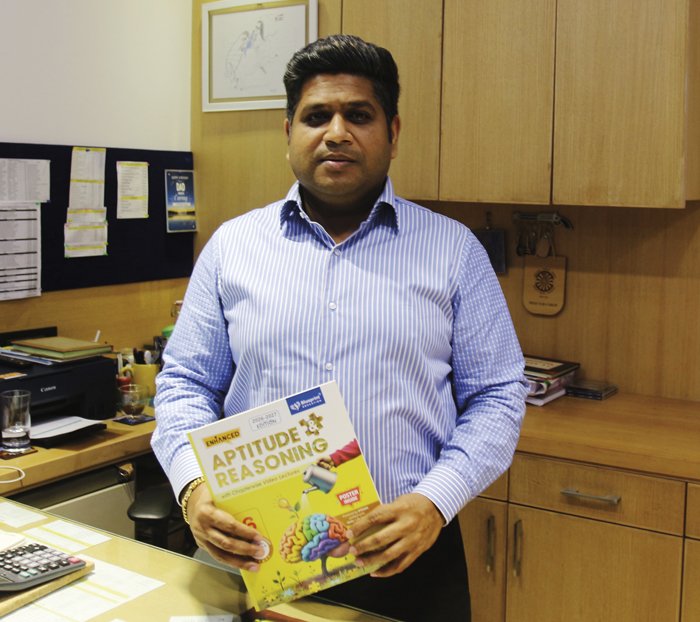
Currently, it is managed by brothers Ajay and Alok Rastogi, and the third generation comprising Nitin and Mayank Rastogi. On a visit in mid-April to its 4,00,000 square foot head office in Meerut’s Mohkampur Industrial Area, we interacted with Nitin Rastogi, the current CEO of Chitra Prakashan and the founder and CEO of its sister concern, Blueprint Education. He spoke about the company’s publishing operations and the geographical and logistical advantages of being located in the educational hub of Meerut. In addition, discussed the role of AI in educational publishing and compliance with the norms for educational publishing established by the Ministry of Education.

With an editorial team of 125 school teachers and college professors, Chitra Prakashan has regional offices across North, East, and Western India, in Noida, Lucknow, Patna, and Calcutta, and Bharuch in Gujarat. The publisher also outsources work to several freelance or part-time authors.
According to Rastogi, Chitra’s textbooks are compliant with the latest CBSE guidelines for NCERT textbooks and the UP state board Madhyamik Shiksha Parishad curriculum framework. They are compliant with the latest Ministry of Education standards in both pedagogy and coverage, too. Its textbooks are printed by the local print vendors in Meerut and the Delhi-NCR.
With over 3,000 titles of higher educational learning materials and academic books from pre-primary classes to standards I-XII, the publisher outsources a minimum order quantity of 3,000 books, while there is no limit on the maximum copies. At least 4,000-5,000 copies of all its titles are kept in stock for last-minute procurement.
Rastogi said that the textbooks for classes I to VIII for the new academic session are based on the previous years’ demand, with order inflow beginning as early as January. The remaining books from standards IX to XII mirror the latest changes in syllabus and examination patterns. If there is no change in curriculum, books for classes I-VIII are resupplied to vendors.
Rastogi explained that recent issues with the standard IX English textbooks resulted in losses in lakhs of rupees as the entire stock had to be recalled from the market. Regarding the standard VIII textbook’s judiciary chapter, he said that the chapter is being rewritten for the academic year 2026-27. While NCERT has recalled the entire stock of previously printed and bound textbooks, the book has not yet been relaunched.
Regarding the rising prices of academic books and educational reference material, Rastogi added, “We try to keep the cost of the books as low as possible and never compromise on quality from content development to editing and production.” To ensure the quality of binding, the firm ensures that the print vendors use the best quality adhesives for perfect-bound books. Random sampling is done on a regular basis to ensure the quality of the final printed product.
The company has paid subscriptions for several image resource platforms such as FreePik, Unsplash, and Shutterstock, from which the authors and content developers can search for high-resolution images and caption them according to curriculum requirements.
QR codes are printed in the books to link to ancillary learning material such as videos, animations, activities, and facts. Rastogi said that the publishing house has been incorporating artificial intelligence (AI) tools on a large scale for content creation. “Though content development has become easier with AI, human intervention is equally necessary to monitor content, as there is less content accuracy, fact checking, and updation of the latest advances and developments in AI-generated content. It has made ideation and translation easy to a large extent.”
He predicts that while the increased use of AI in the future is not going to snatch jobs, the jobs will become very specific, and only people who are able to adapt will flourish in an increasingly competitive environment.
On Meerut as an educational hub, he said, “The printing and binding infrastructure in Meerut is very good. There is no shortage of trained manpower as the location is closely connected to the labor base. Apart from education, Meerut is also a sports and pharmaceutical hub, so the transportation facilities are very good. The location’s proximity to Delhi-NCR sometimes helps in FTL (full truck load) contacts for bulk shipment orders.”
Chitra Prakashan’s cash-generating products, such as the Mastermind Question Banks and Chitra Ek Adyayan, have been running successfully for over five decades. They are said to have a monopoly in the regional markets of Uttarakhand, Uttar Pradesh, and the Delhi-NCR, and state universities such as Chaudhary Charan Singh University, Meerut, and Maa Shakumbhari University, Saharanpur.
Challenges in educational book publishing
Rastogi pointed out that there is considerable government interference in costs and curriculum in the educational books segment. In September 2025, new GST slabs were introduced by the government with 18% GST for packaging inputs, which has made things worse for both commercial printing operations and publishers.
“The recent raw material price hikes following the Gulf War have directly impacted profits. Publishing is mostly dependent on petroleum products, whether inks, adhesives, or lamination, and geopolitical factors like these directly inflate the cost of printing and binding. We are left with no other option than to absorb the cost in production, as at the end of the day we run a business and work for profit,” he concluded.