Boston Micro Fabrication, better known as BMF, has developed a new resin material for additive manufacturing. As the name implies, BMF specializes in micro-precision 3D printing and has developed 3D printers capable of producing 2, 10 and 25 micron layers.
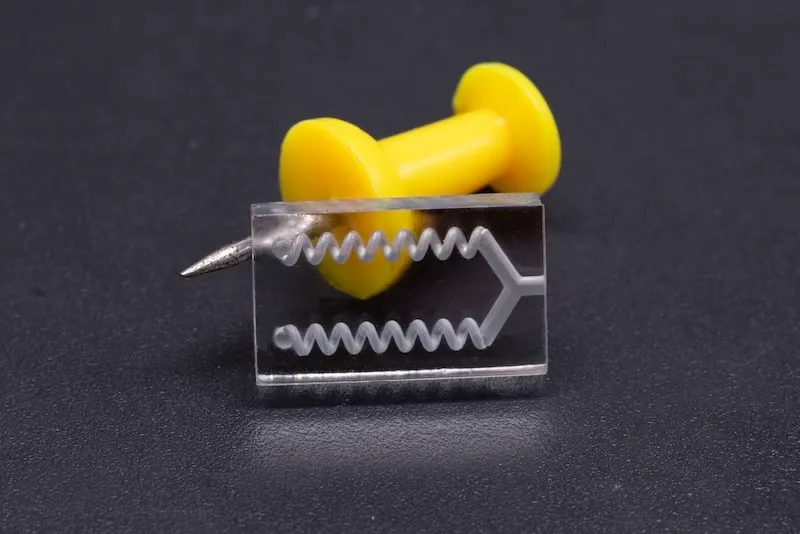
The new BMF Clear is said to be an optically transparent photopolymer resin with more than 90% light transmittance. It has a tensile strength when cured of 23 MPa and 18% elongation at break, both according to ASTM D638. It has a hardness of 55 Shore D, flexural strength of 29 MPa, and viscosity of 230 cP.

It’s aimed at applications such as microfluidic lab-on-a-chip systems with fiber alignment channels, freeform micro-lenses printed directly onto fiber optic tips, chip surfaces or sensor arrays, and integrated waveguides or photonic interfaces for sensing and data communication.
It supports the direct production of components like freeform lenses, complex waveguides, and other intricate optical interfaces directly onto fiber-optic tips, chip surfaces, or sensor arrays – applications that have typically had significant challenges in manufacturing at scale. These applications can be used to produce advanced components such as fiber-to-chip couplers and complex microstructures for high-speed data communication, sensing, and imaging applications.
John Kawola, CEO of Boston Micro Fabrication, said, “For years, achieving optical clarity with high print fidelity has led researchers to rely on traditional methods such as PDMS soft lithography, which limits scalability, durability, and design flexibility. BMF clear resin directly addresses this challenge, bridging the gap between prototyping and production-level micro-manufacturing. By combining true optical transparency with high-resolution printing, excellent surface quality, and the precision of our Projection Micro Stereolithography (PµSL) technology, we empower innovators to create complex geometries with internal channels and integrated optical features – driving the development of next-generation microfluidics, advanced sensors, electronics and beyond.
BMF Clear is designed for use with BMF’s 10-micron and 25-micron systems and can be printed at layer heights between 10 and 50 microns. It’s compatible with both high-end and compact benchtop machines. These devices use a variation on the stereolithography approach called PµSL or Projection Micro Stereolithography. Involves printing in the top-down direction of SLA.
However, rather than using a small spot laser, the entire image, or a section of the image, is cured as done in DLP. A thin plastic membrane that consistently stretches and levels the uncured resin within the vat. This process fabricates micro-sized parts with top-notch resolution, at much faster speeds than traditional microfabrication techniques.