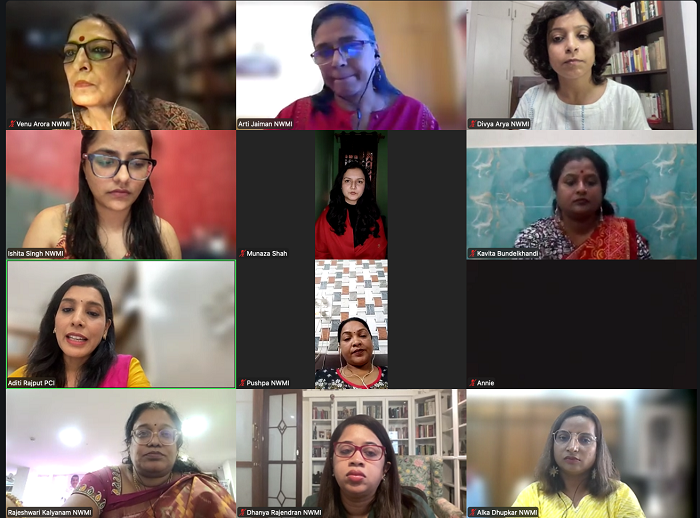
The challenges faced by female journalists working in regional languages and rural areas were the central point of an online discussion organized by the Press Club of India (PCI) and Networks for Women in Media India (NWMI) on 6 March 2026 as part of Women’s Day celebrations.
Financial sustainability
According to Dhanya Rajendran, co-founder of the News Minute, and founding chairperson of DigiPub News India Foundation, the first challenge is the lack of a platform and financial backing. In regional media, salaries are so low that it becomes extremely difficult to manage with one job, she said.

Kavita Bundelkhandi, CEO of Khabar Lahariya, also felt the biggest challenge is financial sustainability. “In urban areas, families may be more supportive as they may have more resources. In contrast, rural women journalists in field reporting have no support and have to pay for their children’s education, run their house, and pay their medical bills from the money they earn.”
Echoing the remarks, Alka Dhupkar from TOI Digital, explained that even though the participation of women has increased, salaries in non-English media are very low. The problem is, she said, an incentive-based system of salaries, which is linked to advertisements.
Safety issues
Pushpa Rokde, independent journalist from Bijapur in Chattisgarh, felt reporting from the interiors is a big risk because of the conflicts between Naxalites and the government. Rokde felt male journalists themselves were roadblocks for women. Schemes for women are not executed, she said, adding. “On Women’s Day, they will give you a chair, but when something happens to you, they won’t support you.”
Referring to the Chameli Devi Jain award, Dhupkar said all awarded reports addressed important issues on health and education, even though they are often labeled as soft stories. “Public toilets, pregnancy, periods—we are not even getting into it—and the pressures women feel at home are other concerns.”
Violence and online harassment
Dhupkar recalled an attack on her after an article on the diesel mafia. “Violence against journalists, both male and female, is a serious problem. Narendra Dabholkar, Gauri Lankesh, and Narendra Pansare were all regional language journalists.”
Contrary to what is being perceived and portrayed in favor of English journalism, regional languages have far more reach as seen from independent journalists and influencers. “They were killed because they were working in regional languages and had a forceful impact, effect and reach.”
Fellowships, mentorships, and awards should be shared with grassroots journalists to make a difference, she suggested.
Khabar Lehariya, Bundelkhandi said, mostly talks about water, forest and land. “Villagers often attack the homes of Dalit and Muslim reporters to force them to delete stories on our channels.”
“We have to deal with society, administration, and political figures. Our families get traumatized over the violence women and Dalit journalists face,” she said, adding in this environment of fear, working in rural areas gets very difficult. At times, women journalists facing family and mental health problems even need counseling.
Thulasi Chandu, independent journalist and YouTube content creator from Hyderabad, talked about online harassment from political parties over critical news reports.
Lack of legal aid
She said she was advised against writing it as it might attract a defamation case. She said it gets daunting for journalists like her in such circumstances—out of fear of losing the job or facing a criminal case. “If organizations such as NWMI and PCI can assure us of legal and financial support, it would make a big difference.
Rajendran stressed the need for a directory containing contacts for legal help—liberal lawyers who will help pro bono for either no or nominal fees. “At DigiPub, we are compiling such a directory.”
Reporting from Kashmir & Urdu journalism
Munazah Shah, an Urdu multimedia journalist from Srinagar, talked about the challenges and changes in reporting from Kashmir in the last few years.
“There is always a special gaze on Kashmir because of its sensitive nature. Reporting has changed in Kashmir—not just technologically and editorially, but politically and structurally. The way news is gathered and broadcast has changed. And thus free and fair ground-level reporting has become much more difficult compared to earlier,” she said
After the abrogation of Article 370, there was a communication blockade in Kashmir, she explained. “That was a big challenge because you had to do stories, and you wanted to get them out to the world. Heightened scrutiny of journalists was a big problem. Journalists were facing legal cases, and the toughest of clauses were imposed, making it almost impossible to get bail. Trials didn’t begin for years. In this environment, it was difficult for journalists to work independently or freely.”
On Urdu journalism, she said there has been a big decline in Urdu newspapers because of economic instability. Urdu newspapers face difficulty getting ads compared to their Hindi and English counterparts. “Organizations are shutting down. Large Urdu channels have shut down because of a lack of ads or institutional support.”
The false narrative that Urdu is not a language of India or has only to do with a minority group is another factor for the decline, she said.
“The kind of journalism and literary debates that used to happen in Urdu journalism were not connected to any particular community,” she said, adding people from all religions used to take part. “It was a very rich discourse, where revolutionary ideas were discussed. We talked about how these ideas went from the intellectuals to the masses,” she said.
Aditi Rajput from PCI and Divya Arya from NWMI were the moderators of the webinar.