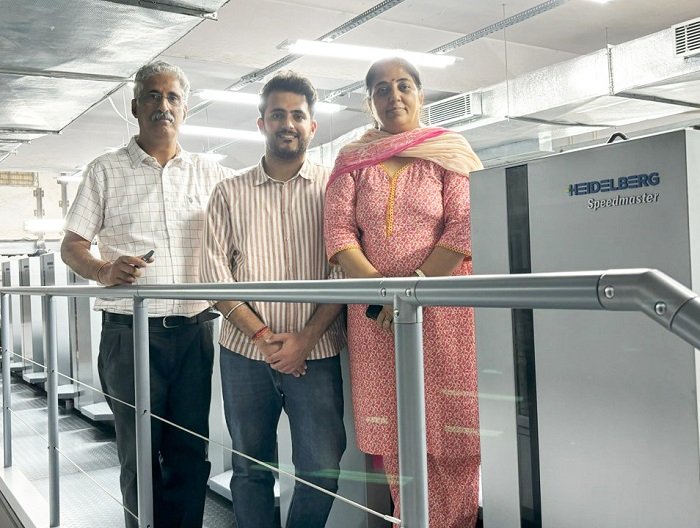
The Okhla-based Rahul Print O Pack specializes in printing children’s books, activity-based learning kits for pre-primary and primary levels, as well as book kits for secondary and higher secondary classes. Over the past eight years, the commercial printer has installed three Heidelberg CS92 4-color presses, as well as a Heidelberg 8-color SX102 perfector. In 2024, the company expanded its original 16,000 square foot space by adding a 20,000 square foot plant. Since our April 2024 visit, the company has installed two new Heidelberg Stahl folders and replaced an outdated folding Stahl folder.
While the installations of 8-color perfectors at book printing exporters have gathered steam in the past five years, what is remarkable is that Rahul Print O Pack produces textbooks and books for domestic consumption.

In mid-March, at the peak of the current academic book printing season, Rahul Soni said the company is not currently doing any work for the NCERT but producing books for many private publishers. “Most of our clients are very reputable multinational publishing houses, and they are very compliant with the rule of the land,” he said, adding these publishers have comprehensive curriculum audits annually to make sure that their books are up to date with the latest curriculum frameworks that the government publishes. “We are quite certain that the books that we are printing for our customers are totally and completely aligned with the new NCERT curriculum,” he said.
Describing the quality reproduction of crisp and vivid images, especially for science and geography textbooks, Soni said, “We have brand new Heidelberg machines, and their prepress and production workflow. All the job data related to ink zones, print runs, and substrate grammage is fed into the pre-press and workflow through a LAN network to the machines. Since the LAN is not connected to our second unit with the Heidelberg 8-color perfector, we send the job data to that press on a USB stick. The inking levels are transferred automatically, and the ink zone cards in the presses open automatically during the ink gradient, which ensures very high-quality images, true to the actual file.”
The company only uses imported vegetable-oil-based inks from Imperial, which are far superior to the usual inks, he said, adding that it procures a special yellow ink with exceptional radiance in comparison to the yellow inks prevailing in the market. “It’s substantially more expensive than even Imperial’s normal yellow. That adds a lot of depth and radiance to the images, which are sharper and crisper. The nice image reproduction also makes for very happy clients. Though we are doing very simple CMYK printing, our color reproduction really stands apart from our competition.”
Whenever new multicolor Heidelberg presses are installed, they are color calibrated or standardized, and this process is revisited every two to three years. We have standardized our raw materials across the plant, including pressroom, plates, chemistry, inks, and post-press adhesives. “At the time of calibrating your press, the raw materials that you use have to be a constant variable. We have consciously chosen the most expensive and the highest quality raw materials, and we have fixed them; we don’t change them.”
On the durability of high usage textbooks like science and maths, Soni said, “99 out of 100 perfect-bound books that we manufacture are section sewn, perfect-bound books. Over the past two years, we’ve invested in four refurbished Aster sewing machines. We only use imported nylon thread, imported tungsten hooks that run long and puncture precisely, and imported German needles. Our rejections are low, and our customers are happy. To ensure the durability and longevity of a book, we use high-quality imported adhesives from Henkel and HB Fuller. As a result, our clients don’t face any binding quality issues such as sections coming out of books.”
Rahul Print O Pack only uses A-grade paper for its clients and doesn’t do job work, only unit cost business. “If a client specifically asks for FSC-certified paper, we ensure that we supply it. We provide them with the labels and bills to show we’ve bought FSC-certified paper. FSC paper costs a rupee or a rupee and a half extra over the standard non-FSC variant. The margins and the competition are such that a rupee or rupee and a half per kg is a huge number and not all customers are willing to pay that,” he noted.
Speaking about meeting schedules and guaranteeing the delivery of all textbooks ahead of the new academic season, Rahul said that his father, Ajay Soni, diligently built a reputation for meeting timely commitments. “We have one of the fastest industry turnaround times and have mastered batch production. Despite the fact that we have a very massive space constraint, out of a very small footprint, you can equate our throughput to any press that operates out of five times the area that we do.” The machines and workflow are scientifically planned for minimal bottlenecks. Standardization across consumables contributes to fewer breakdowns and faster production. “The USP of our company is speed, along with quality. Delivering books on time, before time, is what Rahul Print O Pack stands for,” he adds with some pride.
While the company has printed up to 50,000 books, in a single lot, generally 30,000 is the maximum print run although they can do 4-color short runs as low as 500 units, and even 300 units for single color. Handling last-minute large volume print demand is the company’s USP. “Even clients who don’t have massive accounts with us, at this point in time, approach us for demand-based requirements. All our machines have the same plate size, and they are maintained by Heidelberg. If one machine breaks down, you don’t need to make new plates of a different size. Last March, we received an order for 10,000 books that we dispatched in 50 hours.”
On the logistics for delivering textbooks to multiple school locations across India. Soni said that they had a few not so large publisher clients from Mumbai, and all their north and central region deliveries to the schools or distributors are managed by the printer. However, most of the publishers have their own supply chain networks, he added.
“We have our transport network and vehicles also. Though completely separate, we have an eCommerce venture, and its courier network is handy for very small dispatches. Moreover, we offer logistic services, door deliveries, bulk deliveries, as well as break bulk deliveries at an extra cost,” he shared.
Rahul Print O Pack specializes in kits, which contribute 65% of its top line. The kits include outer packaging, boxes, flashcards, die-cut inserts, sticker books, and other components, which require precise planning. “While some printers are not able to deliver kits on time, our USP is that we can deliver kits within 10 days, or even 7 days from approval.”
Quick production and targeted delivery have become the norm after Covid, when books were not able to easily reach individual students in time. “One of our clients was very late to the market. They had done no printing whatsoever, and in two months, we printed almost a year’s worth of books and materials (around 2.5 lakh kits) and delivered it to their students. The kitting idea was given by my dad to that client. Despite the fact that the client was the last to press, their books were among the first to reach the end user. Other publishers’ books reached the warehouses, but not the students, because of Covid restrictions and fear,” he explained.
Going ahead, there are expansion plans in new segments, technologies such as print-on-demand (POD) books, hardbound books produced with the use of automated state-of-the-art machinery, web-based inkjet for monochrome printing, as well as book exports.